March 3

What was advertised in a revolutionary American newspaper 250 years ago this week?
Massachusetts Gazette and Boston Weekly News-Letter (February 29, 1776).

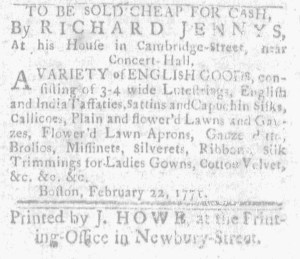
“TO BE SOLD CHEAP FOR CASH … A VARIETY of ENGLISH GOODS.”

After more than seventy years, the Massachusetts Gazette and Boston Weekly News-Letter ended its run with one last advertisement and a colophon that stated, “Printed by J. HOWE, at the Printing-Office in Newbury-Street.”  John Campbell, the publisher, and Bartholomew Green, the printer, distributed the first issue of the Boston News-Letter, as the newspaper was initially named, on April 24, 1704.  It became the first weekly newspaper published in the colonies, preceded only by a single issue of Publick Occurrences, a newspaper quickly shut down by authorities in 1690.

The first issue of the Boston News-Letter concluded with an “Advertisement” soliciting advertisements: “THis News Letter is to be continued Weekly; and all Persons who have any Houses, Lands, Tenements, Farmers, Ships Vessels, Goods, Wares or Merchandizes, &c. to be Sold or Lett; or Servants Run away; or Goods Stoll or Lost, may have the same Inserted at a Reasonable Rate; from Twelve Pence to Five Shillings.”  Over the next seven decades, the Boston News-Letter carried countless advertisements, many of them promoting goods and services to readers experiencing a transatlantic consumer revolution.  The notices concerning “Servants Run away” included enslaved men and women who liberated themselves by fleeing from their enslavers.  Many other advertisements about enslaved people for sale also appeared in the pages of the Boston News-Letter alongside those promoting goods and services or placed for the various other reasons outlined in that first “Advertisement.”

Ownership of the newspaper changed several times.  The Massachusetts Gazette and Boston Weekly News-Letter briefly suspended publication after the battles at Lexington and Concord in April 1775.  When it resumed, it was the only newspaper that continued in Boston.  All the others either closed or relocated to other towns.  New issues sometimes came out sporadically (or “PUBLISHED OCCASSIONALLY,” according to the masthead of the October 13, 1775, edition), often as half sheets with two pages of content instead of the usual full sheets with four pages.  Sometime in late September or early October, John Howe became the final printer of the newspaper.  In his History and Bibliography of American Newspapers, 1690-1820, Clarence S. Brigham indicates that the last known issue was the February 22, 1776, edition, yet a quotation from the February 29 issue appeared in the Boston-Gazette on March 4.[1]  Since publication of Brigham’s History and Bibliography in 1947, a copy of the February 29 issue has been located, digitized, and made accessible via Readex’s America’s Historical Newspapers.  That last known issue consisted of only two pages.  Most of the content consisted of news from London with some local updates from Boston.  Half a dozen advertisements also appeared, including a final notice from Richard Jennys for a “VARIETY of ENGLISH GOODS.”

**********

[1] Clarence S Brigham, History and Bibliography of American Newspapers, 1690-1820 (Worcester: American Antiquarian Society, 1947), 328.

February 3

Who was the subject of an advertisement in a revolutionary American newspaper 250 years ago today?

Virginia Gazette [Pinkney] (February 3, 1776).

“RUN away … a mulatto man, named GABRIEL.”

After taking out an advertisement in a competing newspaper on January 27, 1776, an apology for not publishing his Virginia Gazette because he had difficulty acquiring paper, John Pinkney managed to print the next issue on schedule on February 3.  He may or may not have published subsequent issues, but today the February 3 edition is the last known one from his press.  In his apology, Pinkney lamented, “It gives me the greatest Uneasiness that I cannot publish such Advertisements as ought to have appeared this Week.”  The next (and perhaps final) issue included more than two dozen advertisements of various lengths on the last two pages.

Among those advertisements, Julia Wheatley offered her services as a midwife, Carter Braxton and John Ware described real estate for sale, and Pinkney hawked “A TREATISE on the MILITARY DUTY, By adjutant DAVIS,” a pamphlet that “has met with the approbation of colonel BULLITT, and many other officers.”  Six of those notices, accounting for one-quarter of the advertisements by number and far more than that by length, concerned enslaved people.  David Meade advertised “ABOUT one hundred Virginia born NEGROES” for sale, including “some female house servants, a carpenter, and shoemaker.”  Four described enslaved men who liberated themselves by running away from their enslavers, offering rewards for their capture and return.  The advertisers enlisted the public in engaging in surveillance of Black men to determine if they matched the descriptions in the newspapers.  John Hudson, for instance, pledged “FIVE POUNDS reward” to “Whoever takes up … and secures” a “mulatto man, named GABRIEL, aged 52 or 53 years,” who had “a free woman for his wife, who goes by the name of Betty Baines.”  The other advertisement described “a negro man named Frank,” dressed like a sailor, “COMMITTED to the jaol of Surry county” two months earlier.  Thomas Wall, the jailer, called on Frank’s enslaver, Walter Gwin of Portsmouth, to claim the enslaved man and pay the expenses of holding him and running the advertisement.

Such advertisements stood in stark contrast to news about the Revolutionary War and “EXTRACTS from a most excellent pamphlet, lately published, and addressed to the Americans, entitled COMMON SENSE” that appeared elsewhere in that edition of Pinkney’s Virginia Gazette.  William Rind founded that newspaper nearly a decade earlier, distributing the first issue shortly after the repeal of the Stamp Act.  Eventually, Clementina Rind, his widow, published the newspaper and, following her death, Pinkney did so on behalf of her estate and her children.  During that decade, each of those printers published hundreds of advertisements about enslaved men, women, and children even as they circulated news about the imperial crisis and the first months of the Revolutionary War.  Revenues generated from advertisements about enslaved people underwrote newspaper coverage of current events and editorials about freedom and liberty.

December 11

What was advertised in a revolutionary American newspaper 250 years ago today?

South-Carolina Gazette (December 11, 1775).

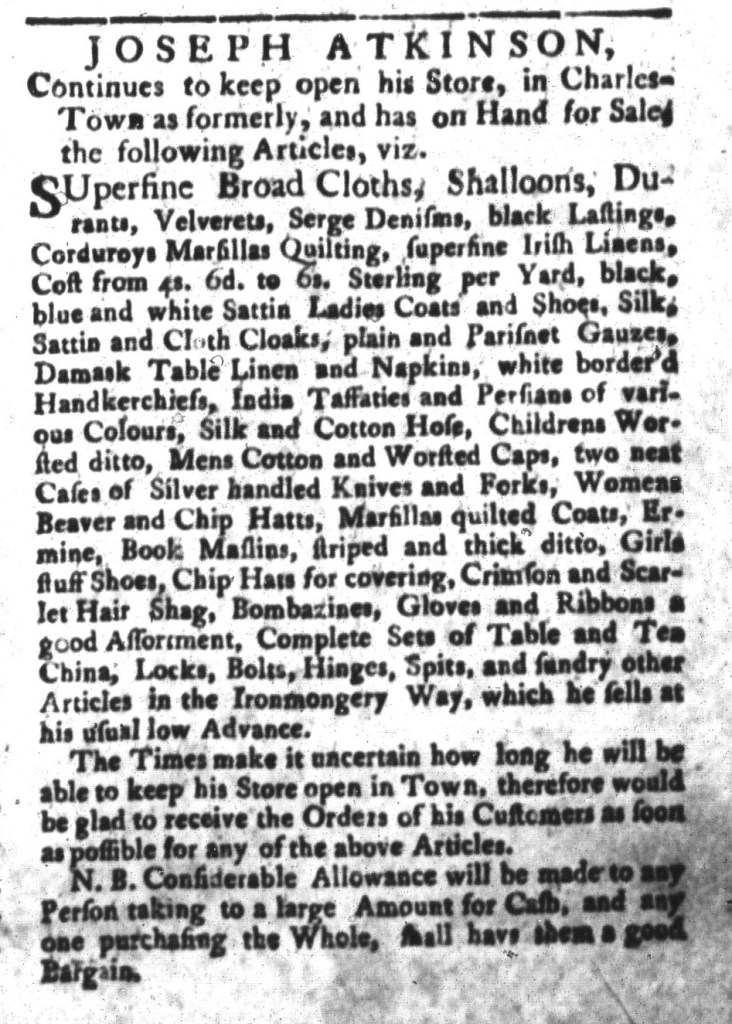
“The Times make it uncertain how long he will be able to keep his Store open in Town.”

Joseph Atkinson placed an advertisement in the December 11, 1775, edition of the South-Carolina Gazette to advise prospective customers that he “Continues to keep open his Store, in Charles-Town as formerly.”  He listed an array of merchandise, including a variety of textiles, “Mens Cotton and Worsted Caps, two Cases of Silver handled Knives and Forks, Womens Beaver and Chip Hats, … Gloves and Ribbons a good Assortment, Complete Sets of Table and Tea China, … and sundry other Articles in the Ironmongery Way.”  Atkinson sought to liquidate his stock, declaring that “Considerable Allowance will be made to any Person taking to a large Amount for Cash.”  Furthermore, “any one purchasing the Whole, shall have them at a good Bargain.”

The shopkeeper also confessed that the “Times make it uncertain how long he will be able to keep his Store open in Town.”  He declared that he “therefore would be glad to receive the Orders of his Customers as soon as possible.”  To underscore the point about uncertain times, the items on the first page of that issue featured updates from the Second Continental Congress in Philadelphia and the colony’s own congress, including a call for provisions “to supply the REGIMENT of ARTILLERY in the Service of this Colony.”  What Atkinson and readers of the South-Carolina Gazette did not know was that the newspaper would soon cease publication.  The December 11 edition became the last known issue, though Clarence S. Brigham reports it “was followed by one other number, probably Dec[ember] 18.”[1]  Peter Timothy, the printer, revived the newspapers as the Gazette of the State of South-Carolina sixteen months later, on April 9, 1777.  As the title indicates, the colonies declared independence by the time Timothy resumed publishing his newspaper.

The demise of the South-Carolina Gazette meant less news and advertising circulating in that colony and the region.  Four months earlier, the South-Carolina Gazette and Country Journal folded.  Now only the South-Carolina and American General Gazette remained.  For nearly a decade, three competing newspapers served Charleston and the rest of the colony, many issues devoting more space to advertising than news.  Although the South-Carolina and American General Gazette continued publication, with occasional suspensions, until February 28, 1781, issues published after 1775 have not been preserved and digitized for wider access.  That means that advertisements from South Carolina, including the urban port of Charleston, will no longer be part of the Adverts 250 Project and the Slavery Adverts 250 Project.  As the projects continue to tell stories about the era of the American Revolution, they will focus on New England, New York, Pennsylvania, and the Chesapeake, drawing on those newspapers that continued publication (or commenced publication during the Revolutionary War) and that have been preserved and digitized.  So many stories remain to be told, but, for a time, South Carolina will be largely absent from this project’s featured advertisements.

**********

[1] Clarence S. Brigham, History and Bibliography of American Newspapers, 1690-1820 (Worcester: American Antiquarian Society, 1947), 1038.

November 23

What was advertised in a revolutionary American newspaper 250 years ago today?

Rivington’s New-York Gazetteer (November 23, 1775).

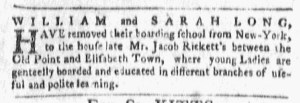
“WILLIAM and SARAH LONG, HAVE removed their boarding school from New-York.”

Late in November 1775, William and Sarah Long placed an advertisement for their boarding school “where young Ladies are genteelly boarded and educated in different branches of useful and polite learning” in the final edition of Rivington’s New-York Gazetteer, though they did not know that it would be the last issue.  They advised prospective students and their parents that they “removed … from New-York, to the house late Mr. Jacob Rickett’s between the Old Point and Elisabeth Town” in New Jersey.  What prompted the Longs to relocate outside the city?  With the siege of Boston continuing, the uncertainty of where and when British soldiers would attempt to assert their authority likely played a role in their decision.  A few months earlier, Andrew Wilson ran an advertisement for his grammar school in Morristown, New Jersey, emphasizing its distance from the coast.  He invoked the “dangerous and alarming times [for] the inhabitants of large cities” and suggested that they “may wish to have their children educated in the interior parts of the country, at a distance from probable, sudden danger and confusion.”  Similar thoughts may have inspired the Longs when they “removed” their school from New York.

On November 27, “sudden danger and confusion” did indeed occur at James Rivington’s printing office on Hanover Square.  Angry with the Tory perspective that Rivington often expressed in his newspaper, the Sons of Liberty attacked his printing office.  It was not the first time, but the damage was much more significant than the previous attack.  The Sons of Liberty destroyed Rivington’s press and type, preventing him from continuing to publish his newspaper or anything else.  The printer decided to leave the city, sailing for London.  He returned in 1777, during the British occupation of New York, and established Rivington’s New-York Gazette.  It continued the numbering of Rivington’s New-York Gazetteer.  That tile lasted for only two issues before he updated it to Rivington’s New York Loyal Gazette for several weeks and then the Royal Gazette throughout the remainder of the war.  Rivington’s newspaper changed names one more time, becoming Rivington’s New-York Gazette for just over a month before ceasing publication with the December 31, 1783, edition.  In his History of Printing in America (1810), patriot printer Isaiah Thomas noted that “for some time Rivington conducted his paper with as much impartiality as most of the editors of that period.”[1]  Adhering to that impartiality longer than other printers contributed to the perception that Rivington favored Tory sentiments when he claimed that he merely exercised freedom of the press.  Earlier in 1775, he advertised “Pamphlets published on both sides, in the unhappy dispute with Great-Britain.”  In addition to the Longs’ advertisement about their boarding school, the final issue of Rivington’s New-York Gazetteer also carried an advertisement for the Constitutional Post Office in New York.  The Second Continental Congress authorized the Constitutional Post as an alternative to the imperial system.

William and Sarah Long and their students “removed” from New York before “sudden danger and confusion” found them.  James Rivington, on the other hand, fled the city after repeated attacks on his printing office made it impossible for him to continue printing his newspaper.

**********

[1] Isaiah Thomas, The History of Printing in America: With a Biography of Printers and an Account of Newspapers (1810; New York: Weathervane Books, 1970), 511.

August 1

What was advertised in a revolutionary American newspaper 250 years ago today?

South-Carolina Gazette and Country Journal (August 1, 1775).

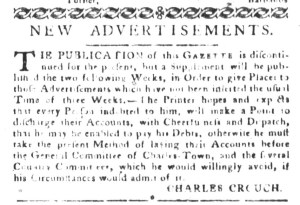
“THE PUBLICATION of this GAZETTE is discontinued for the present.”

It was the last issue of the South-Carolina Gazette and Country Journal, though Charles Crouch, the printer, may not have known it at the time.  The “NEW ADVERTISEMENTS” in the August 1, 1775, edition began with an announcement that the “PUBLICATION of this GAZETTE is discontinued for the present,” suggesting that the printer might revive it at a later time.  For now, he promised that “a Supplement will be published the two following Weeks, in Order to give Places to those Advertisements which have not been inserted the usual Time of three Weeks.”  Perhaps Crouch did distribute those supplements, but extant copies have yet to be located.  However, a nearly complete run of issues from the newspaper’s founding on December 17, 1765, through its last regular issue nearly a decade later does survive.  In 1908, A.S. Salley, Jr., noted, “The Charleston Library Society possesses an almost complete file of Crouch’s paper, only twenty-five numbers being missing from the ten years of the file.”[1]  Four decades later, Clarence Brigham did not record any missing issues in the Charleston Library Society’s collections in his History and Bibliography of American Newspapers, 1690-1820.[2]  Perhaps in the intervening years the Charleston Library Society acquired copies of those missing issues.

Isaiah Thomas, the printer of the Massachusetts Spy who later penned The History of Printing in America in 1810, wrote a short history of the South-Carolina Gazette and Country Journal.  The newspaper, he explained, “was established in opposition to the British American stamp act … and was published without stamps.”  That garnered acclaim from the public, earning Crouch a reputation as a “sound whig” or patriot.  “The general opposition of the colonies to the stamp act induced the public to patronize this Gazette.  It immediately gained a large list of respectable subscribers, and a full proportion of advertising customers.”  Crouch did not leave that to chance.  He included “Gazette” in the title, like the printers of the South-Carolina Gazette and the South-Carolina and American General Gazette, “in order to secure certain advertisements, directed by law to be ‘inserted in the South Carolina Gazette.’”  In addition to those notices, Crouch’s newspaper also carried a variety of advertisements for consumer goods and services as well as notice presenting enslaved people for sale or offering rewards for the capture and return of enslaved people who liberated themselves by running away from their enslaver.  Each sort of advertisement represented a lucrative revenue stream for the printer.  Among its competitors in Charleston, Thomas asserted, Crouch’s newspaper was the only one that “appeared regularly.”[3]  Others sometimes had gaps in publication.

Even though Crouch hoped to resume publishing the South-Carolina Gazette and Country Journal, he did not have the opportunity.  In late August 1775, he boarded a vessel headed to Philadelphia.  He sought supplies for his printing office, especially paper that had grown scarce.  The ship was lost at sea.  Thomas stated that Crouch’s widow published the newspaper for a short time, but Salley clarifies that Ann Crouch “revived her husband’s paper under the name of The Charlestown Gazette” in 1778 and “conducted it until the capture of Charles Town by the British in 1780.”[4]  A few issues have survived and been digitized for greater access by scholars and the public.  The Adverts 250 Project will examine those at the appropriate time.  For now, the demise of the South-Carolina Gazette and Country Journalcertainly had ramifications in Charleston and beyond.  In August 1775, readers in South Carolina had one less source of news and one less publication for disseminating advertisements.

**********

[1] A.S. Salley, Jr., “The First Presses of South Carolina,” Proceedings and Papers (Bibliographical Society of America) 2 (1907-1908): 66.

[2] Clarence Brigham, History and Bibliography of American Newspapers, 1690-1820 (Worcester, Massachusetts: American Antiquarian Society, 1947), 1039.

[3] Isaiah Thomas, The History of Printing in America: With a Biography of Printers and an Account of Newspapers (1810; New York: Weathervane Books, 1970), 571, 582.

[4] Salley, “First Presses of South Carolina,” 65-66.

April 30

What was advertised in a revolutionary American newspaper 250 years ago this month?

Massachusetts Gazette and Boston Weekly News-Letter (April 13, 1775).

THIS DAY PUBLISHED, The Royal American Magazine; FOR MARCH, 1775.”

On April 28, 1775, Daniel Fowle, printer of the New-Hampshire Gazette, reported that the “Boston News Papers … are all stopt, and no more will be printed for the present” following the outbreak of hostilities at Lexington and Concord.  He could have also mentioned that the Royal American Magazine, published by Joseph Greenleaf in Boston, had been suspended as well.  Although some of the newspapers eventually resumed, the Royal American Magazine did not.  The March 1775 issue, distributed in the second week of April, was the last one for that ambitious project that had repeatedly met with mishaps.  Isaiah Thomas, the original publisher, delayed the first issue when the ship carrying new types ran aground in January 1774 and then fell several issues behind because of the “Distresses” that Boston experienced when the Boston Port Act closed the harbor in June 1774 in retaliation for the destruction of tea the previous December.  Shortly after Thomas advised the public that he had suspended the magazine, he announced that he transferred it to Greenleaf.  The new publisher worked diligently to compile, print, and circulate the overdue issues and get back on schedule.

Massachusetts Gazette and Boston Weekly News-Letter (April 20, 1775).

Despite the challenges, he managed to do so, especially considering that eighteenth-century subscribers expected the issue for a month either at the very end of that month or early in the following month.  Accordingly, when Greenleaf first announced publication of the February 1775 issue on March 13 the new issue was on time, especially given the circumstances.  A month later, he ran a brief notice in the April 13 edition of the Massachusetts Gazette and Boston Weekly News-Letter: “THIS DAY PUBLISHED, The Royal American Magazine; FOR MARCH, 1775.”  A week later, he placed a more extensive advertisement in the same newspaper.  That one promoted the “elegant Engraving” that “Embellished” the magazine, though he did not reveal that it was a political cartoon depicting “America in Distress” engraved by Paul Revere.  (See the American Antiquarian Society’s illustrated inventory of “Royal American Magazine Plates” for images and descriptions of Revere’s engravings that accompanied the magazine.)  As he sometimes did in advertisements in previous months, Greenleaf stated that “Subscriptions continue to be taken in.”  That advertisement appeared on April 20, the day after the battles at Lexington and Concord.  Almost certainly Greenleaf composed the advertisement before such momentous events; very likely the type had already been set when word arrived in Boston.  The Massachusetts Gazette and Boston Weekly News-Letter covered the “unhappy Affair” in a single paragraph that ran on the same page as the advertisement for the Royal American Magazine.  It would be the last issue of that newspaper until May 19.  On April 24, the final issue of the Boston Evening-Post carried only three advertisements, one of them announcing publication of the March issue of the Royal American Magazine.

Boston Evening-Post (April 24, 1775).

That brought to conclusion an advertising campaign that lasted nearly two years when Thomas first declared that he would distribute subscription proposals.  For several months, he advertised widely in newspapers in New England, New York, Pennsylvania, and Maryland, seeking subscribers in distant cities for what was the only magazine published in the colonies at the time.  (Robert Aitken eventually launched the Pennsylvania Magazine in January 1775, a year after the Royal American Magazine commenced.)  Thomas scaled back the advertising once he took the first issue of the magazine to press.  In turn, Greenleaf also confined his advertising to Boston’s newspapers.  The ambitious project ended up a casualty of the imperial crisis when resistance became revolution.

This entry concludes an ongoing series in which the Adverts 250 Project has tracked advertisements for the Royal American Magazine from Thomas’s first notice, in May 1773, that he planned to distribute subscription proposals to newspapers advertisements in JuneJulyAugustSeptemberOctoberNovember, and December 1773 and JanuaryFebruaryMarchAprilMay, and June 1774.  No magazine advertisements for the magazine appeared in July 1774 because of the “Distresses,” yet they resumed in AugustSeptemberOctoberNovember, and December 1774 and JanuaryFebruary, and March 1775.

**********

THIS DAY PUBLISHED, The Royal American Magazine; FOR MARCH, 1775”

  • April 13 – Massachusetts Gazette and Boston Weekly News-Letter (first appearance)

JUST PUBLISHED … The Royal American Magazine … For MARCH, 1775”

  • April 20 – Massachusetts Gazette and Boston Weekly News-Letter (first appearance)

“THIS DAY PUBLISHED … The Royal American Magazine … For MARCH, 1775.”

  • April 24 – Boston Evening-Post (first appearance)

February 8

What was advertised in a colonial American newspaper 250 years ago today?

Pennsylvania Chronicle (February 8, 1774).

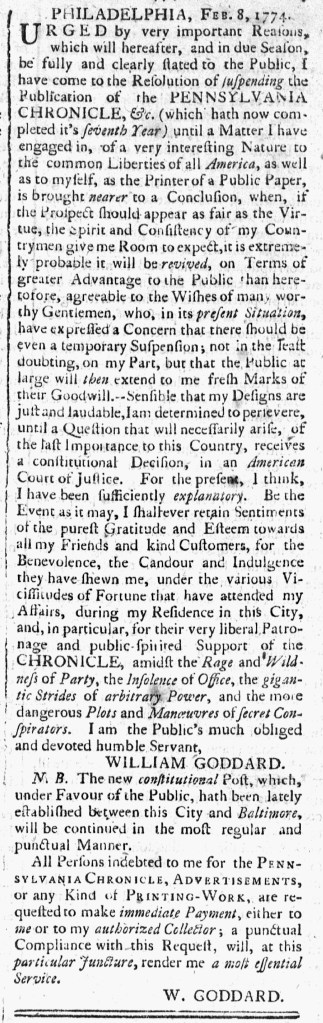
“I have come to the Resolution of suspending the Publication of the PENNSYLVANIA CHRONICLE.”

William Goddard published the final issue of the Pennsylvania Chronicle on February 8, 1774.  That newspaper commenced publication seven years earlier, on January 26, 1767.  The Adverts 250 Project tracked Goddard’s efforts to launch the Pennsylvania Chronicle, advertisements that ran in the first issues, and many more advertisements throughout its run.  Aside from news items, the final issue featured only three paid notices along with a letter from Goddard.

The printer explained that “very important Reasons” led him to “the Resolution of suspending the Publication of the PENNSYLVANIA CHRONICLE.”  He suggested that those reasons “will hereafter, and in due Season, be fully and clearly stated to the Public.”  He further hinted that he planned to revive the newspaper when “a Matter I have been engaged in, of a very interesting Nature to the common Liberties of all America, as well as to myself, as the Printer of a Public Paper, is brought nearer to a Conclusion.”  Goddard made other cryptic references, pronouncing that he had been “sufficiently explanatory.”  Still, he could not resist thanking his patrons for their support “amidst the Rage and Wildness of Party, the Insolence of Office, the gigantic Strides of arbitrary Power, and the more dangerous Plots and Manoeuvres of secret Conspirators.”

Many readers, especially those who had resided in Philadelphia for any amount of time, may have remembered that Goddard initially published the Pennsylvania Chronicle in partnership with Joseph Galloway and Thomas Wharton.  In his History of Printing in America (1810), Isaiah Thomas notes that the newspaper “was established under their influence and subject to their control, until 1770.”  At that time, Galloway and Wharton sold their share to Benjamin Towne, but Goddard soon “separated from his partners.”  After that, a “portion of [the newspaper] was … for a long time, devoted by Goddard to the management of a literary warfare which took place between him and his late partners.”[1]  In 1770, Goddard had also published a pamphlet, The Partnership, that put the enmity between himself and his former partners on full view for the public.  The lengthy subtitle testified to how much the relationship had deteriorated:  “The history of the rise and progress of the Pennsylvania Chronicle, &c.: Wherein the conduct of Joseph Galloway, Esq; speaker of the Honourable House of Representatives of the province of Pennsylvania; Mr. Thomas Wharton, Sen. and their man Benjamin Towne, my late partners, with my own, is properly delineated, and their calumnies against me fully refuted.”  In turn, Galloway and Wharton had Goddard imprisoned for debt for the following year.

As the Pennsylvania Chronicle declined, Goddard founded the Maryland Journal, the first newspaper published in Baltimore, in August 1773.  Goddard relocated to Baltimore after “suspending” the Pennsylvania Chronicle.  In a nota bene at the end of his letter in the final issue, he declared that the “new constitutional Post, which … hath been lately established between this City and Baltimore, will be continued in the most regular and punctual Manner.”  That was the first route in what became a much more expansive network of post offices operated independently of the British postal system, allowing colonizers to send letters and disseminate newspapers without interference from British officials.

As a last matter of housekeeping, Goddard called on “All Persons indebted to me for the PENNSYLVANIA CHRONICLE, ADVERTISEMENTS, or any Kind of PRINTING-WORK … to make immediate Payment.”  Printers and other entrepreneurs regularly placed notices with the intention of settling accounts.  Goddard’s notice merits special attention because he indicates that some customers owed for advertisements.  Many historians of the early American press assert that printers extended generous credit to subscribers while generating revenue by demanding that advertisers paid in advance.  Some printers, however, periodically ran notices calling on advertisers to make payment.  Goddard and some of his fellow printers apparently did not enforce a hard-and-fast policy when it came to paying for advertisement before publication.

Although the Pennsylvania Chronicle ceased publication in 1774, Goddard continued publishing the Maryland Journal and became involved in other projects, including the Constitutional Post, that became the subjects of news articles, editorials, and advertisements.  Undoubtedly, William Goddard will make additional appearances as the Adverts 250 Project continues examining advertising, print culture, and politics during the era of the American Revolution.

**********

[1] Isaiah Thomas, The History of Printing in America: With a Biography of Printers and an Account of Newspapers (1810; New York: Weathervane Books, 1970), 438.