
Who was the subject of an advertisement in a colonial American newspaper 250 years ago today?
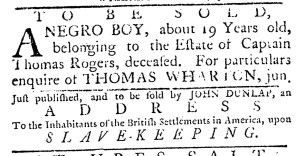
“TO BE SOLD, A NEGRO BOY.”
“Just published … an ADDRESS … upon SLAVE-KEEPING.”
When John Dunlap published An Address to the Inhabitants of the British Settlements in America, upon Slave-keeping in 1773, he advertised widely. He promoted the pamphlet in his own newspaper, the Pennsylvania Packet, before taking it to press, hoping to incite interest and demand among prospective customers. Before and after publication, he inserted advertisements in other newspapers as well. For instance, he ran a brief advertisement in the February 10 edition of the Pennsylvania Journal. Consisting of only four lines, it advised readers that the pamphlet was “Just published, and to be sold by JOHN DUNLAP.”
Printing a pamphlet that critiqued slavery did not prevent Dunlap from generating revenues from newspaper advertisements that perpetuated the slave trade. On January 18, for instance, he ran a lengthy advertisement about the pamphlet, one that included an excerpt from the conclusion, and several notices offering enslaved people for sale or promising rewards for the capture and return of enslaved people who liberated themselves by running away from their enslavers.
Similarly, William Bradford and Thomas Bradford, printers of the Pennsylvania Journal, ran the advertisement for the pamphlet and advertisements about enslaved people. Two advertisements in the February 10 edition, one for a “NEGRO woman eighteen years old, and six months gone with child” and another for a “NEGRO MAN, About 27 years old,” instructed prospective enslavers to “Enquire of the printers” for more information. The Bradfords acted as slave brokers in addition to disseminating those advertisements. Dunlap’s advertisement for the Address … upon Slave-keeping appeared immediately below an advertisement about a “NEGRO BOY, about 19 Years old,” for sale as part of the estate of Thomas Rogers. Did the Bradfords recognize the dissonance inherent in the two advertisements? Did a compositor exercise some editorial discretion in placing one advertisement after another, making a point to both the printers and readers?
Whatever the case, the Pennsylvania Journal gave much more space to perpetuating slavery on that day, made all the more noteworthy by the news item that filled the first two pages of that edition. The Bradfords reprinted the response to Governor Thomas Hutchinson’s speech from a committee appointed by the Massachusetts assembly, a response that vigorously defended the liberties of English colonizers. That response, first published by Isaiah Thomas as an extraordinary issue of the Massachusetts Spy, made its way from newspapers to newspaper, first in New England and then in other regions. Each of those newspapers also ran advertisements that perpetuated slavery, demonstrating the limits of how many colonizers conceived of liberty. The Address … upon Slave-Keeping presented a more expansive view. Despite the excerpt that Dunlap published in his own newspaper, however, that pamphlet did not have such extensive coverage.
