
What was advertised in a colonial American newspaper 250 years ago today?
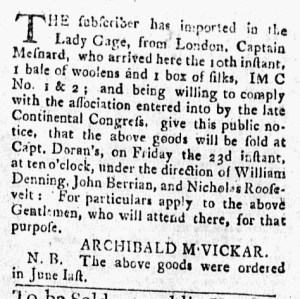
“Willing to comply with the association entered into by the late Continental Congress.”
When a shipment of “1 bale of woolens and 1 box of silks” arrived in New York via the Lady Gage on December 10, 1774, Archibald McVickar surrendered the good to the local Committee of Inspection and placed an advertisement to that effect in the New-York Journal. He declared that he was “willing to comply with the association entered into by the late Continental Congress.” Accordingly, those goods “will be sold … under the direction of William Denning, John Berrian, and Nicholas Roosevelt.” Anyone wishing to learn more about the sale should “apply to the above Gentlemen” rather than to the McVickar.
McVickar abided by the Continental Association, a nonimportation agreement enacted by the First Continental Congress in response to the Coercive Acts. In particular, the tenth article stated, “In Case any Merchant, Trader, or other Persons, shall import any Goods or Merchandise after the first Day of December [1774], and before the first Day of February next, the same ought forthwith, at the Election of the Owner, to be either reshipped or delivered up to the Committee of the County or town wherein they shall be imported, to be stored at the Risk of the Importer, until the Non-importation Agreement shall cease, or be sold under the Direction of the Committee aforesaid.” In other words, McVickar had three options since his shipment arrived on December 10. He could return it, turn the goods over to the committee to store until the nonimportation agreement ended, or turn the goods over to the committee to sell.
McVickar chose the final option. The Continental Association made further provisions that he would be reimbursed for the cost of the goods yet could not earn any profit on them. Instead, any profit was to be applied to relief efforts for Boston where the harbor had been closed and blockaded since the Boston Port Act went into effect on June 1. McVickar added a nota bene to clarify that the “goods were ordered in June last.” At that time, colonizers suspected that a nonimportation agreement might go into effect in the future, but the First Continental Congress had not yet met or composed and disseminated the Continental Association. McVickar suggested that he had not deliberately attempted to get around that agreement, as he further demonstrated in asserting that he was “willing to comply with the association.” Whatever he lost in profit, he gained in staying in the good graces of members of the community who supported the Patriot cause.