
What was advertised via subscription proposals in revolutionary American 250 years ago today?
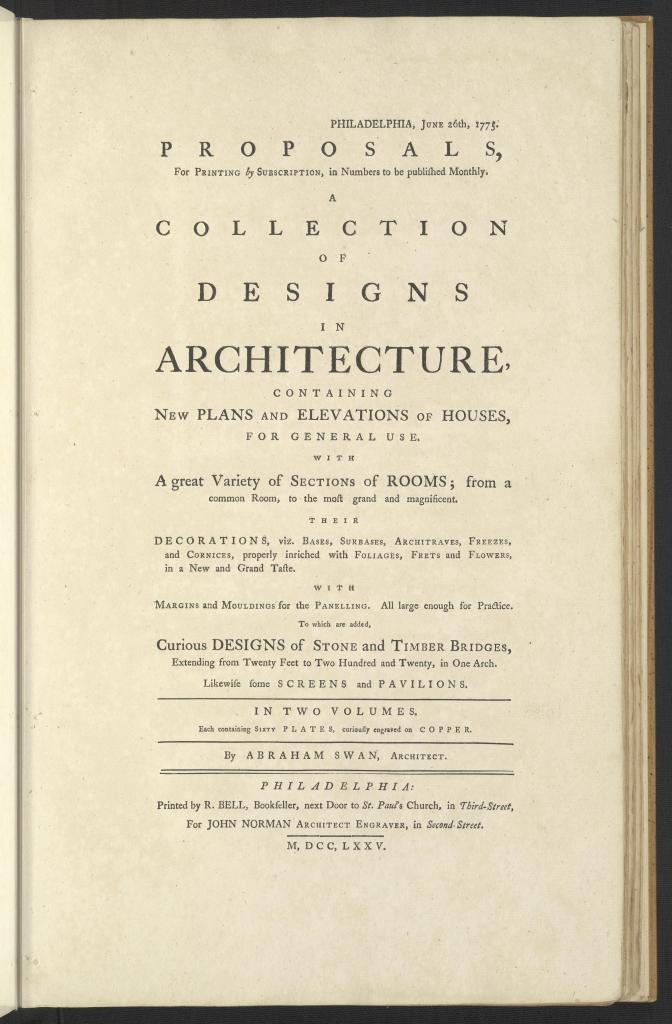
“A COLLECTION OF DESIGNS IN ARCHITECTURE … By ABRAHAM SWAN.”
The Adverts 250 Project recently featured subscription proposals for The Gentleman and Cabinet-Maker’s Assistant with drawings by John Folwell and engravings by John Norman bound into the American edition of Abraham Swan’s British Architect published by Norman in collaboration with Robert Bell in the summer of 1775. Those proposals, facing the title page, were not the only ones in that volume. Other subscription proposals appeared after the text and before the engravings. Norman and Bell once again attempted to entice subscribers and other readers of Swan’s British Architect to purchase a book undoubtedly of interest to them, Swan’s Collection of Designs in Architecture.
In contrast to the proposals for The Gentleman and Cabinet-Maker’s Assistant, the proposals for Designs in Architecture ran on two pages facing each other instead of on a single page. The “CONDITIONS” appeared on the left and the full title, author, and publishers on the right. Those “CONDITIONS” specified that the volume would be “printed on One Hundred and Twenty Folio Copper-Plates, with Explanations in Letter-Press, in Twelve Numbers, and published Monthly.” A new “Number containing Ten Folio Copper-Plates, with Explanations” would be ready for subscribers on the first Monday of every month, amounting to “the Whole of the London Edition” over the course of a year. Subscribers paid five shilling for each “Number” or three pounds altogether, a bargain compared to the four pounds and ten shilling charged for the London edition. As with the British Architect and The Gentleman and Cabinet-Maker’s Assistant, “the Names of the Encouragers will be printed in the Book.” The same local agents in Philadelphia, Annapolis, Baltimore, Charleston, and New York accepted subscriptions, except for John Folwell, the designer who supplied the drawings for The Gentleman and Cabinet-Maker’s Assistant but apparently did not have a stake in the American edition of Swan’s Designs in Architecture.

The proposals for The Gentleman and Cabinet-Maker’s Assistant could be removed from the British Architect, but that was not the case for the proposals for Designs in Architecture. The “CONDITIONS” for that proposed work appeared on the verso of the final page of the text, making it impossible for subscribers, bookbinders, or anyone else to remove that portions of the advertisement from the book. That did not, however, eliminate the possibility of distributing the subscription proposals separately. Norman and Bell could have issued a broadside that featured just the title, author, and publishers or a broadsheet with the title, author, and publishers on one side and the “CONDITIONS” on the other. In his Supplement to Charles Evans’ American Bibliography, renowned bibliographer Roger P. Bristol identifies a broadside with the title, author, and publishers as a separate item, but the catalog maintained by the American Antiquarian Society indicates that he did so based solely on a copy in the collections of the Historical Society of Pennsylvania. That broadside “may be excised” from a copy of the British Architect. Extant copies do not yield a conclusive answer, but Bell, in particular, was such a savvy advertiser that he very well may have distributed the proposals for Designs in Architecture separately.
**********
I have worked with the copy of Swan’s British Architect in the collections of the American Antiquarian Society for this entry. That copy has been digitized, yet it remains behind a subscription paywall. Its features described here match those of copies in the collections of the Gerry Research Institute and the Library of Congress that have been digitized and are accessible to the public.
