April 26

What was advertised in a revolutionary American newspaper 250 years ago today?
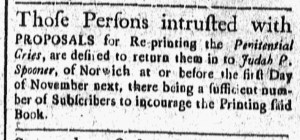
Essex Journal (April 26, 1776).

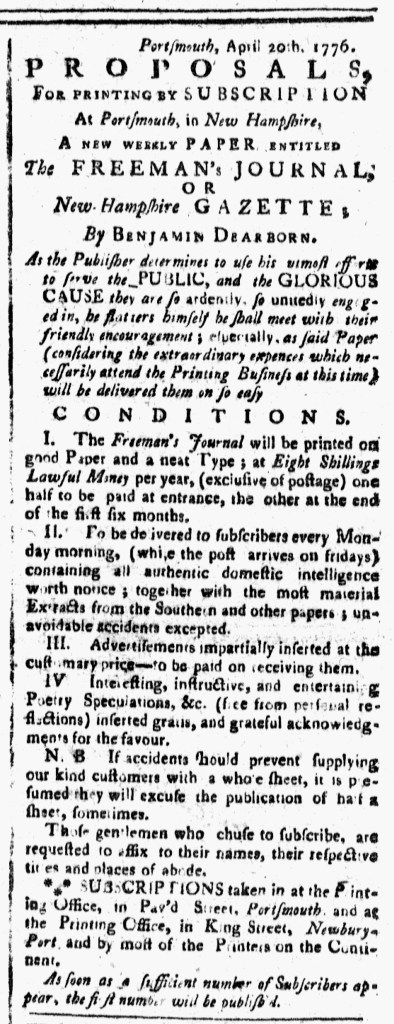
“A NEW WEEKLY PAPER ENTITLED The FREEMAN’s JOURNAL, OR New-Hampshire GAZETTE.”

A year after the battles at Lexington and Concord, Benjamin Dearborn issued “PROPOSALS, FOR PRINTING BY SUBSCRIPTION … A NEW WEEKLY PAPER ENTITLED The FREEMAN’s JOURNAL, OR New-Hampshire GAZETTE.”  Dated April 20, 1776, the subscription proposals appeared in the April 26 edition of the Essex Journal, printed in Newburyport, Massachusetts, though they may have circulated separately as well.  Dearborn intended to publish the Freeman’s Journal in Portsmouth, making it the only newspaper printed in the colony since Daniel Fowle suspended the New-Hampshire Gazette earlier in the year.  The printer asserted that “As soon as a sufficient number of Subscribers appear, the first number will be publish’d.”  A month later, he distributed the first issue on May 25.

The title of the Freeman’s Journal made the editorial stance clear.  So did the explanation that Dearborn gave for establishing the newspaper: “As the Publisher determines to use his utmost efforts to serve the PUBLIC, and the GLORIOUS CAUSE they are so ardently, so unitedly engaged in, he flatters himself he shall meet with their friendly encouragement.”  He took on this service despite the “extraordinary expences which necessarily attend the Printing Business at this time,” simultaneously asking prospective subscribers to “excuse the publication of half a sheet, sometimes,” when “accidents … prevent supplying our kind customers with a whole sheet.”  During the first year of the war, shortages of paper, fears of impending attacks by British forces, post riders arriving behind schedule, and other “accidents” disrupted publication of the newspapers in New England and beyond.

The “CONDITIONS” in Dearborn’s subscription proposals outlined the expectations for the printer and subscribers.  A subscription cost “Eight Shillings Lawful Money per year, (exclusive of postage),” with half due immediately and the other half due in six months.  Newspaper printers often extended generous credit to subscribers, but circumstances did not permit Dearborn to do so for the Freeman’s Journal.  He pledged, “Advertisements impartially inserted at the customary price,” though he did not specify what that was.  He apparently expected that prospective advertisers knew the going rate for running notices in newspapers in the region.  He did declare that advertisements had “to be paid on receiving them.”  The printer did not allow any credit for advertisements.

New issues would circulate “every Monday morning” for as long as “the post arrives on Fridays.”  That allowed time for Dearborn to peruse other newspapers to select items to reprint in the Freeman’s Journal, sift through his own correspondence, and collaborate with others who received letters containing news.  The printer would collate “all authentic domestic intelligence worth notice; together with the most material Extracts from the Southern and other papers.”  He also solicited “[i]nteresting, instructive, and entertaining Poetry Speculations,” presumably for “Poet’s Corner,” a standard feature in many colonial newspapers, that he would publish “gratis” with “grateful acknowledgments for the favour.”

Dearborn accepted subscriptions at his printing office in Portsmouth.  John Mycall, the printer of the Essex Journal, also gathered subscriptions at the printing office in Newburyport.  Dearborn also expected that “most of the Printers on the Continent” would forward any subscriptions they received, signaling to the public that he was part of an expansive network that exchanged news for the benefit of “the PUBLIC, and the GLORIOUS CAUSE.”  Despite the upheavals of the war (or perhaps because of them), Dearborn and other printers established new newspapers during the summer of 1776.

March 20

What was advertised in a revolutionary American newspaper 250 years ago today?

Pennsylvania Journal (March 20, 1776).

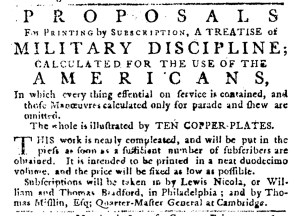
“A TREATISE of MILITARY DISCIPLINE; CALCULATED FOR THE USE OF THE AMERICANS.”

Eleven months after the Revolutionary War began at the Battles of Lexington and Concord, Lewis Nicola distributed subscription proposals for a “TREATISE of MILITARY DISCIPLINE … illustrated by TEN COPPER-PLATES.”  He indicated that the work was “nearly completed, and will be put in the press as soon as a sufficient number of subscribers are obtained.”  Authors and printers often used subscription proposals as a rudimentary form of market research, assessing whether interest merited publishing a book and determining how many copies to print while simultaneously increasing visibility for the project and augmenting demand.  Nicola envisioned a “neat duodecimo volume,” a portable size, but did not affix a price except to say that it “will be fixed as low as possible.”  He expected that other aspects of the manual would convince prospective subscribers to reserve their copies.

For instance, he proclaimed that his manual was “CALCULATED FOR THE USE OF THE AMERICANS.”  Over the past couple of years, especially since the war started, American printers published local editions of a variety of British military manuals, but Nicola’s book, as Douglas R. Cubbison explains, “was one of only two such treatises specifically prepared for the Continental Army at the time.”  Nicola emphasized that he focused on practical matters, including “every thing essential on service” while omitted “those Manoeuvres only for parade and shew.”  Militia training had often been an occasion for socializing and entertainment before the war, but officers and soldiers and the communities they served needed more than fancy formations now that they engaged an enemy rather than gathering on the town common.  Cubbison also notes that Nicola outlined “a unified system of military maneuvers” and stressed that “officers must display forbearance, understanding, and respect for their soldiers.”  In so doing, his manual “anticipated many of the core components of the Baron de Steuben’s more famous and considerably more influential Regulations for the Order and Discipline of the Troops of the United States.”

Nicola accepted subscriptions in Philadelphia, as did William Bradford and Thomas Bradford, the printers of the Pennsylvania Journal.  In addition, “Thomas Mifflin, Esq; Quarter-Master General at Cambridge,” also collected subscriptions.  When the subscription proposal appeared in the Pennsylvania Journal on March 20, residents of Philadelphia did not yet know that the British evacuated Boston three days earlier, ending the siege of the city.  The most recent news, printed in both the Pennsylvania Evening Post on March 19 and the Pennsylvania Gazette on March 20, came Watertown on March 11, a description of the “bombardment of Boston” following the arrival of cannon that Henry Knox transported from Fort Ticonderoga in New York.  “‘Tis reported the Regulars are embarking,” the missive from Watertown stated, but the printers had not yet received word that the British had indeed left Boston.  Whatever came next, the war was not coming to an end.  Nicola likely hoped that news from Watertown would entice readers to subscribe for a military manual “CALCULATED FOR THE USE OF THE AMERICANS.”

December 2

What was advertised in a revolutionary American newspaper 250 years ago today?

Pennsylvania Ledger (December 2, 1775).

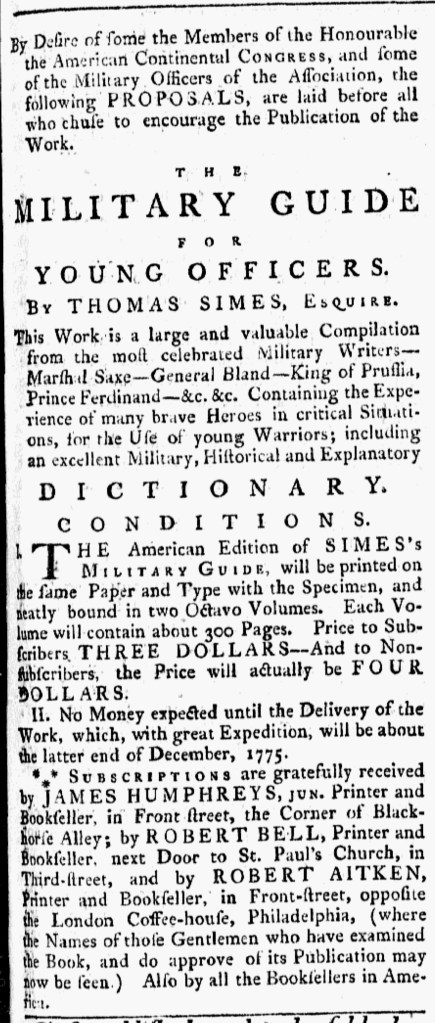
“THE American Edition of SIMES’s MILITARY GUIDE.”

In December 1775, James Humphreys, Jr., Robert Bell, and Robert Aitken collaborated in advertising and publishing The Military Guide for Young Officers by Thomas Simes, making yet another military manual available to the public following the momentous events at Lexington and Concord the previous April.  More recent developments, both military and political, convinced printers that a market existed for military manuals.  According to the introduction to “Books in the Field: Studying the Art of War in Revolutionary America,” an exhibition sponsored by the American Revolution Institute of the Society of the Cincinnati, “a flood of printing began to appear from the American presses.  Much of this activity was centered in Philadelphia, where more than thirty works on military subjects were published in the years 1775 and 1776 alone.”

Of the three of the printer-booksellers who partnered in publishing Simes’s Military Guide, Humphreys was the only one who published a newspaper.  He gave their advertisement a privileged place at the top of the first column on the first page of the December 2, 1775, edition of the Pennsylvania Ledger.  Rather than advertising a book already available for sale, the printer-booksellers distributed subscription proposals, doing so, they claimed, “By Desire of some the Members of the Honourable American Continental CONGRESS, and some of the Military Officers of the Association.”  Readers who wished to reserve copies of the work became subscribers by submitting their names to any of those three printer-booksellers, though they also indicated that “SUBSCRIPTIONS are gratefully received … by all the Booksellers in America.”  Printers, authors, and others in the book trades had more than one reason for circulating subscription proposals.  They hoped to incite greater demand while also learning if sufficient interest existed to make a project viable and, if so, how many copies to produce.

This subscription proposal featured an overview of the contents of the military guide: “a large and valuable Compilation from the most celebrated Miliary Writers … Containing the Experience of many brave Heroes in critical Situations, for the Use of young Warriors” as well as “an excellent Military, Historical and Explanatory DICTIONARY.”  This “American Edition … will be printed on the same Paper and Type with the Specimen, and neatly bound in two Octavo Volumes.”  Apparently, Humphreys, Bell, and Aitken had specimens or samples of the paper and type on display at their printing offices so prospective subscribers could examine them and assess the material quality of the work for themselves before committing to ordering copies.  Printers often circulated specimens along with subscription proposals.  The partners planned to print some surplus copies, expecting that demand would warrant doing so, but encouraged subscribers with a discount.  Those who reserved their copies paid three dollars, but for “Non-subscribers, the Price will actually be FOUR DOLLARS.”  Subscribers did not need to part with their money “until the Delivery of the Work,” anticipated for “the latter end of December, 1775.”  Humphreys, Bell, and Aitken did not take the military manual to press as quickly as they expected.  The imprint on the title page gives the date of publication as 1776.  The partners made one final pitch in the subscription proposals, announcing that “the Names of those Gentlemen who have examined the Book, and do approve of its Publication may now be seen” at Aitken’s printing office.  These marketing efforts apparently helped the partners attract enough subscribers to publish the proposed work.  Not all subscription proposals met with such success.  Current events likely played a role in the outcome when Humphreys, Bell, and Aitken proposed an American edition of The Miliary Guide for Young Officers.

November 8

What was advertised in a revolutionary American newspaper 250 years ago today?

Pennsylvania Gazette (November 8, 1775).

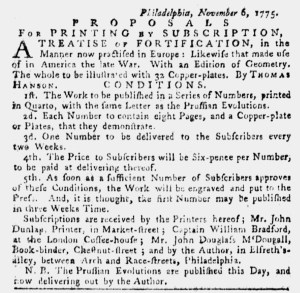
“PROPOSALS FOR PRINTING BY SUBSCRIPTION, A TREATISE OF FORTIFICATION.”

Thomas Hanson announced a new project in the November 8, 1775, editions of the Pennsylvania Gazette and the Pennsylvania Journal.  For several months he had been engaged in soliciting subscribers for his Prussian Evolutions in Actual Engagements, a military manual that garnered the support of both officers and politicians.  With that book “published … and now delivering out by the Author,” Hanson distributed subscription proposals for printing “A TREATISE OF FORTIFICATION, in the Manner now practiced in Europe: Likewise that made use of in America the late War.”  The Prussian Evolutions included thirty copperplate engravings; similarly, this new endeavor would be “illustrated with 32 Copper-plates.”

Hanson adopted a different method for publishing the proposed treatise than he had for the Prussian Evolutions.  Rather than produce a single volume, he planned for the “Work to be published in a Series of Numbers, printed in Quarto, with the same Letter as the Prussian Evolutions,” “Each Number to contain eight Pages, and a Copper-plate or Plates, that they demonstrate,” and “One number to be delivered to the Subscribers every two Weeks.”  Eighteenth-century readers would have been familiar with such “CONDITIONS” for publishing books.  Hanson planned to use the type (“same Letter”) as his first book, giving the two works a similar appearance.  Instead of taking the entire book to press at one time, Hanson planned to print and distribute two sheets (“eight Pages”) and the corresponding illustrations once every two weeks.  Each sheet would have four pages on it, creating a quarto sized book when folded by the printer, bookbinder, or subscriber.  Subscribers paid six pence “per Number” or set of eight pages with corresponding illustrations upon delivery.

Hanson declared that “the Work will be engraved and put to the Press” once “a sufficient Number of Subscribers approves of these Conditions.”  Why did he opt to publish his treatise on fortifications in smaller parts rather than all at once?  Perhaps Hanson had grown frustrated with the delays in publishing the Prussian Evolutions.  In an earlier advertisement, he noted that he first published subscription proposals on May 3, shortly after learning about the battles at Lexington and Concord.  In July, he thought that the book would be completed “in three or four weeks,” yet more than three months passed before the volume was published and ready for delivery.  Printing and distributing a new “Number” every two weeks would keep the project moving forward and the revenues collected upon delivery would likely help as well.  Hanson expected that “the first Number may be published in three Weeks Time,” but it seems that he was disappointed once again.  It does not appear that this proposed project met with the same success as the Prussian Evolutions.  Even if some “Numbers” went to press, no complete volume of the proposed treatise survives today.  Most likely, Hanson did not entice a “sufficient Number of Subscribers.”  According to the American Revolution Institute of the Society of the Cincinnati, he faced a lot of competition.  Presses in Philadelphia produced more than thirty works on military subjects in 1775 and 1776, including Hanson’s Prussian Evolutions.

July 19

What was advertised in a revolutionary American newspaper 250 years ago today?

Pennsylvania Journal (July 19, 1775).

“PROPOSALS, For printing … The PRUSSIAN EVOLUTIONS In actual Engagements.”

The July 19, 1775 editions of the Pennsylvania Gazette and the Pennsylvania Journal carried “PROPOSALS, For printing by SUBSCRIPTION, The PRUSSIAN EVOLUTIONS In actual Engagements” by Thomas Hanson.  A synopsis indicated that the book included “all the different Evolutions and Manoeuvres in firing standing, advancing and retreating, which were exhibited before his present Majesty, May 8, 1769, and before John Duke of Argyle … in 1771; with some additions since that time, explained with thirty folio copper-plates.”  Three bonus images accompanied by descriptions depicted surveying, fortifications, and a gun and mortar.

The advertisement noted that the proposals “were first published May 3, 1775, by THOMAS HANSON, Adjutant for the Second Battalion.”  That means that Hanson proposed and marketed the work very shortly after receiving news of the battles at Lexington and Concord.  Such projects, however, took time.  “It is expected,” Hanson stated, that the “said work will be completed in three or four weeks from this date” or sometime in the middle of August.  To entice readers to reserve copies in advance, Hanson also promised that the “Subscribers names will be inserted, and those that choose to subscribe must do it speedily, otherwise their names will not be in the book.”  Prospective subscribers had an opportunity to demonstrate their support for the American cause and appear in the company of fellow Patriots, just as genteel advocates for improvements in architecture had their names listed in a recently published American edition of Abraham Swan’s British Architect.

Several prominent residents of Philadelphia lent their support to the work by collecting subscriptions on behalf of Hanson, including “John Dickinson, Esq; Thomas Mifflin, Esq; Daniel Roberdeau, John Cox, jun.[,] Samuel Meredith, and John Wilcocks, Merchants,” Benjamin Towne, printer of the Pennsylvania Evening Post; William Hall, David Hall, and William Sellers, printers of the Pennsylvania Gazette; William Bradford and Thomas Bradford, printers of the Pennsylvania Journal; Robert Bell, printer and bookseller; and Thomas Nevell, “at the sign of the Carpenter’s-Hall” (who simultaneously collected subscriptions for The Gentleman and Cabinet-Maker’s Assistant and an American edition of Swan’s Collection of Designs in Architecture).

George Washington had already joined the ranks of the subscribers to Prussian Evolutions by the time Hanson’s proposals ran in the Pennsylvania Gazette and the Pennsylvania Journal on July 19.  According to historians at Mount Vernon, Washington purchased eight copies of Hanson’s manual, “one of the earliest for the instruction of American officers,” on May 20 and “likely distribute[d] the copies among militia officers and other key figures preparing for the growing conflict.  Indeed, “His Excellency George Washington” appeared among the “LIST OF SUBSCRIBERS NAMES” inserted immediately after the “DEDICATION, TO THE PRESERVERS of LIBERTY,” with a notation that he ordered eight copies.  Other subscribers included “The Honourable John Adams,” “The Honourable Benjamin Franklin,” “The Hon. John Hancock,” “His Excellency Richard Henry Lee,” “The Hon. Peyton Randolph,” and “His Excellency Philip Schuyler.”  Washington was not alone in subscribing for multiple copies.  Captain Moore Furman subscribed for five, Lieutenant Colonel Abraham Hunt for six, Captain Joseph Moulder for two, Lieutenant John Patton for two, and Colonel Daniel Roberdeau for four.  The “Merchants” who collected subscriptions also appeared on the list, identified by their military ranks: “Col. John Dickinson, Esq,” “Quarter Master General, Thomas Mifflin,” “Major, John Cox,” “Major, Samuel Meridith,” and “Capt. John Wilcocks.”  Subscribers certainly found themselves in good company!

June 26

What was advertised via subscription proposals in revolutionary American 250 years ago today?

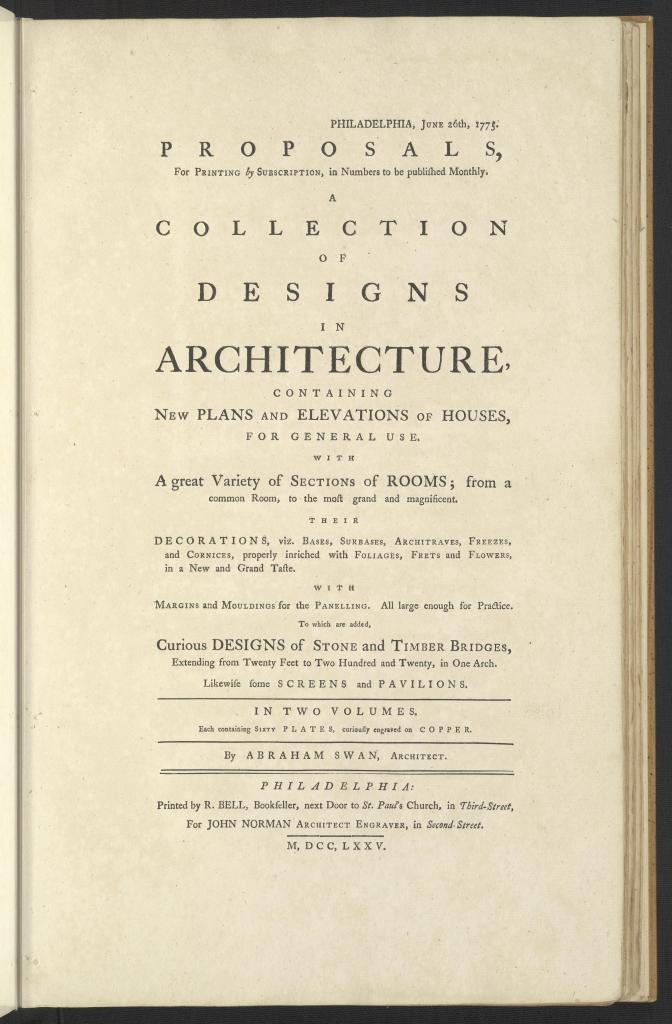
Subscription proposals bound in Abraham Swan, The British Architect: Or, the Builders Treasury of Stair-Cases (Philadelphia: Robert Bell, Bookseller, for John Norman, Architect Engraver, 1775). Courtesy Library of Congress.

“A COLLECTION OF DESIGNS IN ARCHITECTURE … By ABRAHAM SWAN.”

The Adverts 250 Project recently featured subscription proposals for The Gentleman and Cabinet-Maker’s Assistant with drawings by John Folwell and engravings by John Norman bound into the American edition of Abraham Swan’s British Architect published by Norman in collaboration with Robert Bell in the summer of 1775.  Those proposals, facing the title page, were not the only ones in that volume.  Other subscription proposals appeared after the text and before the engravings.  Norman and Bell once again attempted to entice subscribers and other readers of Swan’s British Architect to purchase a book undoubtedly of interest to them, Swan’s Collection of Designs in Architecture.

In contrast to the proposals for The Gentleman and Cabinet-Maker’s Assistant, the proposals for Designs in Architecture ran on two pages facing each other instead of on a single page.  The “CONDITIONS” appeared on the left and the full title, author, and publishers on the right.  Those “CONDITIONS” specified that the volume would be “printed on One Hundred and Twenty Folio Copper-Plates, with Explanations in Letter-Press, in Twelve Numbers, and published Monthly.”  A new “Number containing Ten Folio Copper-Plates, with Explanations” would be ready for subscribers on the first Monday of every month, amounting to “the Whole of the London Edition” over the course of a year.  Subscribers paid five shilling for each “Number” or three pounds altogether, a bargain compared to the four pounds and ten shilling charged for the London edition.  As with the British Architect and The Gentleman and Cabinet-Maker’s Assistant, “the Names of the Encouragers will be printed in the Book.”  The same local agents in Philadelphia, Annapolis, Baltimore, Charleston, and New York accepted subscriptions, except for John Folwell, the designer who supplied the drawings for The Gentleman and Cabinet-Maker’s Assistant but apparently did not have a stake in the American edition of Swan’s Designs in Architecture.

Subscription proposals bound in Abraham Swan, The British Architect: Or, the Builders Treasury of Stair-Cases (Philadelphia: Robert Bell, Bookseller, for John Norman, Architect Engraver, 1775). Courtesy Library of Congress.

The proposals for The Gentleman and Cabinet-Maker’s Assistant could be removed from the British Architect, but that was not the case for the proposals for Designs in Architecture.  The “CONDITIONS” for that proposed work appeared on the verso of the final page of the text, making it impossible for subscribers, bookbinders, or anyone else to remove that portions of the advertisement from the book.  That did not, however, eliminate the possibility of distributing the subscription proposals separately.  Norman and Bell could have issued a broadside that featured just the title, author, and publishers or a broadsheet with the title, author, and publishers on one side and the “CONDITIONS” on the other.  In his Supplement to Charles Evans’ American Bibliography, renowned bibliographer Roger P. Bristol identifies a broadside with the title, author, and publishers as a separate item, but the catalog maintained by the American Antiquarian Society indicates that he did so based solely on a copy in the collections of the Historical Society of Pennsylvania.  That broadside “may be excised” from a copy of the British Architect.  Extant copies do not yield a conclusive answer, but Bell, in particular, was such a savvy advertiser that he very well may have distributed the proposals for Designs in Architecture separately.

**********

I have worked with the copy of Swan’s British Architect in the collections of the American Antiquarian Society for this entry.  That copy has been digitized, yet it remains behind a subscription paywall.  Its features described here match those of copies in the collections of the Gerry Research Institute and the Library of Congress that have been digitized and are accessible to the public.

June 20

What was advertised via subscription proposals in revolutionary American 250 years ago today?

Subscription proposals bound in Abraham Swan, The British Architect: Or, the Builders Treasury of Stair-Cases (Philadelphia: Robert Bell, Bookseller, for John Norman, Architect Engraver, 1775). Courtesy Library of Congress.

“THE GENTLEMAN AND CABINET-MAKER’s ASSISTANT.”

As the summer of 1775 approached, Robert Bell, the prominent bookseller and auctioneer, partnered with John Norman, an architect engraver, in publishing an American edition of Abraham Swan’s British Architect: Or, the Builders Treasury of Stair-Cases.  Norman, who had arrived in Philadelphia just a year earlier, advertised the forthcoming volume in the Pennsylvania Journal in March and advised that prospective subscribers who considered supporting the project could examine printed proposals “with a specimen of the plates and letter press” at his house on Second Street.  He also pledged that the “names of the subscribers to this useful and ornamental work will be published.”  The book eventually included, according to its title page, “upwards of One Hundred DESIGNS and EXAMPLES, curiously engraved on Sixty FolioCopper-Plates,” some of them previously on view.  The “NAMES OF THE ENCOURAGERS,” as promised, appeared on four pages, clustered together by the first letter of their last names.  In the copy in the collections of the American Antiquarian Society, the list of nearly two hundred subscribers had a prominent place immediately after the title page and before the introduction, though binders may have placed the list at the end in other copies.

The copies at the American Antiquarian Society, the Getty Research Institute, and the Library of Congress also include subscription proposals for The Gentleman and Cabinet-Maker’s Assistant with the “DRAWINGS by the ingenious JOHN FOLWELL, Cabinet-Maker; and the ENGRAVINGS by JOHN NORMAN,” bound to face the title page.  While the proposals may have also circulated separately as a broadside, it seems that Bell and Norman seized an opportunity to market a similar book to subscribers and other readers of their edition of British Architecture, an audience that already demonstrated interest in the subject matter.  The proposals carried a date – June 20, 1775 – but could have been paired with British Architecture any time after that.  The proposed volume would feature even more illustrations, “Two Hundred Designs and Examples … with proper Explanations in Letter Press,” at a cost of fifty shillings.  Subscribers were expected to pay fifteen shillings in advance and the remainder “on the Delivery of the Book.”  Folwell and Norman intended to take it to press as soon as subscribers ordered three hundred copies.  As with the British Architect, “The Names of the SUBSCRIBERS to this useful WORK will be printed” as an acknowledgment of their support.  Folwell and Norman accepted subscriptions in Philadelphia, as did Bell and Thomas Nevell “at the Sign of the CARPENTERS-HALL,” but so did local agents in Annapolis, Baltimore, Charleston, and New York.  The list of associates in other towns further suggests that the subscription proposals did indeed circulate separately in an effort to enhance demand.

March 16

What was advertised in a colonial American newspaper 250 years ago today?

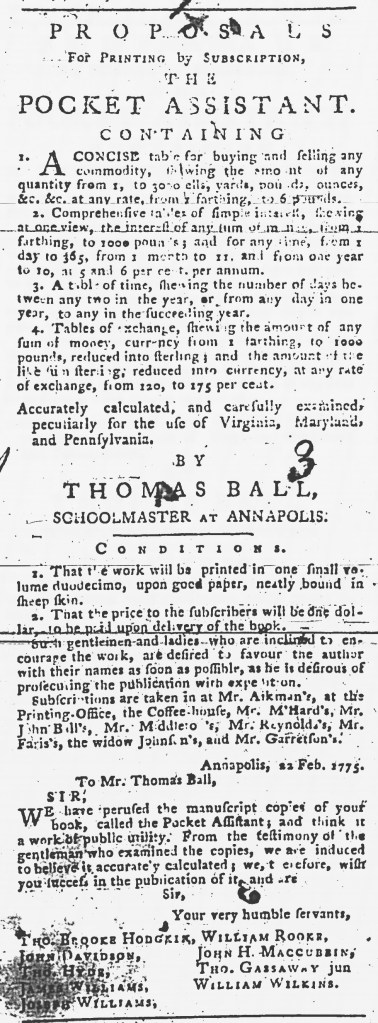
Maryland Gazette (March 16, 1775).

“WE have perused the manuscript copies of your book … and think it a work of public utility.”

Thomas Ball, a schoolmaster in Annapolis, had an entrepreneurial spirit.  He wrote and distributed subscription proposals for “THE POCKET ASSISTANT,” a reference manual that included a “CONCISE table for buying and selling any commodity … at any rate,” “Comprehensive tables of simple interest,” a “table of time, shewing the number of days between any two in the year, or from any day in one yea, to any in the succeeding year,” and “Tables of exchange.”  Merchants, brokers, shopkeepers, and others would certainly find each of those calculations helpful when conducting business.

Ball claimed that each table as “Accurately calculated and carefully examined” so subscribers could trust them.  To that end, he added an endorsement from nine residents of Annapolis after the “CONDITIONS” for subscribing.  “WE have perused the manuscript copies of your book, called the Pocket Assistant,” they declared, “and think it a work of public utility.  From the testimony of the gentleman who examined the copies, we are induced to believe it accurately calculated; we, therefore, wish you success in the publication of it.”  Ball engaged in a bit of sleight of hand: the signatories did not report that they had confirmed the calculations themselves, only that they trusted the unnamed “gentleman” who had looked over them.  Still, Ball considered that recognition significant enough that it might sway prospective subscribers to reserve copies so he could move forward with the project.

The schoolmaster also enlisted the assistance of several local agents who accepted subscriptions on his behalf.  Subscribers could submit their names at popular places for doing business, including the coffeehouse where merchants regularly gathered and the printing office where Anne Catharine Greene and Son published the Maryland Gazette, as well as at William Aikman’s circulating library.  Seven other men and women also took the names of subscribers, though none of them collected any money.  Subscribers only paid “upon delivery of the book,” provided that the proposals generated enough interest to justify Ball taking the “small volume” to press.  Even a carefully orchestrated marketing campaign, however, did not guarantee success.  Many subscription proposals did not result in publication.  Unfortunately for Ball, it does not appear that his Pocket Assistant made it to press.

March 1

What was advertised in a colonial American newspaper 250 years ago today?

Pennsylvania Journal (March 1, 1775).

“THE American Edition of Swan’s British Architect.”

Less than a year after arriving in Philadelphia from London, John Norman, an engraver, embarked on producing an “American Edition of Swan’s British Architect” in the spring of 1775.  He unveiled the project with an advertisement in the March 1 edition of the Pennsylvania Journal, advising the public that he was “Now PUBLISHING” the volume “by SUBSCRIPTION” and seeking supporters to reserve their copies.  He asked those who did so to make a deposit and pay the remainder “at the delivery of the book,” noting that the total price “is Ten Shillings less than the London edition.”

The Continental Association, a nonimportation, nonconsumption, and nonexportation agreement devised by the First Continental Congress in response to the Coercive Acts, was in effect at the time that Norman advertised his American edition of Swan’s British Architect.  His project adhered to the eighth article, which called for “promot[ing] Agriculture, Arts, and the Manufacturers of this Country,” while the subject matter, all sorts of architectural elements in fashion in England, suggested that colonizers continued to value transatlantic cultural ties and their identity as members of the British empire.  The dispute with Parliament had intensified, but most still hoped for a redress of grievances and return to amiable relations.

In addition to the newspaper advertisement, Norman printed more extensive “proposals, with a specimen of the plates and letter press,” that interested parties could view at his house.  Prospective subscribers could learn more about the project and assess the quality of the engravings before placing their orders.  To further entice them, Norman declared that the “names of the subscribers to this useful and ornamental work will be published.”  Just as disseminating subscription proposals was a common marketing strategy in eighteenth-century America, so was publishing the list of subscribers.  In other circumstances, the “gentlemen” who subscribed wanted to see their names alongside those of other genteel members of their community.  That was still the case for this book, yet they likely also wished to see their names in print as they for supporting for an American edition.  Norman offered an opportunity to simultaneously demonstrate their commitment to both the arts and the Continental Association.

February 4

What was advertised in a colonial American newspaper 250 years ago today?

Pennsylvania Ledger (February 4, 1775).

“Numbers have promised they would subscribe that have not sent in their names.”

The second issue of the Pennsylvania Ledger began with the same notice from the printer, James Humphreys, Jr., that appeared as the first item in the first column on the first page of the inaugural issue a week earlier.  He apparently considered it worth running again, especially since the new publication had not yet achieved as wide a circulation as he hoped.  Humphreys’s message to “his kind and benevolent fellow Citizens” thus bore repeating to reach as many readers (and prospective subscribers) as possible as copies of Philadelphia’s newest newspaper found their way into coffeehouses and taverns or passed from hand to hand.

In that address, the printer “repeat[ed] the assurances he has already given” in proposals for the newspaper “that it shall be conducted with the utmost Freedom and Impartiality; and that no Pieces shall be refused a place in the Pennsylvania Ledger, that are written with decency, and void of all reflections upon particular persons, or religious societies.”  Printers often asserted that their publications would represent multiple perspectives when they addressed the public in the decade before the Revolutionary War, though many did not follow through on that promise.  Some privileged their own political views while others responded to what they perceived to be the overwhelming sense (or the most vocal voices) in the communities where they operated their printing presses.  In his subscription proposals, Humphreys promoted a “FREE and IMPARTIAL” newspaper.  In his monumental History of Printing in America (1810), Isaiah Thomas acknowledged that Humphreys purported to publish an impartial newspaper, yet “[i]t was supposed that Humphrey’s paper would be in the British interest” and the Pennsylvania Evening Post, founded by Benjamin Towne at the same time, “took the opposite ground.”[1]  In his address, Humphreys proclaimed that he considered “Liberty of the Press … one of the most valuable blessings of the government under which he lives,” though his ideas about what constituted “Liberty of the Press” may have differed from that of other colonizers.  As the imperial crisis intensified, more and more newspapers became associated with either Patriots or Loyalists.

Still, Humphreys wanted to make a go of it with the Pennsylvania Ledger.  In that second issue, he inserted the proposals immediately below his address to the public, filling the remainder of the column.  He explained in even more detail that “the general Design of this News Paper is both to amuse and instruct” so “every Article of News, and all other Matters of Importance will be faithfully inserted.”  In billing his newspaper as “Free and Impartial,” Humphreys may have intended to make a point that readers should expect to encounter pieces representing a variety of views, but, as Thomas suggested, many were suspicious of Humphreys’s intentions when it came to disseminating content from the Tory perspective.  That could have contributed to a note that the printer added to the proposals.  He claimed that he received enough “encouragement … to proceed in the Undertaking,” but “numbers have promised they would subscribe that have not sent in their names.”  As they learned more about the positions the Pennsylvania Ledger would likely take, some prospective subscribers apparently decided they did not wish to support the newspaper.

**********

[1] Isaiah Thomas, The History of Printing in America: With a Biography of Printers and an Account of Newspapers (1810; New York: Weathervane Books, 1970), 399.