December 30

What was advertised in a revolutionary American newspaper 250 years ago today?
Providence Gazette (December 30, 1775).

Great Allowance made to those that take a Quantity.”

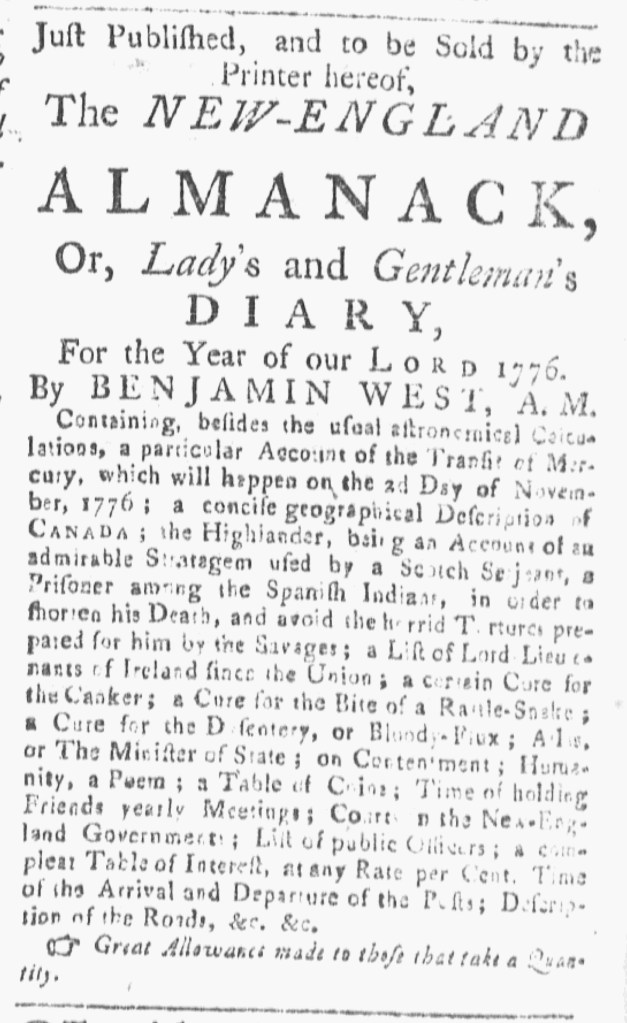
The collaboration between John Carter, the printer of the Providence Gazette, and Benjamin West, an astronomer and mathematician, continued for another year.  An advertisement in the final issue of the Providence Gazette for 1775 alerted readers that the “NEW-ENGLAND ALMANACK, Or, Lady’s and Gentleman’s DIARY, For the Year of our LORD 1776” by Benjamin West was “Just Published, and to be Sold by the Printer hereof.”  At the end of the advertisement, a manicule directed attention to a note that informed shopkeepers and others of a “Great Allowance made to those that take a Quantity.”  In other words, Carter offered steep discounts to retailers who purchased a significant number of copies to sell to their own customers.  That pricing scheme allowed them to turn a profit by setting prices that competed with customers acquiring the almanac at the printing office.

To entice customers of every sort, Carter provided an overview of the contents of the almanac.  In addition to the “usual astronomical Calculations,” it included “a particular Account of the Transit of Mercury, which will happen on the 2d Day of November, 1776.”  Carter stoked anticipation for that event, making it even more appealing by providing those who purchased the almanac detailed information to help them understand it.  The almanac also contained useful reference material, including “a Table of Coins, Time of holding Friends yearly Meetings; Courts in the New-England Government; List of public Officers; a compleat Table of Interest, at any Rate per Cent. Time of the Arrival and Departure of the Posts; [and] Description of the Roads.”  The almanac also served as a medical manual with several remedies, such as “a certain Cure for the Canker, a Cure for the Bite of a Rattle-Snake; [and] a Cure for the Dysentery, or Bloody-Flux.”  In addition to all that, the almanac had items selected to entertain or to educate readers, including a short essay “on Contentment,” “Humanity, a Poem,” and “a concise geographical Description of CANADA.”  That last item may have been of particular interest given the American invasion of Canada in hopes of winning support for the American cause.  Despite capturing Montreal in November, the attack on Quebec City failed in late December.  American forces withdrew.  The “concise geographical Description of CANADA” would not serve the intended purpose once word arrived in New England, though readers could consult it to supplement reports they read in the Providence Gazette and heard from others.  Overall, Carter aimed to convince prospective customers that this almanac has an array of features that merited selecting it for use throughout the new year.
December 17

What was advertised in a colonial American newspaper 250 years ago today?

Providence Gazette (December 17, 1774).

“The NEW-ENGLAND ALMANACK … By BENJAMIN WEST.”

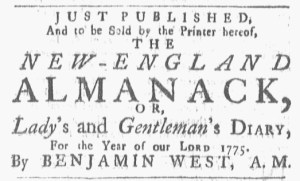
The December 17, 1774, edition of the Providence Gazette carried nearly two dozen advertisements, including one by the printer, John Carter, for “THE NEW-ENGLAND ALMANACK, OR, Lady’s and Gentleman’s DIARY, For the Year of our LORD 1775. By BENJAMIN WEST.”  For a decade, West and the printers of the Providence Gazette had been collaborating on that annual publication, even as proprietorship of the newspaper and the printing office changed hands.  The Adverts 250 Project has documented that partnership, covering West’s almanac perhaps more extensively than any other almanac advertised in early American newspapers.

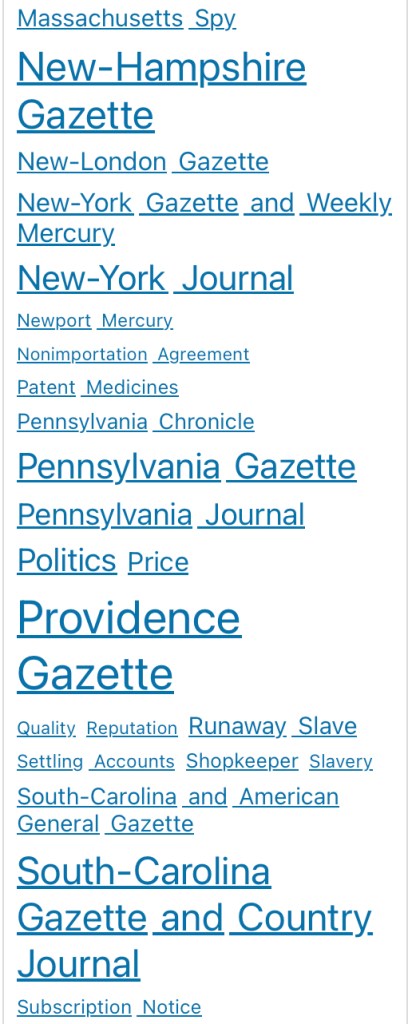
Some of the “most used” tags for the Adverts 250 Project.

That is a result, in part, of the project’s methodology that calls for examining an advertisement published 250 years ago that day.  Accordingly, I select advertisements from approximately two dozen newspapers that have been digitized and made more widely accessible, yet publication of those newspapers did not occur evenly throughout the week.  Throughout most of the nine years that I have produced the Adverts 250 Project, the Providence Gazette was the only newspaper published in Saturdays.  As a result, that newspaper has been disproportionately featured in the project … and the methodology has encouraged me to have a closer look at the annual publication of West’s New-England Almanack than most other almanacs.

The word cloud generated for the “most used tags” by WordPress reflects this.  “Providence Gazette” appears in a larger font and thicker bold than any other newspaper or other tag, even though it was not the most significant newspaper published in the colonies, neither for news coverage nor for advertising innovation.  Similarly, advertisements from the New-Hampshire Gazette have also been featured regularly due to the methodology because for quite some time that was only newspaper published on Fridays that had been digitized.  While the Providence Gazetteand the New-Hampshire Gazette might not be considered as significant as certain other newspapers published during the era of the American Revolution, this project’s methodology has caused me to approach the contents of those newspapers with greater attention and creativity.

These are the newspapers published 250 years ago this week that have been digitized for greater access:

Monday

  • Boston Evening-Post
  • Boston-Gazette
  • Connecticut Courant (Hartford)
  • Dunlap’s Pennsylvania Packet (Philadelphia)
  • Maryland Journal (Baltimore)
  • Massachusetts Gazette and Boston Post-Boy
  • Newport Mercury
  • New-York Gazette and Weekly Mercury
  • South-Carolina Gazette

Tuesday

  • Essex Gazette (Salem)
  • South-Carolina Gazette and Country Journal (Charleston)

Wednesday

  • Essex Journal (Newburyport)
  • Pennsylvania Gazette (Philadelphia)
  • Pennsylvania Journal (Philadelphia)

Thursday

  • Maryland Gazette (Annapolis)
  • Massachusetts Gazette and Boston Weekly News-Letter
  • Massachusetts Spy
  • New-York Journal
  • Norwich Packet
  • Rivington’s New-York Gazetteer
  • Virginia Gazette [Pinkney] (Williamsburg)
  • Virginia Gazette [Purdie and Dixon] (Williamsburg)

Friday

  • Connecticut Gazette (New London)
  • Connecticut Journal (New Haven)
  • New-Hampshire Gazette (Portsmouth)
  • South-Carolina and American General Gazette (Charleston)

Saturday

  • Providence Gazette

October 22

What was advertised in a colonial American newspaper 250 years ago today?

Providence Gazette (October 22, 1774).

“On Wednesday next will be published, and sold by the Printer hereof, WEST’s ALMANACK.”

Although he sometimes ran advertisements on the first page of his newspapers, John Carter, the printer of the Providence Gazette, opted to place all of them at the end of the October 22, 1774, edition.  News filled most of the first three pages, with the final third of the last column on the third page given to advertising and then the entire fourth page as well.  As usual, the news concluded with local updates, including accounts of sheep being sent to the “distressed Towns of Boston and Charlestown” to relieve the residents while the Boston Port Act remained in effect and coverage of the capture of a suspected burglar.

As readers finished with the news, they immediately encountered an advertisement for “WEST’s ALMANACK, For the Year of our Lord 1775” before paid notices submitted by Carter’s customers.  That advertisement announced that the printer would publish and sell the almanac on the following Wednesday, the first mention of Benjamin West’s almanac for the coming year in the Providence Gazette.  The public likely anticipated its publication and marketing since West, an astronomer and mathematician, had been collaborating with the printer of the Providence Gazette for more than a decade.  The partnership began before Carter became the proprietor of the newspaper, passing from printer to printer as the Providence Gazette changed hands.  West initially worked with William Goddard, followed by Sarah Goddard, before Carter ran the printing office.

For his part, Carter often gave advertisements for the works that he printed, whether books or West’s almanac, a privileged place.  Sometimes they appeared as the first item on the first page, while other times he positioned them as the first item following the news.  Either way, he increased the chances that readers would see and take note of advertisements that promoted his own endeavors in the printing office.

December 11

What was advertised in a colonial American newspaper 250 years ago today?

Providence Gazette (December 11, 1773).

“WEST’s ALMANACK for the year 1774.”

For more than a decade, Benjamin West, an astronomer and mathematician, collaborated with the printers of the Providence Gazette in publishing “THE NEW-ENGLAND ALMANACK, OR Lady’s and Gentleman’s DIARY.”  In 1773, John Carter worked with West, but other printers previously entered into partnership with him before Carter became the proprietor of the Providence Gazette.  Advertisements promoting the New-England Almanack became a familiar sight in that newspaper each fall, continuing into the winter.  Some notices provided extensive details about the contents of the new edition for the next year.  A shorter advertisement in the December 11 edition of the Providence Gazette promoted “the usual astronomical Calculations,” “a brief historical Account of the Rise and Settlement of RHODE-ISLAND Government,” and “some Anecdotes of the celebrated Mr. ROGER WILLIAMS, Founder of this Colony” in the almanac for 1774.

Carter sold the almanac in “large or small Quantities.”  Consumers could purchase individual copies for use in their own households, while merchants and shopkeepers could obtain multiple copies to sell in their own stores and shops.  Thurber and Cahoon, for instance, acquired copies to sell in their shop “at the Sign of the Bunch of Grapes.”  They stocked a “great Variety of English and India GOODS” imported via “the last Vessel from London” as well as the almanac produced in their own town.  To entice prospect customers to visit their shop, Thurber and Cahoon listed many of those items, concluding with “WEST’s ALMANACK for the year 1774.”  They had done so the previous year as well.  Apparently, Thurber and Cahoon considered the New-England Almanack such a draw that it would help get customers into their shop, though it may have been Carter, rather than the merchants, who decided that the title should appear in capital letters, thus drawing attention to it over the rest of the merchandise in the advertisement.  Regardless of who made that decision, Carter and West certainly welcomed the assistance in marketing the almanac beyond their own advertisements.

January 30

What was advertised in a colonial American newspaper 250 years ago today?

Providence Gazette (January 30, 1773).

“The NEW-ENGLAND ALMANACK, Or Lady’s and Gentleman’s DIARY, For the Year of our Lord 1773.”

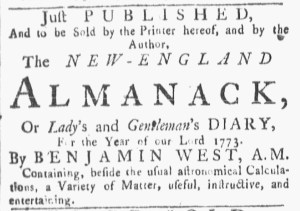
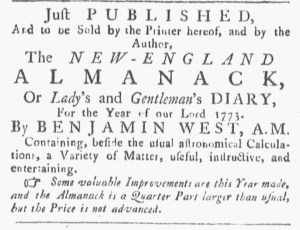
By the end of January 1773, it was a familiar advertisement to readers who regularly perused the Providence Gazette.  John Carter once again promoted the “NEW-ENGLAND ALMANACK, Or Lady’s and Gentleman’s DIARY, For the Year of our Lord 1773,” though it was not “Just PUBLISHED” as the advertisement purported.  Instead, Carter, the printer of both the newspaper and the almanac, sought to sell surplus copies and achieve a better return on his investment.  With each passing day, portions of the almanac, especially the “astronomical Calculations,” became obsolete.

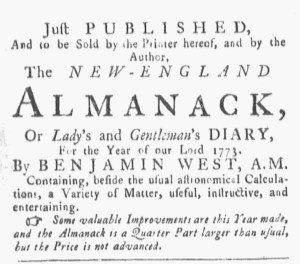
Carter announced the imminent publication of the almanac in the October 24, 1772, edition of the Providence Gazette, treating it as a news item, following immediately after an update about the Gaspee incident, rather than an advertisement.  A week later, the advertisement that ran in late January appeared for the first time (with a brief note about the price staying the same as the previous year despite “valuable Improvements” that made the almanac “a Quarter Part larger than usual”).  Carter gave it a privileged place, first among the advertisements.  A week later, he gave it even more prominence, the first item in the first column on the first page of the November 7 edition.  That made it difficult for readers to miss it.

In subsequent weeks, the advertisement moved around among the paid notices that ran in the Providence Gazette.  When it appeared in the January 30, 1773, edition, Carter once again attempted to direct attention to it via its placement in the first column on the first page.  Only one item appeared before it, a public service announcement about an upcoming meeting “to consider of some Method for erecting and building a Bridge from the Town of Providence (across the Lower Ferry) to the Town of Rehoboth.”  In this instance, Carter did not place his own interest in selling the remaining copies of the almanac ahead of all other items in his newspaper, but he did give it priority by having the announcement about an important public works project flow into his advertisement for the New-England Almanack.

November 7

What was advertised in a colonial American newspaper 250 years ago today?

Providence Gazette (November 7, 1772).

“Just PUBLISHED … The NEW-ENGLAND ALMANACK.”

The advertising campaign for the 1773 edition of the “NEW-ENGLAND ALMANACK, Or Lady’s and Gentleman’s DIARY” continued in the November 7, 1772, edition of the Providence Gazette.  The author, Benjamin West, and the printer, John Carter, both sold copies, as did Thurber and Cahoon at the Bunch of Grapes on Constitution Street.

Marketing efforts in the public prints began two weeks earlier.  Carter, who also happened to be the printer of the Providence Gazette, included an announcement among the news to inform prospective customers that “WEST’s ALMANACK … is now in the Press, and will be speedily published by the Printer hereof.”  He nestled it between an update about the Gaspee incident, the burning of a British customs schooner near Warwick, Rhode Island, in June, and shipping news from the customs house.  Exercising his discretion as printer, Carter treated the impending publication of the almanac as news.  The following week, he placed an advertisement for the almanac first among the advertisements, increasing the chances that readers interested only in news would at least glimpse it even if they did not peruse other advertising.

Carter increased the likelihood that readers would see the advertisement when he moved it to the front page on November 7.  It appeared as the first item in the first column, immediately below the masthead.  Readers could not help but notice it.  Carter usually reserved advertising for the final pages of the Providence Gazette.  Except for his own notice about the almanac, he did so again.  All of the other advertisements in that issue ran on the last two pages.

Printing almanacs was often a very lucrative venture for colonial American printers.  Carter sought to generate as much revenue as possible for the New-England Almanack by placing advertisements in prime places in his newspaper.  The imprint on the title page indicated that Carter sold the almanac “wholesale and retail.”  He intended for his message to reach shopkeepers as well as consumers.  His newspaper notices facilitated distribution to retailers in Providence and the surrounding area as well as individual sales.  Thurber and Cahoon already included “WEST’s ALMANACK” in the list of merchandise available at their store.  Carter likely desired that others would acquire copies to sell at their own locations.

October 31

What was advertised in a colonial American newspaper 250 years ago today?

Providence Gazette (October 31, 1772).

“Just PUBLISHED … The NEW-ENGLAND ALMANACK.”

In advance of having copies of the “The NEW-ENGLAND ALMANACK, Or Lady’s and Gentleman’s DIARY, For the Year of our Lord 1773” available for sale, John Carter, the printer of both the almanac and the Providence Gazette, inserted an announcement among the local news to inform prospective customers that the almanac “is now in the Press, and will be speedily published.”  The following week, he once again exercised his power as printer to give an advertisement for the almanac a privileged place in the newspaper.  It ran first among the advertisements in the October 31, 1772, edition.  Even if readers did not peruse all of the advertisements, they likely noticed the one about the almanac that immediately followed the news.  In subsequent issues, Carter placed the advertisement among the paid notices, but the first time it appeared it occupied a prime place on the page.

Prospective customers would have been familiar with the New-England Almanack, written by West.  The astronomer and mathematician had a decade of experience authoring the almanac and collaborating with the printers of the Providence Gazette in marketing and selling it.  As the newspaper changed hands over the years, the new printers continued publishing both the Providence Gazette and the New-England Almanack, augmenting their revenue by doing so.  For the 1773 edition of the almanac, Carter and West declared that it included “Some valuable Improvements” and “is a Quarter Part larger than usual, but the Price is not advanced.”  For the same price they paid the previous year, customers could acquire an almanac that contained thirty-two pages rather than twenty-four, certainly a bargain.

Providence Gazette (October 31, 1772).

In addition to the notice placed “by the Printer hereof, and by the Author,” the New-England Almanack received attention in another advertisement the first week it was available for sale.  Thurber and Cahoon ran a lengthy advertisement that listed scores of items available at their shop at the Sign of the Bunch of Grapes.  They included “WEST’s ALMANACKS” among the books in the final paragraph.  That item appeared in all capitals, distinguishing it from the rest of the merchandise mentioned in the advertisement.  Did Thurber and Cahoon arrange to have the almanac highlighted in their advertisement in hopes of benefitting from retail sales?  Or did Carter make the intervention in their advertisement, recognizing any sales of the almanac as beneficial to his bottom line?  Either way, the advertisement suggests that Carter and West quickly distributed the almanac to retailers to increase sales.  As soon as it came off the press, consumers could purchase the almanac at several locations in Providence.

December 21

What was advertised in a colonial American newspaper 250 years ago today?

Providence Gazette (December 21, 1771).

“THE NEW-ENGLAND ALMANACK … For the Year of our LORD 1772.”

As the first day of winter arrived and the new year approached, John Carter and Benjamin West continued marketing the almanacs that West wrote and Carter printed.  In the December 21, 1771, edition of the Providence Gazette, they inserted an advertisement that advised prospective customers that they could purchase “THE NEW-ENGLAND ALMANACK, OR Lady’s and Gentleman’s DIARY, For the Year of our LORD 1772” from either the printer of the author.  The contents included “the usual Astronomical Calculations,” undertaken by West, an astronomer, mathematician, and professor at Rhode Island College (now Brown University), as well as “a Variety of Matter, useful, instructive, and entertaining.”  In addition, the printer and the astronomer also sold “West’s SHEET-ALMANACK, For the Year 1772,” giving consumers a choice of formats.  The pamphlet version was more portable, but the broadsheet better for hanging on a wall for easy reference.

Carter and West had been marketing these products for several months.  On September 21, they advised prospective customers that the New-England Almanack would be published just days later.  To generate demand, especially among retailers, they listed prices that included a discount for purchasing a dozen and an even more significant discount for purchasing at least two dozen.  A little over a month later, they advertised the sheet almanac, once again offering a discount for purchasing a dozen.  For a while, they ran separate advertisements for the two formats, but by the end of the year incorporated parts of each advertisement into a single notice.  Perhaps they determined that they had already achieved any additional visibility garnered from multiple advertisements.  Alternately, Carter, who also printed the Providence Gazette, may have streamlined the advertisements to create more space for paid notices, news, and other items in the newspaper.  After several months of promoting the almanacs, Carter and West may have decided that additional advertisements, even though they proclaimed “JUST PUBLISHED,” operated as reminders for most readers, making multiple or elaborate notices ineffective or unnecessary.  Having worked together on publishing almanacs for several years, they very well may have calibrated their advertising with the same attention that West gave to performing the astronomical calculations.

November 2

What was advertised in a colonial American newspaper 250 years ago today?

Providence Gazette (November 2, 1771).

West’s SHEET-ALMANACK, For the Year of our LORD 1772.”

In the fall of 1771, Benjamin West, an astronomer and mathematician, and John Carter, printer of the Providence Gazette, collaborated in producing, marketing, and selling the “NEW-ENGLAND ALMANACK, OR, Lady’s and Gentleman’s DIARY, For the Year of our LORD 1772.”  It was West’s tenth almanac.  Over a decade he worked with a succession of printers of the Providence Gazette, including William Goddard (almanacs for 1763, 1764, and 1765), William Goddard and Sarah Goddard (1766), Sarah Goddard and Company (1767), Sarah Goddard and John Carter (1768), and John Carter (1769, 1770, 1771, and 1772).  West not only provided the “usual Astronomical Calculations” but also assisted in selling copies to both readers and retailers.  Advertisements for the New-England Almanack consistently informed buyers that it was “Sold by the Printer hereof, and by the Author.”

West and Carter also collaborated in developing more than one format to suit the needs of their customers.  In late September, they announced the imminent publication of the standard edition, a pamphlet containing twenty-four pages.  In early November, they marketed an additional product, “West’s SHEET-ALMANACK, For the Year of our LORD 1772.”  Colonists who purchased that broadside as an alternative to the standard edition could post it for easy reference throughout the year.  The broadside cost a little less than the standard edition, four coppers compared to six.  In addition, West and Carter offered discounts for purchasing a quantity.  For the standard edition, buyers paid a lower rate “per single Dozen” and an even lower rate “per Dozen by the Quantity.”  The pricing structure for the broadside edition, however, was less complicated; buyers received a discount “per Dozen” regardless of how many dozens they purchased.

Rather than combine the marketing into a single advertisement, West and Carter promoted the two editions separately.  Doing so may have allowed them to gain greater notice through repetition since the advertisements ran on different pages of the Providence Gazette.  As printer of the newspaper, Carter exercised control over where notices appeared, an advantage not available to other advertisers.  In their efforts to sell the New-England Almanack, West and Carter brought together several strategies, including multiple formats, discounts for retailers and others who bought a quantity, and privileged placement on the page within the newspaper.

September 21

What was advertised in a colonial American newspaper 250 years ago today?

Providence Gazette (September 21, 1771).

“Price Three Shillings per single Dozen, Two Shillings and Sixpence per Dozen by the Quantity.”

As fall arrived in 1771 advertisements for almanacs began appearing in newspapers throughout the colonies.  On September 21, John Carter, the printer of the Providence Gazette, inserted an advertisement that he would publish “THENEW-ENGLAND ALMANACK, OR, Lady’s and Gentleman’s DIARY, For the Year of our LORD 1772” by Benjamin West.  For several years West, an astronomer and mathematician, and Carter collaborated on almanacs, the former as author and the latter as printer.  As always, the newest edition included “a Variety of Matter, useful, instructive, and entertaining” in addition to “the usual Astronomical Calculations.”

Like others who promoted almanacs, Carter and West offered the New-England Almanack wholesale and retail.  Consumers could purchase single copies for “Six Coppers” or six pence from the author or at the printing office.  Shopkeepers, booksellers, peddlers, and others who bought by the dozen, however, received discounts.  Carter and West charged “Three Shillings per single Dozen,” but offered an even better bargain to those who bought in even greater volume.  Those customers paid “TWO SHILLINGS and Sixpence per Dozen by the Quantity.”  In other words, a dozen almanacs cost thirty-six pence (or three pence each), but two dozen almanacs cost thirty pence per dozen (or two and a half pence each).

This pricing structure suggests just how much retailers could mark up prices for almanacs.  Those who bought only a dozen still acquired them for half the retail price that Carter and West charged.  Retailers who purchased two dozen or more could double the price they paid to five pence per almanac and still charge less than Carter and West did for single copies.  The printer and author probably did not worry too much about being undersold by retailers who assumed the risk for finding consumers for the almanacs, preferring the revenues guaranteed in bulk sales.  For their part, some readers may have decided to hold off on purchasing new almanacs for their homes, hoping to get better bargains from local shopkeepers and booksellers.