December 24

What was advertised in a colonial American newspaper 250 years ago today?
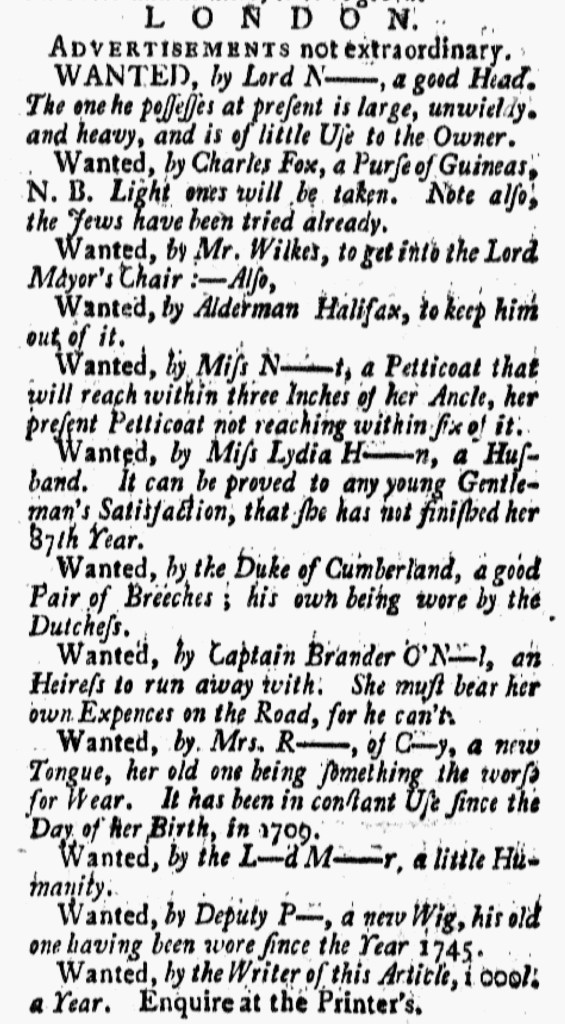
New-Hampshire Gazette (December 24, 1773).

“WANTED, by Lord N—, a good Head.  The one he possesses at present, unwieldy, and heavy, and is of little Use to the Owner.”

Printers, authors, and others sometimes played with advertisements, adapting the format for unintended ends.  In recent weeks, the Adverts 250 Project has examined purported advertisements that delivered opinions about society and politics, made all the more powerful because they initially looked like they had been placed for one purpose but upon closer examination achieved another.  On November 22, 1773, for instance, the Pennsylvania Packet published more than a dozen advertisements submitted by an anonymous correspondent who believed that genre could be better perfected by extending them “to more of the different arts, professions, wants, losses, &c. of mankind.”  Several other newspapers subsequently reprinted the letter from the correspondent and the advertisements.  A few weeks later, the Connecticut Gazette carried a WANTED” advertisement that described an ideal husband.  While several of the advertisements in the piece in the Pennsylvania Packet critiqued women, this notice instead lectured men on how they should treat women.

As a transition between news, much of it about the crisis over tea, and advertising, the December 24, 1773, edition of the New-Hampshire Gazette published “ADVERTISEMENTS not extraordinary,” all of them “wanted” notices supposedly reprinted from newspapers in London.  Like the advertisements in the Pennsylvania Packet, this collection included some that expressed political views and others that provided social commentary.  In this instance, each of them invoked or alluded to the name of a real person, someone prominent enough that readers in England and the colonies would have recognized them.  The first advertisement proclaimed, “WANTED, by Lord N—, a good Head.  The one he possesses at present, unwieldy, and heavy, and is of little Use to the Owner.”  Readers did not need Lord North’s full name to recognize a jab at the prime minister.  Another advertisement stated, “Wanted, by the Duke of Cumberland, a good Pair of Breeches; his own being wore by the Dutchess.”  The writer apparently considered it well known that the duchess did not abide by her expected role but instead ruled her husband.  Yet another scolded a woman who did not demonstrate appropriate decorum in how she dressed.  “Wanted, by Miss N—t,” it declared, “a Petticoat that will reach within three Inches of her Ancle, her present Petticoat not reaching within six of it.”  The litany of advertisements concluded with one placed by the author: “Wanted, by the Writer of this Article, 1000l. a Year.  Enquire at the Printer’s.”  Those final instructions echoed the directions given in so many advertisements.  Printers often served as intermediaries who supplied additional information beyond what appeared in the advertisements published in their newspapers.  These “ADVERTISEMENTS not extraordinary” provided a platform for the anonymous author to become a pundit, each notice making a biting remark about contemporary politics and culture.

November 28

What was advertised in a colonial American newspaper 250 years ago this week?

Pennsylvania Packet (November 22, 1773).

“The following advertisements … may serve as models for some of your correspondents.”

At a glance, they looked like authentic advertisements in the first column on the first page of the Pennsylvania Packet, but on closer examination readers discovered that an anonymous correspondent submitted a series of notices “extended to more of the different arts, professions, wants, losses, &c. of mankind.”  The author explained that he or she had recently read “a little essay upon NEWS-PAPERS” and realized “the public benefit of ADVERTISEMENTS” among “other advantages of these periodical papers.”  While some people engaged in “complaining of [advertisements] being so common in all business,” a testament to the dissemination of broadsides, handbills, trade cards, billheads, and catalogs in addition to newspapers, “S.T.” wished to see advertising applied to other purposes.  To that end, he or she composed nineteen advertisements “as models for some of [the printer’s] correspondents who have more leisure and inclination to pursue this valuable branch of public intelligence.”

Some of those advertisements commented on everyday events or misfortunes familiar to readers.  For instance, one declared, “WAS LOST, A MEMORY.  The person who met with this misfortune has received innumerable benefits which he cannot recollect so as to thank his benefactors for them.”  Readers could have interpreted that notice as bittersweet, but the one above it was certainly more pointed: “WAS LOST, A FRIEND.  He disappeared immediately after asking a favour of him.”

Others mocked or critiqued women.  Playing on both runaway wife advertisements and notices about enslaved people who liberated themselves, the headline for one proclaimed, “MADE THEIR ESCAPE.”  The remainder of the counterfeit advertisement explained, “AN husband’s affections.  They disappeared immediately after seeing his wife with her face and hands unwashed at breakfast.”  Another offered even more strident commentary about the role women were supposed to fill in the household.  “WERE LOST,” it alerted readers, “THE seven last years of a lady’s life.  They were seen frequently in the Play-house—in the stress—an in the Assembly room.”  Rather than tending to her home and family, this imaginary lady frivolously spent her leisure time at the theater and exposed to all sorts of vices on the street as she went from shop to shop and, perhaps worst of all, attempting to usurp the authority of husbands and fathers within and beyond the household by taking an active interest in politics.  Despite such denunciations, the roster of counterfeit advertisements included a lewd “WANTED” notice for “AN house-keeper for a batchelor—She must understand housewifery perfectly well, and be able to turn her hand to any thing.”  Readers could imagine for themselves what “any thing” meant.

Pennsylvania Packet (November 22, 1773).

 The last two advertisements trenchantly commented on the imperial crisis.  Modeled after formulaic runaway wife advertisements, the first one, signed by “LOYALTY,” addressed the public: “WHERAS my wife AMERICAN LIBERTY, hath lately behaved in a very licentious manner, and run me in debt; this is to forwarn all persons from trusting her, as I will pay no debts of her contracting from the date hereof.”  Women who were the subjects of actual runaway wife advertisements only occasionally had the resources to respond.  In contrast, “AMERICAN LIBERTY” published an even longer rebuttal than the allegations made in the first advertisement.  “WHEREAS my husband Loyalty hath, in a late advertisement, forwarned all persons form trusting me on his account,” the aggrieved American Liberty asserted, “this is to inform the public that he derived all his fortune from me; and that by our marriage articles, he has no right to proscribe me from the use of it.—My reason for leaving him was because he behaved in an arbitrary and cruel manner, and suffered his domestic servants, grooms, foxhunters, &c. to direct and insult me.”  Astute readers recognized the allegory and the parallels to the charges that colonizers made against Great Britain as Parliament attempted to take a more active role in regulating commerce throughout the empire.  Anticipating arguments that Thomas Paine would advance in Common Sense, American Liberty claimed that Loyalty (Great Britain) needed American Liberty (the colonies) more than American Liberty (the colonies) needed Loyalty (Great Britain).  The colonies represented the most significant of the empire’s (the marriage’s) “fortune.”  Furthermore, through charters and other practices, a long history of “marriage articles” gave colonies the right to oversee their own affairs.

These counterfeit advertisements ran in columns next to advertisements promoting “HAMILTON AND LEIPER, TOBACCONISTS,” “FRANCIS, DANCING MASTER,” “KEYER’s FAMOUS PILLS,” and “JAMES LOUGHEAD’s VENDUE” or Auction.  Other advertisements included one from Frederick Weaker instructing the public not to extend credit to his wife because she “eloped from him without any just cause” and another in which Samuel Finch described “a negro man called JACK” and offered a reward for his capture and return to enslavement.  The models proposed by the anonymous correspondence took formats quite familiar to readers of the Pennsylvania Packet and other newspapers, demonstrating that advertising was so widespread and many of its conventions so broadly recognized that colonizers could adapt advertising to deliver satirical and political messages about everyday life and current events.

February 15

What was advertised in a colonial American newspaper 250 years ago today?

Georgia Gazette (February 15, 1769).

“Proposed to be published.”

As usual, advertising comprised the final page of the February 15, 1769, edition of the Georgia Gazette. Yet the layout of the rest of that issue differed significantly from the standard order of news followed by advertising. Instead, advertisements appeared on every page, distributed throughout the issue alongside news items.

For instance, the front page was divided evenly between news and advertising. News filled the column on the left and three advertisements filled the column on the right. The first of those advertisements, a subscription notice for “THE ROYAL MERCHANT: A WEDDING SERMON” by Johannes Scriblerius, however, appears to have been a satire rather than a legitimate advertisement. Signed by “The EDITOR,” who otherwise remained unnamed, it advised “Those who chuse to have copies of the Royal Merchant are desired to send in their names to the printer of this paper as soon as possible.” It did not otherwise provide any information concerning a plan of publication commonly incorporated into most subscription notices. Whether inserted by the printer or another colonist, this playful piece masquerading as an advertisement served as a bridge between news and paid notices.

Advertising continued immediately on the second page, filling the entire column on the left and overflowing into the column on the right. News from Savannah, including the shipping news from the custom house, often the final item inserted before advertisements, filled most of the remainder of the column, though two short advertisements did appear at the bottom. More advertisements ran at the top of the column on the left on the third page, but filled only a portion of it. News items reprinted from newspapers from Boston and London accounted for the rest of the content on the page. Advertising filled the final page, not unlike most issues of the Georgia Gazette.

Not including the satirical “advertisement” on the front page, advertising accounted for more than half of the content of the February 15 edition, significantly more than usual for the Georgia Gazette. Perhaps the abundance of paid notices prompted James Johnston, the printer, to think creatively about the layout for the issue, though he would have certainly noticed that other colonial newspapers that he received from counterparts in other cities experimented with the placement of paid notices in relation to other content. Those that did so tended to have more advertising than would fit on the final page. Though they made exceptions on occasion, it appears that colonial printers adopted a general rule when it came to the layout of their newspapers. Reserve the final page for advertising and only distribute paid notices to other parts of an issue if they would not all fit on that last page.

December 9

What was advertised in a colonial American newspaper 250 years ago today?

New-London Gazette (December 9, 1768).

“[B]OSTON Nov. 20. An Advertisement.”

The December 9, 1768, edition of the New-London Gazette included an advertisement reprinted from one of the Boston newspapers. Or did it? In their effort to acquire sufficient content to fill the pages of newspapers, colonial printers liberally reprinted news and other content that previously appeared in other newspapers. This usually did not include advertisements. After all, printers expected to be paid to insert those in their newspapers. Yet sometimes printers considered an advertisement so entertaining that they reprinted them as novelties to amuse their readers.

At a glance, that appears to have been the case with “An Advertisement” for a concert in Boston. It featured an awkward poem, one even more poorly constructed than most rhymes used to promote consumer goods and services in eighteenth-century advertisements. In the New-London Gazette, it appeared immediately after news (including news from Boston) and before an assortment of paid notices, acting as a transition between the two types of content. The advertisement carried a dateline that attributed it to an unnamed newspaper published in “[B]OSTON Nov. 20.” That date, however, was impossible. November 20, 1768, was a Sunday. No printers anywhere in the colonies published newspapers on Sundays. The date was not merely an error. The “Advertisement” had not appeared in any of the newspapers printed in Boston in the past month. The missing “B” in “[B]OSTON” may have been a wink and a nod to readers of the New-London Gazette that the purported advertisement was actually a piece with another purpose, some sort of political or satirical commentary on current events.

What was its purpose? That may have been readily apparent to readers in 1768, but it has not remained clear with the passage of time. Colonial newspapers are peppered with quips considered humorous at the time that do not translate well for subsequent generations. The opening line of this “Advertisement” invited “all Ladies who paint” to attend a concert and a ball. “Ladies who paint” may have referred to those of such status that they could spend leisure time learning arts like painting, but it may have also been a jibe at women perceived to be promiscuous because they wore cosmetics. It very well could have been a conflation of the two. The invitation to a concert by “various Masters of some sort” followed by a dancing at a ball suggested close interactions with the opposite sex, as did the ambiguous suggestion that “they may retire to their Bed, or their Fire” at the end of the evening.

The advertisement never specified where concert or ball would take place or the exact time, but it did direct those interested to acquire “your Tickets near Liberty Tree.” Did that reference inject politics into the poem? Or did it merely reference a well-known Boston landmark that could complete the final rhyme. The final two lines stated that “In Lawful or Sterling, it heeds not a Farthing, / If you give a JOAN, as a Fee.” What did the author mean by that last reference? Except for the first word of the poem, which was capitalized by convention, only the words “JOAN” and “CHASE” appeared in all capitals, suggesting that readers were to take note of them. Did the “Advertisement” name an individual? Did it imply that “all Ladies who paint” should instead “CHASE JOAN?” Did it make some other sort of quip?

The Oxford English Dictionary includes two definitions for “joan,” both in use at the time the poem was written: “a generic name for a female rustic” and the “name for a close-fitting cap worn by women in the latter half of the 18th century.” Perhaps “JOAN” meant a cap of liberty, an increasingly popular symbol as the imperial crisis continued. (The same day this “Advertisement” appeared in the New-London Gazette an advertisement for an almanac on the front page of the New-Hampshire Gazette proclaimed that it included “eight curious Plates,” but described the one that depicted the “celebrated Patron of Liberty JOHN WILKES” with a “Cupid, with the Cap of LIBERTY.”) Perhaps the poem that masqueraded as an advertisement was meant to offer instruction to the women of Boston and elsewhere that they should concern themselves less with overcoming their anxieties that they were rustics who needed to resort to painting, music, and dance to secure their status and instead concern themselves with activities that advanced the cause of liberty for the colonies.

Either the printer or someone else went to some trouble to make a point to the readers of the New-London Gazette, especially the female readers. The poem in the counterfeit advertisement may have merely made some sort of jest, but it also could have delivered trenchant political or social commentary that readers would not have missed.