October 27

What was advertised in a colonial American newspaper 250 years ago today?

Pennsylvania Journal (October 27, 1773).

“As he is determined to quit Trade and settle his Affairs, he will sell off all his remaining Goods at public Sale.”

Randle Mitchell advertised a “going out of business” sale in the fall of 1773.  He announced that he “is determined to quit Trade and settle his Affairs” and “is now selling off his stock of European and India GOODS, Imported in the last Vessels from London and Bristol.”  The merchant outlined the terms of the sale in an advertisement that ran in the Pennsylvania Journal for several weeks in October.

Mitchell ran the advertisement in advance of commencing the sale, hoping to build both anticipation and competition among wholesalers and retailers interested in acquiring his wares.  The sale would start on November 1, but interested parties could examine the merchandise at Mitchell’s store on Water Street “three days before the sale.”  He pledged that “the Good [will be] arranged in order for any person to view them.”  In addition, he distributed “Hand bills with the particulars of the goods … thro’ the city and country, a week before the sale.”  Mitchell did not rely on newspapers notices as the only means of advertising his “going out of business” sale.  Though none of those handbills survive, Mitchell’s reference to them suggests that colonizers encountered more advertisements in various formats than have been preserved in research libraries, historical societies, and private collections.

To entice prospective buyers, Mitchell declared that he “will sell off in the Packages to any Merchant or Shopkeeper at prime cost or the usual credit.”  He offered more generous terms to those who bought in greater volume, setting “Six Months Credit” for “All Persons purchasing above Fifty Pounds value.”  Those purchasing “only £20 value and under £50” received just three months credit, while smaller purchases had to be paid in cash at the time of sale.  Furthermore, anyone eligible for six months credit who instead chose to pay case “may have a discount of Five per cent.”  Those who qualified for three months credit, in turn, received “a discount of Two and a half per cent” for paying cash.  Mitchell considered these terms “so very convenient, and advantageous to the Purchasers, that they must see their Interest in purchasing at the Sale.”

Although Mitchell did not use the term “going out of business” to describe his sale, that was the kind of event that he sponsored at his store.  With newspaper advertisements and handbills distributed far and wide, he attempted to create a buzz of anticipation for the bargains soon available to merchants and shopkeepers interested in buying in volume.  To inspire them to imagine how they could manage such purchases, Mitchell explained the discounts and credit available.  In the process, he devised a structure that encouraged larger purchases in his efforts to liquidate his inventory.  Mitchell did not merely announce that he was going out of the business.  He made his decision “to quit Trade” an event that demanded the attention of merchants and shopkeepers in and near Philadelphia.
September 30

What was advertised in a colonial American newspaper 250 years ago today?

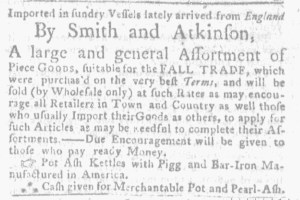
Supplement to the Massachusetts Gazette and Boston Weekly News-Letter (September 30, 1773).

“At such Rates as may encourage all Retailers in Town and Country … to complete their Assortments.”

Smith and Atkinson encouraged shopkeepers in and near Boston to augment their inventories for the fall season.  In an advertisement that appeared in several newspapers in September 1773, the merchants announced that they carried a “large and general Assortment of Piece GOODS, suitable for the FALL TRADE” that they “Imported in sundry Vessels lately arrived from England.”  These were not leftovers from last year, Smith and Atkinson suggested, but instead new merchandise to enhance the offerings of “all Retailers in Town and Country.”  Those prospective customers needed such items “to complete their Assortments” and attract the attention of consumers.  They knew that shopkeepers emphasized providing choices for consumers in their own advertisements.

For their part, Smith and Atkinson did not deal with shoppers directly.  The merchants confined their business to wholesale purchases only, supplying shopkeepers with goods at advantageous prices.  Smith and Atkinson proclaimed that they acquired their shipments “on the very best Terms” and planned to pass along the bargains “at such Rates as may encourage” shopkeepers to do business with them rather than their competitors.  As further inducement, the merchants declared that they gave “Due Encouragement … to those who pay ready Money.”  In other words, cash purchases qualified for additional discounts.

Smith and Atkinson competed with other merchants who made similar appeals while also attempting to distinguish themselves in the marketplace.  In the September 30, 1773, edition of the Massachusetts Gazette and Boston Weekly News-Letter, James and Patrick McMasters and Company similarly advertised a “large and general Assortment of English, India, and Scotch GOODS, suitable for the Season” that they “imported in the last Ships from LONDON.”  While they did not specify that they sold “by Wholesale only” like Smith and Atkinson, McMasters and Company did assert that “Town and Country Merchants and others who are pleased to favour them with their Custom, may depend on the best Usage, and handsome Allowance to those who buy by the Quantity.”  They offered discounts for purchasing in volume rather than discounts for cash.  Some retailers may have found that marketing strategy more appealing.

In another advertisement, Amorys, Taylor, and Rogers declared that they sold a “general Assortment of GOODS Suited to the Season … at the lowest Rates, by Wholesale or Retail.”  Other merchants inserted advertisements with their own variations in their efforts to move their merchandise.  They did not expect that they could merely announce that they had goods for sale and then expect retailers to purchase them.  Instead, merchants devised marketing strategies to entice shopkeepers to acquire merchandise from them.  In turn, shopkeepers crafted strategies for inciting demand among consumers rather than relying on incipient demand.

September 23

What was advertised in a colonial American newspaper 250 years ago today?

Massachusetts Gazette and Boston Weekly Mercury (September 23, 1773).

“Those who may defer purchasing any of the above GOODS in Expectation of their being put up at Public Auction will be disappointed.”

Ward Nicholas Boylston planned to leave the colonies in the fall of 1773.  Before his departure, he attempted to the liquidate the merchandise at his store on King Street in Boston.  His advertisement in September 23 edition of the Massachusetts Gazette and Boston Weekly News-Letter incorporated several strategies to entice customers to purchase his wares.

The notice commenced with a headline: “At first Cost, for Cash only.”  Like an advertisement that Boylston ran in February, a decorative border enclosed the headline to draw attention to it.  The merchant offered the best prices available, even the prices he paid to acquire his inventory.  Earning profits on the goods mattered less than getting them out of his store, but taking advantage of those bargains required paying in cash.  With his departure quickly approaching, Boylston was not in a position to extend credit.  That also explains why the merchant “repeatedly desires all Persons who have any Demands against him to bring in their Accounts & receive their Ballances, & those who are indebted to him to make immediate Payment.”  Boylston did not want any leftovers in his ledgers when he departed.

He also trumpeted that he provided “an Abatement to those who take large Quantities.”  Merchants who planned to wholesale the goods as well as retailers in town and country looking to supplement their inventories would receive discounts for purchasing in volume.  Boylston cautioned that these deals were the best that buyers should anticipate, warning that “[t]hose who may defer purchasing any of the above GOODS in Expectation of their being put up at Public Auction will be disappointed.”  He declared that “what may remain unsold when he leaves the Country … will be disposed of another Way,” but did not give details.  Once again, this advertisement echoed one that Boylston placed in February.  He addressed “[t]hose who have witheld buying hitherto, on a dependence that the above Goods will be finally exposed to Public Sale” and acknowledged that purchasing at auction often resulted in “better Pennyworths” or bargains. That would not be the case in this instance, the merchant promised, because he would dispose of unsold merchandise “otherwise than at Auction.”  The current sale, “The last Chance” promised in the headline, was “the present and last Opportunity” for the best deals possible for purchasing Boylston’s goods.

With only “Fifteen or Twenty Days” remaining before Boylston left town, those who previously did business with him and those who considered doing business with him had a limited time to settle accounts and to buy an “Assortment of English and India Goods … at the neat Sterling Cost, free of any Charges,” from the merchant.  Realizing that some prospective customers might attempt to wait him out in hopes of purchasing his wares at auction for even lower prices than “the first Cost” and discounts for volume that he already offered, Boylston cautioned them, as he had a habit of doing, not to depend on that strategy because he had other plans for disposing of his merchandise.

March 3

What was advertised in a colonial American newspaper 250 years ago today?

Pennsylvania Journal (March 3, 1773).

“ALL kinds of ribbons, which he will sell for cash at 65 per cent, on sterling cost.”

David Shakespear marketed “ALL kinds of ribbons” and “sundry other dry Goods, hardware, jewellery,” and other merchandise in advertisements that ran in the Pennsylvania Journal in February and March 1773.  He did not, however, invite consumers to browse his wares and make purchases.  Instead, he made clear that he restricted his commercial activities to wholesale transactions.  He addressed “City and Country Shopkeepers” in his notice.

In promoting his selection of ribbons, an especially popular accessory for enhancing garments, millinery, and women’s elaborate hairstyles, Shakespear informed prospective buyers that he “will sell for cash at 65 per cent, on sterling cost.”  He apparently believed that such transparency would entice “City and Country Shopkeepers” to do business with him, provided that they had the cash to take advantage of the bargain prices he charged.  Given the discount, it made sense that Shakespear wished to sell by volume to retailers rather than deal directly with consumers who made smaller purchases.

He outlined his business model, stating that he “purposes to continue importing to sell by wholesale only” and “hopes that the small advance put on [his wares], will recommend him to the custom of the City and Country Shopkeepers.”  Shakespear envisioned distributing his inventory throughout Philadelphia, a bustling urban port and the largest city in the colonies, and towns in Pennsylvania, Delaware, New Jersey, and Maryland.  He provided an alternative to doing business with English merchants in London, positioning himself as a middleman who offered deals that allowed retailers who made wholesale purchases from him to pass along the savings to their own customers.

Although Shakespear mentioned the discount only in relation to ribbons, he may have anticipated that prospective customers would associate bargain rates with his other merchandise.  Even if those deals for dry goods, hardware, and other items were not as generous as his prices for ribbons, some of those “City and Country Shopkeepers” may have anticipated that they could negotiate with Shakespear for favorable prices.  His advertisement signaled that he was open to such overtures.

September 20

What was advertised in a colonial American newspaper 250 years ago today?

South-Carolina Gazette (September 20, 1770).

“Such Articles as the Resolutions of the Inhabitants of this Province will admit of.”

As summer turned to fall in 1770, Brian Cape advertised “a tolerable Assortment of Goods” for sale in the South-Carolina Gazette.  This unusual description, “a tolerable Assortment,” had at least two meanings.  Like their counterparts in Boston, New York, and Philadelphia, the merchants of South Carolina enacted nonimportation agreements to protest duties imposed on certain imported goods by the Townshend Acts.  Cape assured prospective customers that he carried “such Articles as the Resolutions of the Inhabitants of this Province will admit of.”  In that sense, his merchandise was “tolerable” according to the standards adopted by the community.  It was also “tolerable” in the sense that it was as extensive as could be expected under the circumstances.  Consumers grew accustomed to vast arrays of choices in the eighteenth century.  Nonimportation agreements constrained those choices, but Cape suggested that the ability and pick and choose had not been eliminated at his shop.

He also vowed that prospective customers would not encounter exorbitant prices for his “tolerable Assortment of Goods” as the result of scarcity caused by the nonimportation agreement.  Indeed, scarcity may have been a relative term since many merchants and shopkeepers seized the opportunity to sell inventory that had lingered on their shelves and in their storerooms.  Cape asserted that he sold his wares “at moderate Prices” that were fair to consumers.  He also included a nota bene that offered a special bargain: “Ten per Cent will be discounted for ready Money.”  In other words, he rewarded customers who paid in cash rather than credit with significant savings.  Credit was one of the primary features that made the consumer revolution possible in the eighteenth century, yet it could be tricky to manage.  Merchants and shopkeepers frequently placed advertisements calling on customers to settle accounts or face legal action.  Cape presented an opportunity to avoid future troubles by paying with “ready Money” from the start.

Compared to modern marketing campaigns, eighteenth-century advertisements have sometimes been dismissed for being so straightforward as to be merely announcements of goods for sale.  That approach underestimates the appeals that advertisers worked into their notices in their attempts to entice customers to visit their shops.  Cape addressed both price and politics in his advertisement in 1770, incorporating issues that resonated with consumers at the time.

November 16

What was advertised in a colonial American newspaper 250 years ago today?

Nov 16 - 11:16:1769 South-Carolina Gazette
South-Carolina Gazette (November 16, 1769).

“He will sell at the lowest Advance, and allow ten per Cent. discount for CASH.”

In the late 1760s James Courtonne operated a jewelry shop on Broad Street in Charleston. In an advertisement in the November 16, 1769, edition of the South-Carolina Gazette, he promoted a variety of his wares, including an “Assortment of Sterling PLATE and JEWELS, of the newest Fashions, most elegantly finished,” “Silver and double gilt Swords,” and “a great Variety of MARCASITE and COQUE-DE-PEARL Ear-Rings.” In addition to selling these imported items, the jeweler also offered several services, noting that the “continues to make and mend Diamond and mourning Rings, and Ear-Rings and Lockets enamelled in the neatest Manner.”

Not surprisingly, Courtonne advanced an appeal to fashion when describing his wares, yet that was not his only means of marketing his jewelry and the array of silver coffeepots, spoons, and spurs available at his shop. He also lowered his prices under circumstances, proclaiming that he would “allow ten per Cent. discount for CASH.” He would allow credit for these purchases, but he saw a definite advantage to dealing in cash. In turn, he sought to make paying in cash attractive to prospective customers as well.

Credit helped fuel the consumer revolution of the eighteenth century. Merchants and shopkeepers extended credit to consumers while also drawing on transatlantic networks of credit that connected them to merchants, producers, and suppliers in Britain and other places. This system depended on trust and the ability to make savvy decisions. It was risky. Merchants, shopkeepers, and others frequently placed newspaper advertisements calling on customers who made purchases on credit to settle their accounts or face legal action, sometimes in the same advertisements that they marketed their wares to other prospective customers.

Rather than make threats, Courtonne offered an incentive for prospective customers to pay in cash at the time of purchase. Everyone benefitted. Customers paid less. The jeweler received payment in a timely manner. In addition, Courtonne and those clients cultivated relationships with each other that did not have the specter of credit looming over them.