September 23

What was advertised in a colonial American newspaper 250 years ago today?
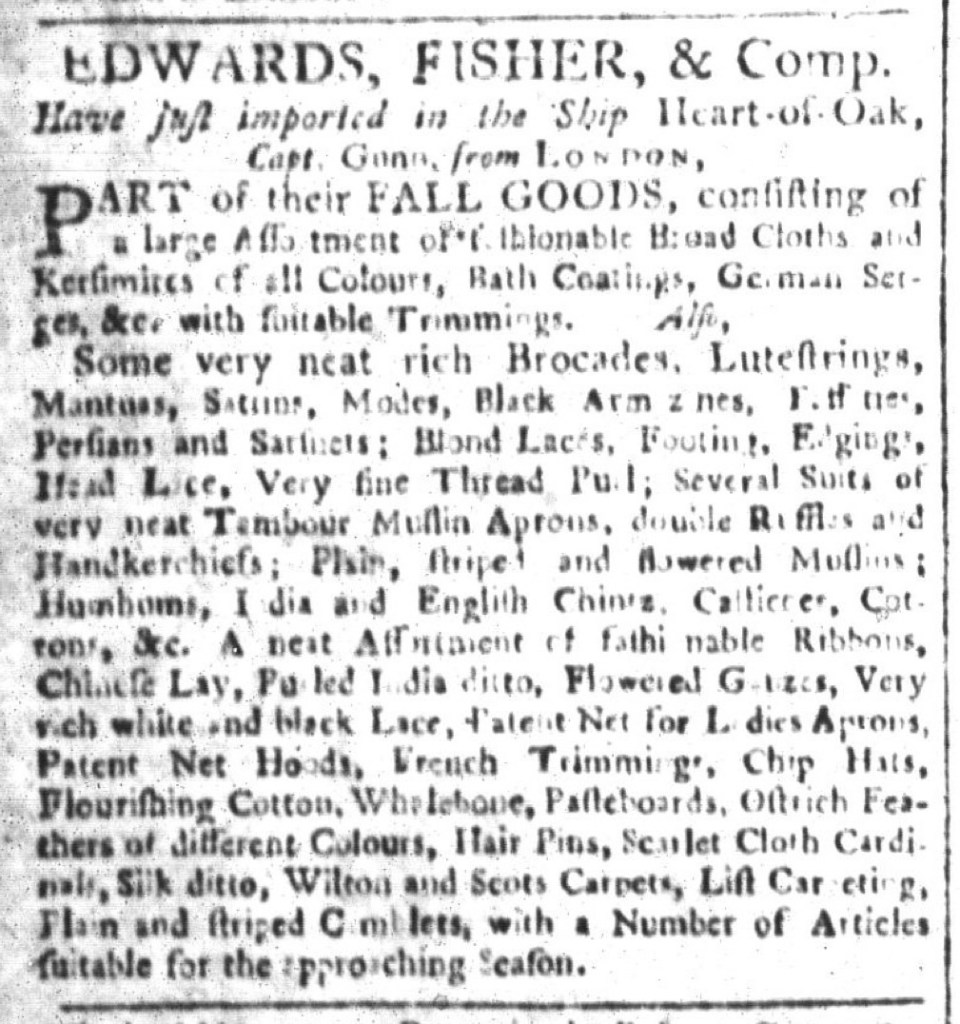
South-Carolina and American General Gazette (September 23, 1774).

“Just imported … from LONDON, PART of their FALL GOODS.”

Like many other merchants and shopkeepers, Edwards, Fisher, and Company in Charleston updated their merchandise with the changing of the seasons.  With the arrival of fall in 1774, they ran advertisements in the South-Carolina and American General Gazette, the South-Carolina Gazette, and the South-Carolina Gazette and Country Journal to announce that they had “just imported” a “large Assortment” of textiles and other items.  This new inventory accounted for “PART of their FALL GOODS,” suggesting that they would continue to supplement their wares as ships arrived from London.

Edwards, Fisher, and Company may have believed that they had a narrow window of opportunity to import and sell these goods.  Earlier in the month, a competitor acknowledged that “a Non-importation Agreement will undoubtedly soon take Place here,” encouraging consumers (“Ladies” in particular) to shop while they had the chance.  The First Continental Congress had recently convened in Philadelphia to discuss coordinated measures in response to the Coercive Acts.  Their deliberations would result in the Continental Association, a nonimportation, nonconsumption, and nonexportation agreement set to go into effect on December 1.  In late September, merchants, shopkeepers, and consumers in Charleston and other American cities and towns did not yet know exactly which measures the First Continental Congress would adopt, but they reasonably anticipated that importing and purchasing goods would be constrained in the coming months.

That gave Edwards, Fisher, and Company an opportunity to sell the “Number of Articles suitable for the approaching Season” that had already arrived as “PART of their FALL GOODS.”  They probably kept their fingers crossed that other shipments would arrive from London before news of a nonimportation agreement arrived from Philadelphia.  They sought to entice prospective customers with an extensive list of their wares, describing them as “fashionable” more than once.  What consumers would consider fashionable, however, evolved when nonimportation agreements went into effect.  Homespun textiles produced in the colonies rather than “very neat rich Brocades” and other imported fabrics became fashionable because of the political principles they communicated.  Edwards, Fisher, and Company would have to content with that another day; for the moment, they could continue following familiar strategies for marketing imported textiles and other goods.

February 7

What was advertised in a colonial American newspaper 250 years ago this week?

South-Carolina Gazette (February 4, 1773).

“As complete Assortment as any ever imported into this Province.”

Consumers would not find a larger selection of merchandise anywhere else in the colony.  That was the promise made by Edwards, Fisher, and Company in an advertisement in the February 4, 1773, edition of the South-Carolina Gazette.  The partners reported that they “just imported” a variety of wares in the Fair American from Liverpool as well as “the late Vessels from LONDON,” achieving “as complete [an] Assortment as any ever imported into this Province.”  To demonstrate the point, Edwards, Fisher, and Company deployed dual deadlines, each in larger font than the rest of the advertisement, declaring that they stocked “A VERY LARGE AND COMPLETE ASSORTMENT of GOODS, Suitable for the present Season” and “A LARGE ASSORTMENT OF Ironmongery, Cutlery, Tin-Ware, &c.”  That abbreviation for et cetera alerted readers to even more items.

Lists of goods, short catalogs, followed each of the headlines.  Among the merchandise “Suitable for the present Season,” the merchants carried a “large Quantity of Ladies Calamanco Shoes and Pumps,” “Fashionable Beaver Hatts,” “Mens, Womens, Boys, and Girls Worsted Hose,” “Fashionable Broad Cloths,” a “large Quantity of exceeding good white Plains,” and a variety of other textiles in many different colors and patterns.  Their selection of ironmongery, cutlery, and housewares included everything from “Very neat Parrot Cages” to “Complete Setts of Table China” to “long and short Pipes.”  In some instances, the merchants referred to the packaging materials to suggest the volume of dishes and other ceramics they imported, such as “Crates of yellow Ware” and “Hogsheads [or large barrels] of assorted Delf Ware.”  They offered a tantalizing description of a “large Quantity of Queens Ware,” proclaiming that it included “one Sett of Desert, exceeding elegant, and is the First of the Kind ever imported into this Province.”  Their merchandise was not merely more of the same kinds of items that shoppers could find in other stores and warehouses in Charleston.

Edwards, Fisher, and Company did not publish the longest advertisement for imported consumer goods in that edition of the South-Carolina Gazette.  Others, including John Wilson and a merchant who went by Wakefield, inserted announcements as long or longer.  Wakefield divided his notice into even more categories, while Wilson listed hundreds of items available at his store.  Yet Edwards, Fisher, and Company made a bid for offering the largest selection in their efforts to draw prospective customers to their shop to browse and buy.