September 29

What was advertised in a colonial American newspaper 250 years ago today?
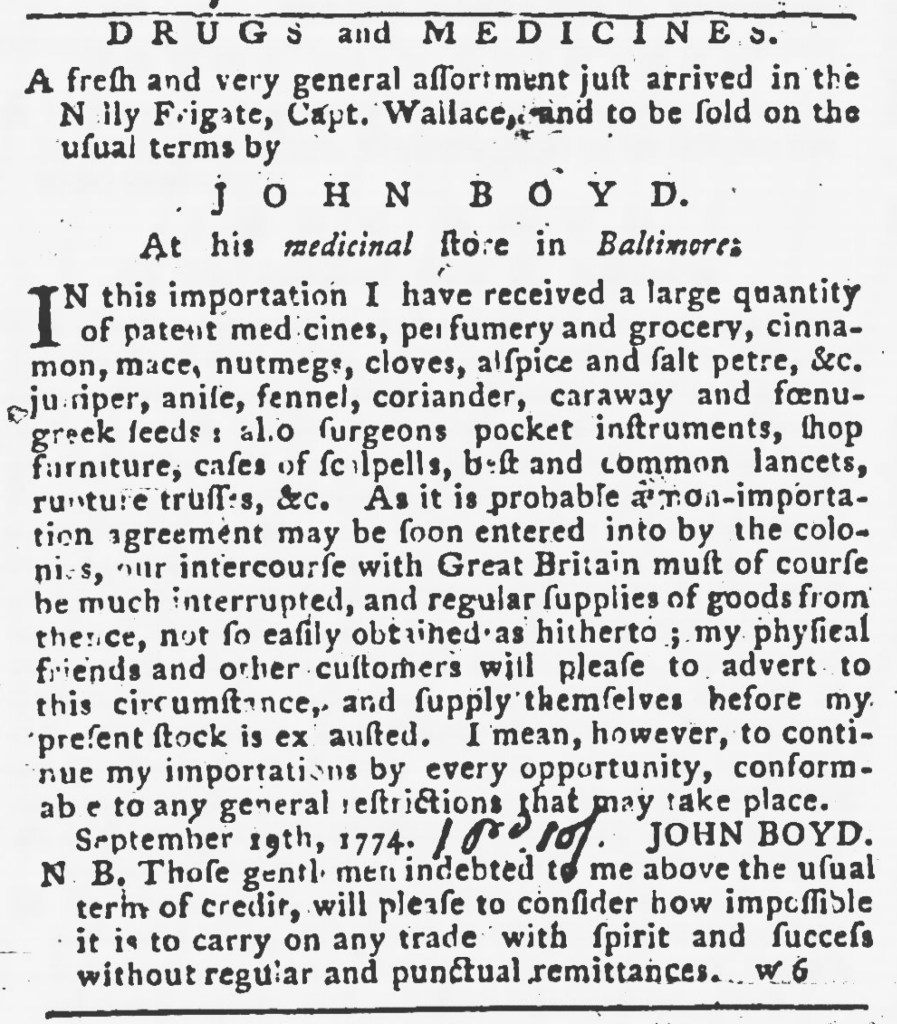
Maryland Gazette (September 29, 1774).

“It is probable a non-importation agreement may be soon entered into by the colonies.”

In the fall of 1774, John Boyd advertised the “DRUGS and MEDICINES” available at “his medicinal store in Baltimore” in both the Maryland Gazette, published in Annapolis, and the Maryland Journal, published in Baltimore.  The latter was still so new that the apothecary realized many of his prospective customers still relied on the former as their local newspaper.  He reported that he just imported a “fresh and very general assortment” of patent medicines, “perfumery and grocery” items, spices, and medical equipment.

Boyd also leveraged current events in hopes of moving his merchandise.  At that moment, the First Continental Congress was meeting in Philadelphia, deliberating over responses to the Coercive Acts passed after the Boston Tea Party.  He reminded readers that “it is probable a non-importation agreement may be soon entered into by the colonies” and when that happened “our intercourse with Great Britain must of course be much interrupted, and regular supplies of goods from thence, not so easily obtained as hitherto.”  That being the case, he advised doctors, his “physical friends,” and his other customers to “supply themselves before my present stock is exhausted.”  In other words, they needed to make purchases while the items they needed or wanted were still available.  A boycott would result in scarcity and, eventually, empty shelves, storerooms, and warehouses.  Boyd was not the only entrepreneur making that argument.  In Charleston, Samuel Gordon recommended to “the Ladies” that they needed to buy his textiles, accessories, and housewares while supplies lasted because “a Non-importation Agreement will undoubtedly take Place here.”  Boyd’s advertisement made clear that it was not solely “the Ladies” who needed to worry about politics causing disruptions in the marketplace.

He vowed to do what he could to limit the effects, stating that he would “continue my importations by every opportunity,” though he carefully clarified that he would do so “conformable to any general restrictions that may take place.”  He would continue accepting shipments for as long as possible, replenishing his stock to ward off scarcity, yet there would come a time that he would have to yield to whatever agreement colonizers adopted.  His advertisement preemptively suggested to prospective customers that they should check with him when they discovered that other apothecaries no longer stocked their usual wares.  Colonizers had experienced nonimportation twice in the past decade, first in response to the Stamp Act and later in response to the duties on certain imported goods in the Townshend Acts.  Savvy entrepreneurs like Boyd reminded them how to prepare for what looked to be inevitable disruptions.
September 2

What was advertised in a colonial American newspaper 250 years ago today?

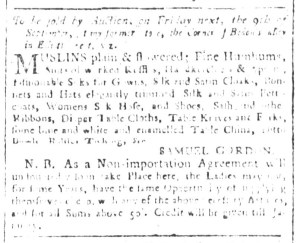
South-Carolina and American General Gazette (September 2, 1774).

“A Non-importation Agreement will undoubtedly soon take Place here.”

A week in advance of an auction to be held on September 9, 1774, Samuel Gordon took to the pages of the South-Carolina and American General Gazette to promote the various items up for bids.  The sale would include “MUSLINS plain & flowered; Fine Humhums, … fashionable Silks for Gowns, Silk and Satin Cloaks, Bonnets and Hats elegantly trimmed, Silk and Satin Petticoats, Womens Silk Hose, and Shoes, [and] Sash and other Ribbons.”  In addition, Gordon listed “Table Cloths, Table Knives and Fork, [and] some blue and white and enamelled Table China.”  He concluded with “&c.” (an abbreviation for et cetera) to indicate that consumers could acquire a variety of other wares at the auction.

Gordon appended a nota bene to his notice: “As a Non-importation Agreement will undoubtedly soon take Place here, the Ladies may not, for some Years, have the same Opportunity of supplying themselves cheap, with any of the above necessary Articles.”  The auctioneer referred to measures under consideration in response to the Boston Port Act, the Massachusetts Government Act, and the other Coercive Acts passed by Parliament in retaliation for the Boston Tea Party.  Throughout the colonies, patriots came to the defense of Massachusetts, rallying to determine common measures to address infringements on their liberty and rights as English subjects.  At the moment that Gordon published his advertisement, delegates were already arriving in Philadelphia for what would become known as the First Continental Congress.  Their deliberations would result indeed result in the Continental Association, a trade boycott intended as political leverage.  Colonizers had previously adopted similar nonimportation agreements in response to the Stamp Act and the duties on certain goods levied in the Townshend Acts.

Gordon encouraged readers to draw on their memories of the conditions during those boycotts or imagine what would likely happen when another nonimportation agreement went into effect.  He stoked fear and anxiety that goods would become scarce and, as a result, much more expensive.  Colonizers needed to acquire textiles and housewares while they were available and while they were affordable.  To facilitate that, he offered credit until January for purchases that exceeded fifty pounds.  That suggests that even though he addressed “Ladies,” the colonizers so often accused of the vice of luxuriating in consumption in newspaper editorials of the era, that he actually anticipated that it would be merchants and retailers, most of them men, who would make bids and purchase this merchandise with the intention of selling it once again.  Still, readers considered Gordon’s warning as they perused the many other advertisements for imported goods in the newspaper.  The auctioneer committed to print what many colonizers were likely thinking about their prospects for purchasing goods in the coming months and years.