June 12

What was advertised in a revolutionary American newspaper 250 years ago today?
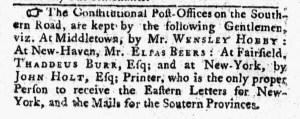
Connecticut Courant (June 12, 1775).

“The Constitutional Post-Offices on the Southern Road, are kept by the following Gentlemen.”

Although William Goddard established the Constitutional Post as an alternative to the British Post Office in 1773, advertisements for the service appeared in colonial newspapers only sporadically until after the battles at Lexington and Concord in April 1775.  After the Revolutionary War began, however, the number and frequency of newspaper notices promoting the Constitutional Post increased, especially in New England, New York, and Pennsylvania.  In May 1775, for instance, Nathan Bushnell, Jr., a postrider in Connecticut, stated that he was affiliated with the Constitutional Post in advertisements that ran in both the New-England Chronicle, published in Cambridge, Massachusetts, and the Connecticut Gazette, published in New-London.  John Holt, the printer of the New-York Journal, inserted a lengthy advertisement to advise readers that a “Constitutional POST-OFFICE, Is now kept” at his printing office in early June.

An unsigned advertisement in the June 12, 1775, edition of the Connecticut Courant, published by Ebenezer Watson in Hartford, listed four branches: “The Constitutional Post-Offices on the Southern Road, are kept by the following Gentlemen, viz. At Middletown, by the Mr. WENSLEY HOBBY: At New-Haven, Mr. ELIAS BEERS: At Fairfield, THADDEUS BURR, Esq; and at New-York, by JOHN HOLT, Esq; Printer.”  Holt may have been responsible for the notice, considering that it described him as “the only proper Person to receive the Eastern Letters for New-York, and the Mails for the Sout[h]ern Provinces.”  One of the other postmasters could have placed the notice, though Watson may have done it of his own volition as a public service.  Joseph M. Adelman persuasively argues that “printers had a direct financial and business interest in promoting a post office to their liking both because it distributed their newspapers and other print goods and because they were the chief beneficiaries of a patronage system centering on the post office.”[1]  He also acknowledges that printers “enlisted merchants and members of the revolutionary elite … to provide financial and political support.”[2]  The notice in the Connecticut Courant included only one printer, John Holt, among the four postmasters.  Fairfield and Middletown did not have newspapers, but they did have need of reliable post offices and trustworthy postmasters.  In New Haven, Thomas Green and Samuel Green printed the Connecticut Journal, yet the notice did not indicate that they had an affiliation with the Constitutional Post Office.  While printers played an important role in establishing the service, they worked alongside postmasters from other occupations in creating an infrastructure for disseminating news and information.

**********

[1] Joseph M. Adelman, “‘A Constitutional Conveyance of Intelligence, Public and Private,’: The Post Office, the Business of Printing, and the American Revolution,” Enterprise and Society 11, no. 4 (December 2010): 713.

[2] Adelman, “Constitutional Conveyance,” 709.

February 21

What was advertised in a colonial American newspaper 250 years ago today?

Connecticut Journal (February 21, 1772).

Can be afforded cheaper than if purchased in Boston or New York.”

In February 1772, Isaac Beers and Elias Beers took to the pages of the Connecticut Journal and New-Haven Post-Boy to advertise “a small Assortment of GOODS” they recently imported from London.  They listed some textiles, promising as well “a general Assortment of Articles in the Cloathing Way.”  They concluded their advertisement with a note that they sold their wares “at the very lowest Rates.”  A manicule drew attention to that proclamation.

The shopkeepers provided additional commentary about price intended to convince prospective customers to shop at their store rather than seek out alternatives.  “As we imported the above Goods immediately from London,” they explained, “they undoubtedly can be afforded cheaper than if purchased in Boston or New York.”  Residents of New Haven and nearby towns did not need to visit one of the bustling port cities or send away to shopkeepers there in order to benefit from the best bargains.  The higher volume of shipping that arrived in Boston and New York did not necessarily mean that consumers in those cities had access to better deals, at least not according to the Beerses.  In addition, they managed to keep prices low at their store in New Haven because they did not acquire their merchandise via wholesalers in Boston and New York.  Receiving their goods “immediately from London” eliminated a round of markups.

Readers did not need to look beyond New Haven for the best prices.  The Beerses underscored that point when they asserted that they “are determined to sell [the above Goods] as low as they possibly can be afforded.”  They were not the only entrepreneurs to make appeals to price in Connecticut Journal, but they did provide the most extensive explanation to demonstrate how they managed to keep prices low for their customers.  In so doing, they acknowledged that consumers assessed the claims made in newspaper advertisements and made careful choices when shopping.

May 27

What was advertised in a colonial American newspaper 250 years ago today?

May 27 - 5:27:1768 Connecticut Journal
Connecticut Journal (May 27, 1768).

“A few of the so much esteem’d FARMER’s Letters.”

Isaac Beers and Elias Beers sold a variety of goods at their shop in New Haven. In the spring of 1768 they enumerated many of their wares in an advertisement in the Connecticut Journal, listing textiles and adornments that ranged from “blue, bluegrey, and blossom colour’d German Serges” to “A very large Assortment of Buttons, Bindings, and all kind of Trimmings for Mens Cloathes” to “A genteel Assortment of the newest fashion’d Ribbons.” They stocked grocery items, including tea, cofeem and sugar, as well as “Pigtail Tobacco” and snuff.

Although they were not booksellers or stationers, the Beers included writing supplies and books among their inventory. Like other shopkeepers, they carried “Writing Paper” and wax wafers for making seals. They also sold bibles and spelling books as well as “A few of the so much esteem’d FARMER’s Letters.” (Although that portion of the advertisement has been damaged in the copy of the May 27, 1768, edition of the Connecticut Journal seen above, the same advertisement appeared the next week in an issue that has not been damaged.)

The Beers did not need to provide any further explanation for prospective customers to identify the pamphlet that contained all twelve of John Dickinson’s “Letters from a Farmer in Pennsylvania” previously printed and reprinted in newspapers throughout the colonies, starting in December 1767 and continuing into the spring of 1768. In these “Letters,” Dickinson, under the pseudonym of “A Farmer,” presented a dozen essays that explained how Parliament overstepped its authority in passing the Townshend Act and other measures that usurped the authority of colonial legislatures. He encouraged colonists to resist Parliament’s designs or risk even greater abuses.

Upon completion of the series, industrious printers in Boston, New York, and Philadelphia collected all twelve “Letters” in pamphlets. Printers and booksellers in several colonies advertised that they sold the “Letters,” but supplying the public with that pamphlet was not the province of the book trade alone. Shopkeepers like the Beers purchased “A few” copies to retail alongside general merchandise in their own shops, considering the “Letters” significant enough to merit particular mention in their advertisements. In so doing, they assisted in disseminating some of the arguments that eventually transformed resistance into a revolution. The choices they made as retailers and advertisers helped to shape the rhetoric of the Revolution.