
What was advertised in a revolutionary American newspaper 250 years ago today?
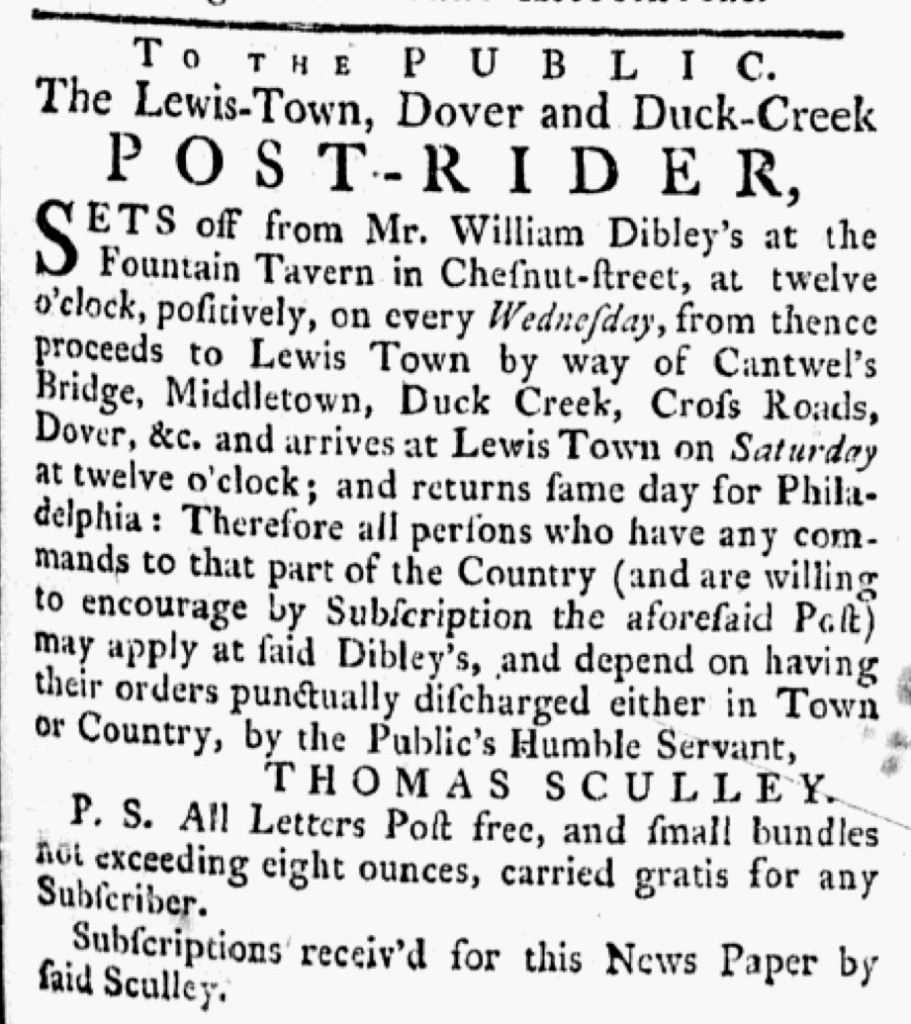
“All Letters Post free, and small bundles not exceeding eight ounces, carried gratis for any Subscriber.”
As the Revolutionary War commenced, Thomas Sculley, a post rider, followed a route that connected several towns in Delaware to Philadelphia. At noon on every Wednesday, he departed from William Dibley’s Fountain Tavern on Chestnut Street and made for Lewis Town (now Lewes). He stopped at Middletown, Dover, and other towns along the way, delivering letters, newspapers, and packages. That took three days. Sculley arrived at Lewis Town by noon on Saturday and started the return trip later the same day. Presumably he made it to Philadelphia on Tuesday, giving customers an opportunity to consult with him at the Fountain Tavern.
Sculley placed an advertisement for his services in the July 29, 1775, edition of the Pennsylvania Ledger. Like some other post riders, he did not charge solely by the letter, package, or newspaper subscription but instead marketed a subscription service. Subscribers paid a set fee on a regular basis whether they made use of the service or not. In return, they could post as many letters as they wished as well as send “small bundles not exceeding eight ounces.” Anything else incurred additional charges. Even if customers did not use Sculley’s service every time he rode between Philadelphia and Lewes, the subscription fee could have been a bargain compared to paying for each letter or package each time. In addition, Sculley intended for subscriptions, if paid on time, to yield steady income that made serving his route possible. Prospective customers who wanted to make sure that a post rider was available when they desired needed to support the enterprise with their subscriptions, not just when they had letters and packages to send.
Sculley also accepted subscriptions for the Pennsylvania Ledger. He may have also delivered other newspapers printed in Philadelphia at the time, including Dunlap’s Pennsylvania Packet, the Pennsylvania Evening Post, the Pennsylvania Gazette, and the Pennsylvania Journal. Subscriptions to his service also supported dissemination of news about the imperial crisis, the hostilities that had recently commenced in Massachusetts, the meeting of the Second Continental Congress in Philadelphia, and reactions from throughout the colonies. Post riders like Thomas Sculley played an important role in the communications infrastructure that disseminated news during the era of the American Revolution.