November 16

What was advertised in a colonial American newspaper 250 years ago today?
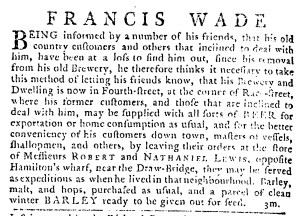
Pennsylvania Journal (November 16, 1774).

“For the better conveniency of his customers … leav[e] their orders at the store of Messieurs ROBERT and NATHANIEL LEWIS.”

Moving to a new location had caused some difficulty for Francis Wade, a brewer, prompting him to insert an advertisement in the Pennsylvania Journal in hopes of remedying the situation.  He formerly operated his brewery in the vicinity of “Hamilton’s Wharf, near the Draw-Bridge,” in Philadelphia, but in the fall of 1774 he could be found on Fourth Street “at the corner of Race-street.”  Wade reported that he had been “informed by a number of his friends,” likely including some of his former neighbors, “that his old country customers and other that inclined to deal with him, have been at a loss to find him out” since he moved.  Although many residents of the city knew about his new location, his “former customers” from the countryside did not have the same familiarity with the happenings in Philadelphia.  Since the Pennsylvania Journal circulated far beyond Philadelphia, Wade hoped that his notice would reach them and encourage them to seek him out on Fourth Street.

The brewer realized that his new location might not have been as convenient for some customers as his old one, so he used his advertisement as an opportunity to offer them an alternative.  Wade instructed “his customers down town, masters of vessels, shallopmen, and others” that they could place their orders at the store operated by Robert Lewis and Nathaniel Lewis.  When they did so, they could expect that they would “be served as expeditious as when he lived in that neighbourhood.”  Wade enlisted the aid of associates in his efforts to maintain and grow his client base, seeking to ameliorate an obstacle that he encountered following “his removal from his old Brewery.”  Working with the Lewises allowed him to maintain a presence in the vicinity of his former location.  Running newspaper advertisements made that presence visible to his “country customers” and other prospective customers.  Wade endeavored to sell “all sorts of BEER for exportation or home consumption as usual,” yet his move caused him to devise new methods of doing business that had not been part of his usual routine.

May 31

What was advertised in a colonial American newspaper 250 years ago this week?

May 31 - 5:28:1767 Pennsylvania Gazette
Pennsylvania Gazette (May 28, 1767).

“WADE and HEMPHILL’s NEW STORE, in Wilmington, will be continued as usual.”

Francis Wade ran two shops, one on Second Street in Philadelphia and another in nearby Wilmington, Delaware. The latter he operated in partnership with William Hemphill. Wade intended to “leav[e] off the retail business,” and placed an advertisement to that effect. He sought to liquidate his merchandise in an eighteenth-century version of a going out of business sale, “selling off all his stock in trade, at prime cost … for cash only.” He also called on former customers to settle their accounts or else face legal action.

Although the Philadelphia location was closing, “WADE and HEMPHILL’s NEW STORE, in Wilmington, will be continued as usual by William Hemphill.” In the final paragraph of his advertisement, a paragraph devoted to the Wilmington location, Wade outlined some of the common commercial practices that allowed many colonists, especially those who lived in the hinterlands beyond the major urban ports, to participate in the consumer revolution.

Wade and Hemphill purchased surplus crops from country farmers who transported wheat, flaxseed, and produce to ports as part of an export market directed to other North American colonies and the Caribbean. Although the partners paid “the highest prices … in cash,” they anticipated that farmers and their families would spend at least some of that money on merchandise in their store.

To facilitate such trading, Wade underscored some of the advantages that benefited farmers in Philadelphia’s hinterland who chose to deal with Wade and Hemphill’s New Store in Wilmington. The partners purchased wheat and flaxseed “at the Philadelphia prices,” so farmers would not lose any money by opting for the smaller port. In fact, many of them would save valuable time and money because “the road from Lancaster county is 15 miles shorter to Wilmington than Philadelphia, and no ferriage.” Wade offered this information as “an inducement for the wagons to come that way with their loading.” If he managed to convince farmers in the countryside, Wade stood to attract more customers and obtain larger quantities of produce to export for profit.

Wade’s advertisement suggests that colonists did not engage solely in sustenance farming, growing just enough to meet the needs of their family. Instead, they intentionally raised agricultural surpluses with the intention of taking them to market for export elsewhere in the Atlantic world. In turn, they used some of the revenues generated from such sales to purchase both necessities and imported goods they merely desired. Merchant-shopkeepers like Francis Wade and William Hemphill facilitated such transactions, giving many colonists – even those beyond major port cities – access to consumer culture.