August 14

What was advertised in a revolutionary American newspaper 250 years ago today?
Massachusetts Spy (August 14, 1776).

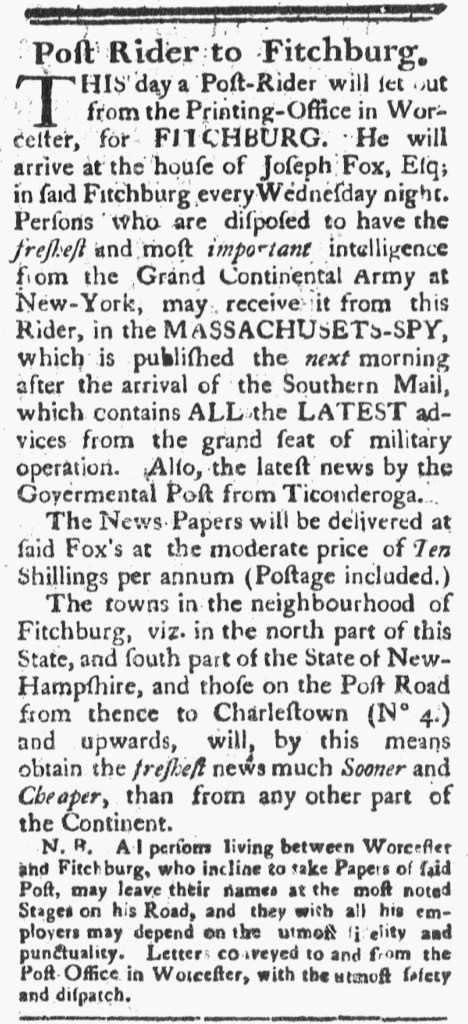
“The freshest and most important intelligence from the Grand Continental Army at New-York.”

An advertisement in the August 14, 1776, edition of the Massachusetts Spy promoted the services of a “Post Rider to Fitchburg,” a town twenty-five miles north of Worcester.  The unnamed post rider stressed that there was no quicker way for residents of that town and others in the vicinity to receive the latest news, especially updates about the war being waged for independence.

The post rider explained that he set out from Worcester on Wednesdays, the same day that William Stearns and Daniel Bigelow published a new issue of the Massachusetts Spy, and “arrive[d] in … Fitchburg every Wednesday night,” supplying the “freshest and most important intelligence from the Grand Continental Army at New-York.”  Readers could depend on it being the latest news because Stearns and Bigelow printed the Massachusetts Spy “the next morning after the arrival of the Southern Mail” on Tuesdays, giving them just enough time to glean the most significant news to include in new issues on Wednesdays.  The letters and newspapers the printers received “contain[ed] ALL the LATEST advices from the grand seat of military operation” as well as “the latest news by the Government Post from Ticonderoga.”  Stearns and Bigelow likely collaborated with the post rider in providing this service as well as in writing an advertisement that promoted the Massachusetts Spy to readers throughout central Massachusetts and southern New Hampshire.  The Massachusetts Spy competed with newspapers published in Boston and Watertown in Massachusetts and Exeter and Portsmouth in New Hampshire, yet subscribers who received the Massachusetts Spy via the “Post Rider to Fitchburg” would “obtain the freshest news much Sooner and Cheaper, than from any other part of the Continent.”  An annual subscription with delivery cost “Ten Shillings per annum (Postage included)” or two shillings more than the base price, “Eight Shillings, per Annum, exclusive of Postage,” listed in the newspaper’s colophon.

The Massachusetts Spy carried all sorts of news, including updates from the Continental Congress in Philadelphia, yet the printers and the post rider believed that readers were most interested in the latest news about the progress of the war. Better than any other newspaper printed in Massachusetts or New Hampshire, the Massachusetts Spy and the “Post Rider to Fitchburg” could deliver that news to subscribers and other readers.

February 12

What was advertised in a colonial American newspaper 250 years ago today?

South-Carolina Gazette and Country Journal (February 12, 1771).

“They have entered into Co-partnership, and continue to carry on the FACTORAGE BUSINESS.”

Like many other colonial newspapers, the masthead for the South-Carolina Gazette and Country Journal proclaimed that it “Contain[ed] the freshest Advices, both Foreign and Domestic.”  In other words, printers promoted their newspapers by claiming that they delivered accounts of current events as soon as they became available.  Local news appeared quickly, but news from other colonies, Great Britain, Europe, and other distant places took more time to report.  Printers published letters they received from distant correspondents and reprinted items as newspapers arrived from other colonies and London.

In addition to those “freshest Advices,” colonial newspapers also contained significant amounts of advertising.  On occasion, some even seemed as though they were delivery mechanisms for advertisements rather than purveyors of news.  The February 12, 1771, edition of the South-Carolina Gazette and Country Journal provides an extreme example.  It consisted almost entirely of paid notices from the first page to the last.  In the first column immediately below the masthead readers encountered a header for “NEW ADVERTISEMENTS.”  Charles Crouch, the printer filled all three columns of the first page with advertisements.  He inserted one column featuring news from Charleston and towns in other colonies, shipping news from the customs house, and a poem to entertain readers on the second page.  Otherwise, advertising constituted the remainder of the second page and the entire third and fourth pages.  Overall, paid notices accounted for eleven of twelve columns in the February 12 edition.

That did not mean, however, that readers did not have access to the “freshest Advices.”  Advertisements delivered a variety of news, especially about local people and events.  One notice published on February 12, for instance, identified colonists who did not appear in court to serve as jurors and would be fined if they did not “make good and sufficient Excuses, upon Oath, for their Non-Attendance.”  Several estate notices informed the public of deaths, accounts to be settled, and real estate and household goods for sale.  One advertisement described enslaved men who liberated themselves, offering rewards for their capture and return while simultaneously encouraging readers to scrutinize all Black men they encountered.  Another notice lamented that “there are many Gentlemen who have Plantations and Negroes in the Parish of St. James, Goose Creek, and no white Man on them, by which Means, the Negroes are enabled to prosecute all Manner of Roguery.”  The advertisement then instructed such offenders to “provide white Men for their respective Plantations” and organize patrols or face legal consequences.  An array of advertisements, including one in which William Gibbes and William Hort offered their services as factors or brokers, kept readers informed about local commerce.  One advertisement in Welsh invited those who could read it to participate in St. David’s Day celebrations.

Crouch did not print many news articles in that particular edition of the South-Carolina Gazette and Country Journal, but that did not mean that he neglected to provide readers with valuable information.  The advertisements presented the “freshest Advices” about many local and regional events, keeping readers informed.

May 1

What was advertised in a colonial American newspaper 250 years ago today?

May 1 - 5:1:1770 South-Carolina Gazette and Country Journal
South-Carolina Gazette and Country Journal (May 1, 1770).

“NEW ADVERTISEMENTS.”

As usual, the masthead for the May 1, 1770, edition of the South-Carolina Gazette and Country Journal proclaimed that it contained “the freshest Advices, both Foreign and Domestic.”  The front page featured news from Boston, including reports that a committee had been formed to gather testimonies from colonists who witnessed the Boston Massacre.  That issue also included news reprinted from newspapers published in Providence, Newport, Hartford, New York, and Philadelphia, though those items were often themselves republished from English newspapers or letters received from correspondents in faraway places like Gibraltar and Jamaica.  A couple of items of local news as well as the shipping news from the customs house rounded out the “freshest Advices.”

Yet news of the Boston Massacre was not the first item that readers encountered, even though it was on the first page.  Instead, a legal notice filled the upper half of the first two columns.  Assorted advertisements appeared below the legal notice.  News from Boston ran in the third column.  Elsewhere in that issue, news items comprised the entire second page and most of the first column on the fourth, but advertisements filled the third page and two of the three columns on the final page.  The standard issue consisted of five columns of news and seven columns of paid notices … and that was not even the end of the advertising disseminated in the South-Carolina Gazette and Country Journal on May 1.  Charles Crouch, the printer, issued a two-page supplement, another six columns, that consisted entirely of paid notices. Advertising accounted for more than two-thirds of the content delivered to subscribers in the May 1 edition and its supplement.  Like many other printers, Crouch touted the “freshest Advices” that appeared in his newspaper, but the publication was also (and on many occasions primarily) a vehicle for distributing advertising.