January 11

What was advertised in a colonial American newspaper 250 years ago today?

South-Carolina Gazette and Country Journal (January 11, 1774).

“Their assortment is as compleat as most in the province.”

In an advertisement in the January 11, 1774, edition of the South-Carolina Gazette and Country Journal, George Cooke and Company informed prospective customers that they recently imported a “fresh SUPPLY of GOODS” from London on the Portland.  Their merchandise included “very fashionable brocades” and other textiles, “men and boys fine beaver hats,” “womens black and coloured satin hats,” “all sorts of gloves and mitts,” “hosiery of all kinds,” and “a great variety of other goods.”

Cooke and Company competed in Charleston’s bustling marketplace.  John Webb advertised a similar inventory, as did Z. Kingsley and Samuel Gordon.  Other merchants and shopkeepers placed advertisements in the city’s other newspapers, the South-Carolina Gazette and the South-Carolina and American General Gazette.  Many did not advertise in the public prints, relying instead on other means of attracting customers to their stores and shops.  Consumers had many choices for acquiring goods in the busy port.

Realizing that was the case, Cooke and Company strove to convince readers that they offered a selection as extensive as those they would find just about anywhere else in Charleston or the rest of the colony.  The items they just received from the Portland supplemented previous shipments.  Those “several late importations from London and Bristol” made their assortment of goods “as compleat as most in the province.”  Customers did not need to go from shop to shop, looking for wares that appealed to them, when Cooke and Company stocked just about anything they could imagine.

Webb, Kingsley, and Gordon all demonstrated some of the choices they offered to consumers by listing dozens of items in their advertisements, each of them indicating that they carried much more than they could include in newspaper advertisements, yet Cooke and Company alone in that issue of the South-Carolina Gazette and Country Journal provided assurances that few if any of their competitors surpassed the selection at their shop.  Whether or not that swayed any prospective customers, Cooke and Company attempted to give their enterprise an advantage over the marketing undertaken by other merchants and shopkeepers.
December 13

What was advertised in a colonial American newspaper 250 years ago today?

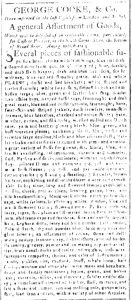
Dec 13 - 12:13:1769 South-Carolina and American General Gazette
South-Carolina and American General Gazette (December 13, 1769).

“GEORGE COOKE, & Co. Have imported … [illegible].”

The Adverts 250 Project and the Slavery Adverts 250 Project are made possible by databases of eighteenth-century newspapers that have been digitized in order to make them more accessible to scholars and other readers. Such databases have revolutionized the work done by historians, allowing them to ask – and answer – questions that would have been impractical or impossible to consider just a couple of decades ago. Various tools, including keyword searches that rely on optical character recognition, allow historians to streamline their research methods as they efficiently identify sources that otherwise would have been overlooked.

To some extent, the production of digital surrogates for primary sources has democratized the research process, making historical documents more widely accessible. Historians and other scholars no longer need to visit libraries, archives, and historical societies to gain access to original sources. Instead, they can access many of them (including eighteenth-century newspapers) from anywhere they have a reliable internet connection. This democratization of access to digital surrogates is sometimes limited by access to financial resources. Consider the databases consulted for the Adverts 250 Project and the Slavery Adverts 250 Project. Colonial Williamsburg makes its database of eighteenth-century newspapers published in Virginia freely available to the public. Accessible Archives and Readex, however, have different business models for South Carolina Newspapers and America’s Historical Newspapers, respectively. Both are available only by subscription. Some institutions can afford access to those databases; others cannot. I am fortunate that my college has a subscription to America’s Historical Newspapers. I am also fortunate that Accessible Archives has an individual subscription option at a reasonable price. It provides limited access compared to an institutional subscription, but it is sufficient for my purposes and the projects I have designed.

Even though scholars and other users benefit from these databases, they also learn that accessibility does not necessarily mean legibility. In some instances, the original sources have been damaged, but in many others poor photography or other shortcomings of the remediation process produce digital surrogates that are accessible but not legible. Consider George Cooke and Company’s advertisement from the front page of the December 13, 1769, edition of the South-Carolina and American General Gazette. Some of it is legible; other portions are not. An experienced reader can carefully work through much of the advertisement, filling in the gaps by considering both context and prior knowledge of eighteenth-century newspaper advertisements for consumer goods. Inexperienced readers would not derive nearly as much information from this advertisement, nor would keyword searches that rely on optical character recognition reach the same conclusions as a human reader.

Digitization has forever changed historical research methods, but digital surrogates do not replace original sources. Digital surrogates come with their own set of limitations that scholars must take into consideration. They make sources more accessible – sometimes. Both subscription fees and illegible remediations of original sources limit the usefulness of digital surrogates.