October 19

What was advertised in a revolutionary American newspaper 250 years ago today?
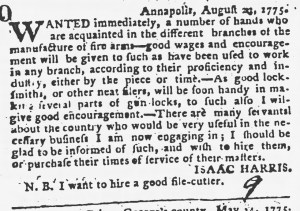
Maryland Gazette (October 19, 1775).

“WANTED immediately, a number of hands who are acquainted in the different branches of the manufacture of fire arms.”

In the late summer and early fall of 1775, Isaac Harris took to the pages of the Maryland Gazette with a call for “a number of hands who are acquainted in the different branches of the manufacture of fire arms.”  The timing of Harris’s advertisement, dated August 23, coincided with a new stage of the imperial crisis that started more than a decade earlier when Parliament attempted to regulate trade with the colonies following the conclusion of the Seven Years War.  The crisis had intensified at various moments, including passage of the Stamp Act in 1765 and imposition of duties on certain imported goods via the Townshend Acts in the late 1760s.  Events in Boston had often fueled the crisis, including the Boston Massacre in March 1770 and the destruction of tea by dumping it into the harbor in December 1773.  Parliament responded with the Coercive Acts, including the Boston Port Act and the Massachusetts Government Act, to punish the unruly Patriots, yet colonizers in other places believed that they could also be subject to similar treatment.

Yet only recently had hostilities commenced when Harris composed his advertisement and submitted it to the printing office in Annapolis.  News of the battles at Lexington and Concord in April 1775, the ensuing siege of Boston, the Battle of Bunker Hill in June 1775, and the appointment of George Washington as commander-in-chief of the Continental Army inspired colonizers to make preparations to defend their liberties.  Harris may have been among their ranks as he set about making firearms in Maryland.  He offered “good wages” to workers with experience in any aspect of producing firearms, paying them “according to their proficiency and industry, either by the piece or time.”  In addition, he thought that “good locksmiths, or other neat filers, will be soon handy in making several parts of gun locks.”  Colonizers with experience in other occupations could apply their skill to this endeavor.  Harris also sought indentured servants to join this enterprise, offering to hire them or “purchase their times of service [from] their masters.”  According to his advertisement, Harris planned to make a significant investment in acquiring the labor to support what he called “the necessary business” of making firearms.  Readers almost certainly made a connection between Harris’s plan to make firearms and the events that continued to unfold in Massachusetts.
March 19

What was advertised in a colonial American newspaper 250 years ago this week?

New-York Journal (March 16, 1775).

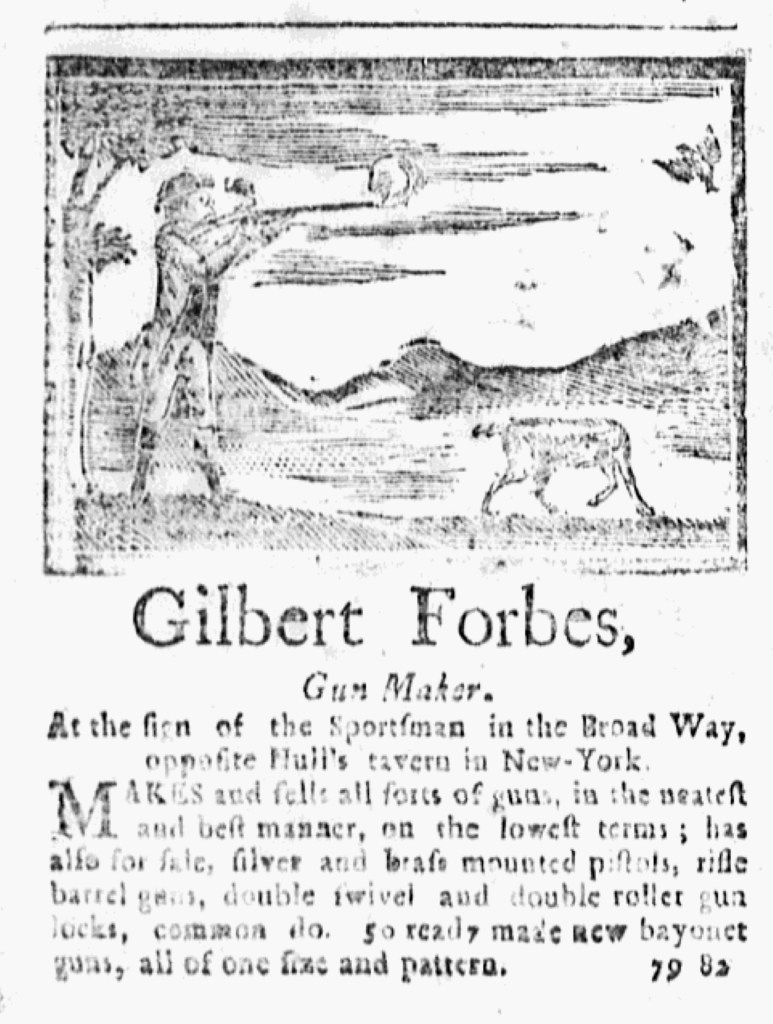
“Gilbert Forbes, Gun Maker, At the sign of the Sportsman.”

Gilbert Forbes, “Gun Maker, At the sign of the Sportsman in the Broad Way,” took to the pages of the New-York Journal to advertise “all sorts of guns” that he made “in the neatest and best manner “and sold “on the lowest terms” as spring approached in 1775.  He made some of the standard appeals deployed by artisans – quality and price – yet those were not the focal point of his advertisement.  A woodcut dominated his notice, accounting for more than half the space he purchased in the newspaper.

Commissioning the woodcut may very well have been worth the investment.  It almost certainly attracted the attention of readers, not only because it appeared on the first page of the March 16 edition.  The image depicted a scene of a well-dressed gentleman firing a gun, a bird plummeting out of the sky, and a hunting dog waiting below.  A puff of smoke wafted out of the barrel of the gun, capturing the moment just after the gentleman pulled the trigger.  Such a scene differed dramatically from other images that appeared in newspaper advertisements during the era of the American Revolution.  When advertisers commissioned woodcuts, they usually requested static images that corresponded to some aspect of their business, most often replicating their shop sign or showing an item that they made or sold at their shop.  For instance, an image of a fish adorned an advertisement for “CORNISH’s New-England FISH HOOKS” in the Massachusetts Spy and an image of a spinning wheel appeared in James Cunning’s advertisement for dry goods he sold “At the Sign of the SPINNING-WHEEL” in the Pennsylvania Journal.  In contrast, Forbes provided a scene in motion, distinguishing his advertisement from others.

Relatively few advertisements featured images at all.  Those that did most often incorporated stock images of ships at sea, houses, horses, or enslaved people, each of them provided by the printer.  Occasionally, advertisers commissioned woodcuts intended exclusively for their own use.  Among that small number, an image of a scene, one that invited viewers to imagine events in motion, was exceptionally rare.  As such, it demanded attention.

March 16

What was advertised in a colonial American newspaper 250 years ago today?

Pennsylvania Gazette (March 16, 1774).

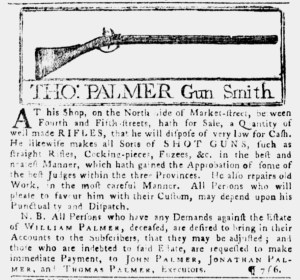
“THO. PALMER Gun Smith.”

Jack Healy, a student in my Revolutionary America class, selected Thomas Palmer’s advertisement for “a Quantity of well made RIFLES” and “all Sorts of SHOT GUNS” to feature on the Adverts 250 Project, hoping to learn more about firearms in the colonies during the era of the American Revolution and the Early Republic.  The woodcut depicting a gun, which the gunsmith previously used in other advertisements, helped attract Jack’s attention, prompting him to seek more information.

Among other secondary sources, I recommended that Jack peruse Saul Cornell’s A Well-Regulated Militia: The Founding Fathers and the Origins of Gun Control in America.  In the opening chapter, “English Tyranny versus American Liberty,” Cornell describes militia laws “that required each householder to provide himself with a musket to meet his obligation to participate in the militia” for the purposes of keeping order and defending their communities.  “It would be impossible,” Cornell asserts, “to overstate the militia’s centrality to the lives of American colonists.”  In addition to providing defense, the militia “served an important social role” as “one of the central means for organizing citizens” prior to the emergence of modern political parties.  Communities gathered at musters, drilling, celebrating, and forging bonds.[1]

Palmer did not mention any of that in his advertisement.  He did not need to do so since prospective customers were so familiar with the part that militias played in colonial culture.  Instead, he emphasized the quality of the firearms he produced, declaring that he constructed them “in the best and neatest Manner.”  Furthermore, his work “hath gained the Approbation of some of the best Judges within the three Provinces” of Pennsylvania, New Jersey, and Delaware, though he did not identify who gave such endorsements.  For those not in the market to purchase a new firearm, Palmer offered to repair “old Work, in the most careful Manner.”  To fulfill their civic obligations and to participate in communal gatherings, many colonizers may have turned to Palmer to obtain and maintain the firearms they carried as members of their local militia.

**********

[1] Saul Cornell, A Well-Regulated Militia: The Founding Fathers and the Origins of Gun Control in America (New York: Oxford University Press, 2006), 12-13.

March 31

What was advertised in a colonial American newspaper 250 years ago today?

Pennsylvania Gazette (March 31, 1773).

“A Quantity of well made RIFLES.”

Thomas Palmer, a gunsmith, made several appeals to prospective customers in Philadelphia in the advertisement he placed in the March 31, 1773, edition of the Pennsylvania Gazette.  He declared that his inventory included a wide selection, a “Quantity of well made RIFLES, of different Lengths and Sizes of Bores.”  Palmer was so confident of the quality of those guns that he proclaimed that he “will insure to the Purchasers” that they were “as good and as handsomely fitted up as any made in America.”  Consumers would not find better in Philadelphia or anywhere else in the colonies.  In addition, the gunsmith “makes Fowling Pieces, of different Sizes, such as have been approved of by Gentlemen of this City.”  Short of publishing testimonials from his clients, Palmer suggested that men with good reputations endorsed the guns produced in his workshop.  In addition to making rifles and fowling pieces, he also “repairs old Guns in the most careful Manner.”

Palmer did not rely on advertising copy alone to market his services.  Instead, he incorporated a visual image into his notice.  A woodcut that may have replicated a sign that marked the gunsmith’s location adorned the advertisement, though the copy did not make reference to any sign at Palmer’s shop on “the North Side of Market-street, between Fourth and Fifth-streets.”  On the other hand, Palmer may have considered it unnecessary to mention a sign in copy that appeared immediately below an image of a rifle and the words “THO: PALMER Gun Smith” enclosed within a double border.  Residents of Philadelphia may have already been familiar with the sign and readers from beyond the city would have easily recognized it if they decided to visit Palmer’s shop.  Whether or not Palmer displayed a sign at his shop on Market Street, the woodcut helped distinguish his advertisement from other content in the Pennsylvania Gazette, likely making it worth the investment.  With the exception of the seal in the masthead, only one other image appeared in that issue.  A stock image of a house ran with a real estate notice, but that lacked the same level of customization as the woodcut in Palmer’s advertisement.  The gunsmith deployed text and image simultaneously in his efforts to engage prospective customers.