September 16

What was advertised in a colonial American newspaper 250 years ago today?
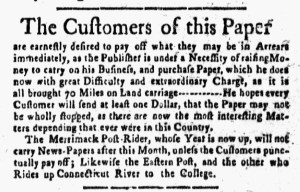
New-Hampshire Gazette (September 16, 1774).

“There are now the most interesting Matters depending that ever were in this Country.”

Colonial printers frequently ran advertisements asking customers, especially subscribers, to pay their overdue bills.  Daniel Fowle, the printer of the New-Hampshire Gazette, seemed to do so more often than others.  Such advertisements became a regular feature in his newspaper.  One appeared in the September 16, 1774, edition of the New-Hampshire Gazette.  This time, Fowle pleaded that the “Customers of this Paper” are earnestly desired to pay off what they may be in Arrears immediately, as the Publisher is under a Necessity of raising Money to carry on his Business.”  The fate of the newspaper, Fowle’s ability to continue publishing it, was at stake.  In part, that was because he apparently experienced a disruption in his supply of paper, acquiring it “with Difficulty and extraordinary Charge, as it is all brought 70 Miles on Land carriage.”  The printer did not go into greater detail on that point, though at various times in the past he had suggested that he used only paper produced in the colonies rather than paper imported from England.  The blockade of Boston, one of Parliament’s responses to the Boston Tea Party, may have affected Fowle’s route for receiving paper produced in another colony.

Even if subscribers could not settle accounts, Fowle requested that they “send at least one Dollar, that the Paper may not be wholly stopped, as there are the most interesting Matters depending that ever were in this Country.”  The printer recognized that the imperial crisis had intensified with the Boston Port Act and the rest of the Coercive Acts.  Earlier in the month, the First Continental Congress commenced its meeting in Philadelphia, deliberating about a unified response across the colonies.  Discussion and debates also took place in communities near and far.  That same issue of the New-Hampshire Gazette carried updates from Philadelphia, New London, Hartford, Newport, Boston, Salem, and other towns in Massachusetts.  Local news included coverage of a tea consignee in Portsmouth refusing to accept the shipment, diverting it to Halifax rather than cause a scene.  Yet that article also warned, “In future no such Indulgence will be allowed to the Enemies of America.”  Momentous events were underway.  Fowle did not know what would happen next, but he assured subscribers that they did not want to lose access to the news he supplied if they did not pay what they owed.

September 3

What was advertised in a colonial American newspaper 250 years ago today?

Sep 3 - 9:3:1768 Providence Gazette
Providence Gazette (September 3, 1768).

“We have a sensible Pleasure in finding, that our weekly Publications, have hitherto afforded general and entire Satisfaction.”

With the exception of two extraordinary issues (extras) published on August 24, 1765, and March 12, 1766, the Providence Gazette went on hiatus between May 11, 1765, and August 9, 1766. Some of this period coincided with the Stamp Act, but other factors played a role as well. The Providence Gazette halted publication nearly six months before the Stamp Act went into effect and did not resume until a couple of months after colonists learned that it had been repealed. When Sarah Goddard and Company revived the Providence Gazette they explained that “the Procrastination of a weekly Paper in this Town, was unavoidably owing to the inadequate Number of Subscribers to carry it on with Credit, and to defray the necessary Charges that will always attend such an Undertaking.” By early August 1766 they had enough subscribers to risk printing weekly issues once again, thus offering an important service to the public. As they explained in an address in the first issue upon commencing publication once again, “the Productions of the Press have ever been esteemed one of the principal Means of defending the glorious Cause of Liberty.”

A year later, Sarah Goddard and Company inserted a short notice to “inform their candid Readers, this this Week’s Paper compleats the Year since the PROVIDENCE GAZTTE, &c. was revived.” They encouraged subscribers, advertisers, and others to settle accounts, but also invited the further “Encouragement” of those who understood the importance of a having a newspaper published in Providence. A year later, the publishers – now Sarah Goddard and John Carter – composed a lengthier acknowledgment that ran for several weeks. Rather than merely calling on readers to pay their bills, Goddard and Carter had three purposes. First, they thanked their “Friends” who had “patronized and endeavoured to promote the Success of this Paper.” Then they pledged to continue serving the public in general and their readers in particular by further improving upon a newspaper that had “hitherto afforded general and entire Satisfaction.” They vowed that “no Pains or Expence shall be spared,” but they also requested “the Assistance of Gentlemen of Learning and Ingenuity.” The usefulness of the Providence Gazette to all readers depended on the publishers’ ability to acquire interesting and timely content to better inform the public. Goddard and Carter invited readers to become correspondents who submitted items for publication. Only after expressing their gratitude for past favors and their plans for further improvements did Goddard and Carter turn to settling accounts. In so doing, they underscored that their ability to serve the public depended on debtors paying their bills.

Many eighteenth-century printers inserted similar notices alongside other advertisements that appeared in their publications. They called for payment, but argued that readers, advertisers, and others also performed a service to the public when they settled accounts. Such transactions were not strictly a private matter. Instead, they had repercussions that reverberated throughout the community, determining whether or not a newspaper continued publication and pursuing its mission to keep the public informed and vigilant.