February 24

What was advertised in a revolutionary American newspaper 250 years ago today?
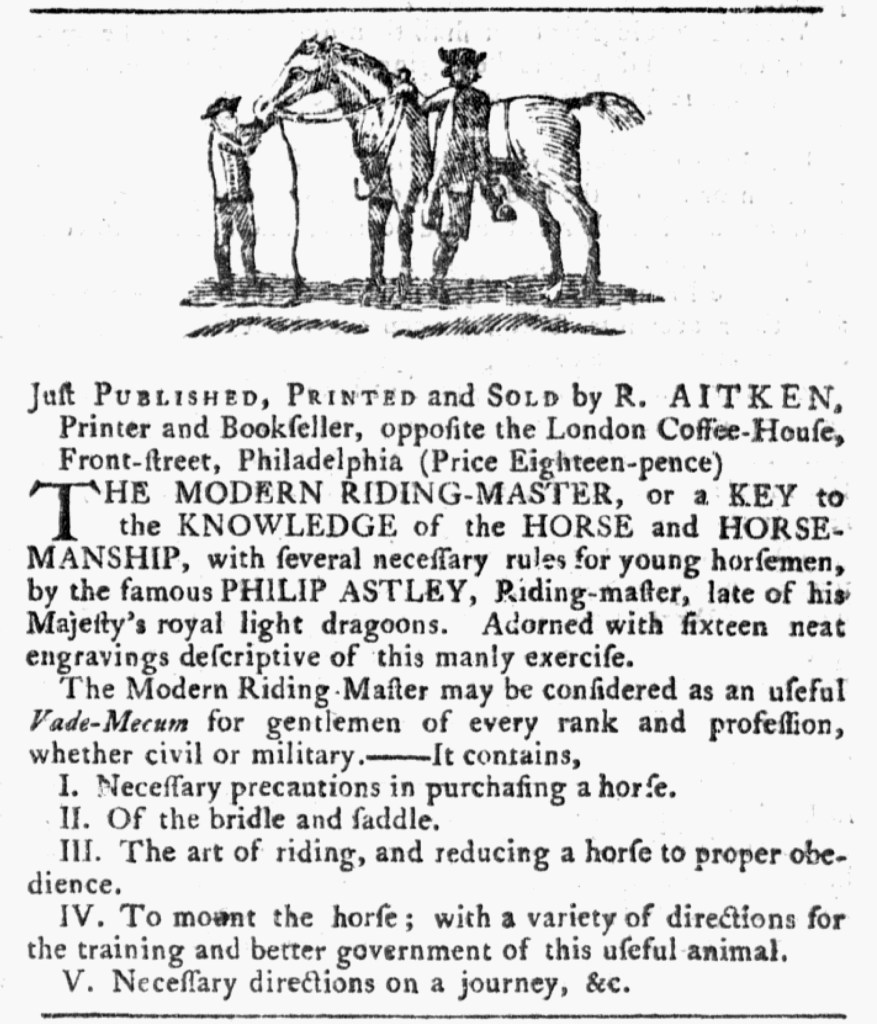
Pennsylvania Evening Post (February 24, 1776).

“THE MODERN RIDING-MASTER … Adorned with sixteen neat engravings.”

When Robert Aitken “PUBLISHED, PRINTED and SOLD” an American edition of Philip Astley’s “THE MODERN RIDING-MASTER, or a KEY to the KNOWLEDGE of the HORSE and HORSEMANSHIP,” he placed an advertisement in the Pennsylvania Evening Post.  In marketing the manual, he emphasized Astley’s celebrity, identifying him as a “Riding-master, late of his Majesty’s royal light dragoons.”  Aitken also promised that the manual included “several necessary rules for young horsemen.”  To that end, he declared that The Modern Riding-Master “may be considered as an useful Vade-Mecum” or handbook “for gentlemen of every rank and profession, whether civil or military.”  As printers and booksellers often did in their advertisements, Aitken copied the section headings to provide an overview of the contents.  The manual began with “Necessary precautions in purchasing a horse” and attention “Of the bridle and saddle,” continued with “The art of riding, and reducing a horse to proper obedience,” and also covered how “To mount the horse; with a variety of directions for the training and better government of this useful animal” and “Necessary directions on a journey.”
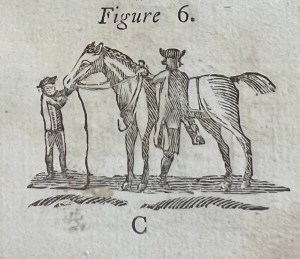
Figure 6 from Philip Astley, The Modern Riding-Master (Philadelphia: Robert Aitken, 1776). Courtesy American Antiquarian Society.

In addition to these directions, the manual featured “sixteen neat engravings descriptive of this manly exercise.”  Aitken exaggerated a bit.  The handbook did indeed have sixteen illustrations, but they were woodcuts integrated into the text rather than copperplate engravings printed separately.  Those images “Adorned” the text, as Aitken stated, but they were not of the same quality as engravings.  Still, they provided useful visual aids for readers.  To draw the attention of prospective customers, Aitken submitted one of those woodcuts, Figure 6, to accompany his advertisement in the Pennsylvania Evening Post.  It depicted a rider placing his “left Foot in the Stirrup” as he prepared to mount a horse held steady by an attendant.  Aitken made savvy use of the woodcut, reusing it in an advertisement once he finished printing the manual.  It was the only visual image in his notice in the Pennsylvania Evening Post, a newspaper that did not even have a device in its masthead.  The woodcut gave a preview of what readers could expect if they purchased Astley’s manual.

Woodcuts in Philip Astley, The Modern Riding-Master (Philadelphia: Robert Aitken, 1776). Courtesy American Antiquarian Society.

August 12

What was advertised in a colonial American newspaper 250 years ago this week?

Aug 12 - 8:11:1766 Newport Mercury
Newport Mercury (August 11, 1766).

“DIRECTIONS for making calcined or PEARL ASHES.”

Advertisements associated with the potash industry appeared quite regularly in colonial newspapers. Some advertisers wanted to buy it, offering a good price in exchange for potash. Others supplied some of the equipment, such as oversized kettles, necessary for producing potash. Although not necessarily directly involved in potash production, printers also published advertisements that indicated they stood to profit from it all the same. Some sold “Justices Blank Certificates” used in the packing and regulation of potash, while others peddled instruction manuals to those who wanted to participate in the industry or improve on their previous efforts.

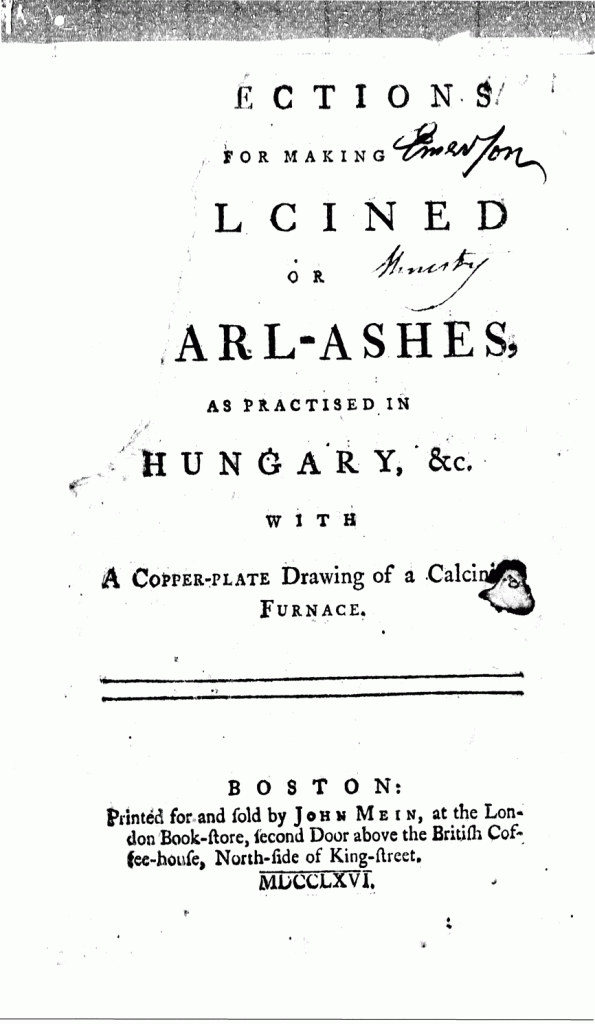
Such was the case with a short pamphlet (less than twenty pages) devoted to “DIRECTIONS for making calcined or PEARL ASHES, As practised in Hungary, &c.” Samuel Hall, the printer of the Newport Mercury, sold the pamphlet at his shop “on the North Side of the Parade,” but the imprint on the pamphlet itself indicated that it was “Printed for and sold by JOHN MEIN, at the London Book-store” in Boston. Both printers (and quite likely others throughout New England that exchanged stock with Mein) looked to make a profit from indirect involvement in the potash trade through the sale of ancillary products.

Aug 12 - Potash Pamphlet
Directions for Making Calcined or Pearl Ashes, as Practised in Hungary, &c. with a Copper-plate Drawing of a Calcining Furnace (Boston:  John Mein, 1766).  Boston Public Library.

Both the advertisement and the title page of the pamphlet underscored that it included “a Copper-Plate Drawing of a calcined Furnace.” This would have certainly increased the expense of producing the pamphlet and, ultimately, the cost to the customer, but such an investment could be readily justified. The accompanying image likely offered valuable insight into the text, making it more comprehensible. Art historian Nancy Siegel has argued that engraved images that accompanied eighteenth-century cookbooks were imperative in demonstrating the meaning of the text to readers. The same would have been true for an instruction manual detailing equipment and processes for producing potash, especially for readers not already well versed in the subject. After all, the directions in the pamphlet were “founded on the most extensive Knowledge of Pearl Ashes—a Knowledge acquired by long Practice, Experience and Success. The advertisement warned readers that this was “the only Means to establish Matters of Fact.” It concluded by jeering that “plausible Theories” were “little better than ingenious Amusements.”

In other words, both the text and the engraved copperplate drawing merited attention from anybody serious about potash production. Both were worth the expense.