
What was advertised in a colonial American newspaper 250 years ago today?
“I will pay no debts of his contracting after the date hereof.”
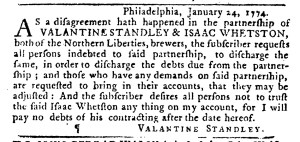
Valantine Standley and Isaac Whetston had a falling out at the beginning of 1774. The brewers formed a partnership in the Northern Liberties on the outskirts of Philadelphia, but, as Standley explained in an advertisement in the February 9 edition of the Pennsylvania Journal, “a disagreement hath happened” that caused them to dissolve their partnership and go their separate ways. Accordingly, Standley sought to separate his finances from Whetston, issuing a call for those who had done business with the brewers to settle accounts. He requested “all persons indebted to said partnership, to discharge the same, in order to discharge the debts due from the partnership.” At the same time, he asked that “those who have any demands on said partnership … bring in their accounts, that they may be adjusted.”
Standley could have left it there. Merchants, shopkeepers, artisans, printers, and other entrepreneurs regularly placed advertisements asking their associates to settle accounts. Similarly, executors often did so on behalf of the estates they administered. Standley, however, inserted additional instructions to the partnership’s associates and to the general public, instructions that resembled those given by aggrieved husbands who ran what have become known as “runaway wife” advertisements to warn purveyors of goods and services not to extend credit to wives who had abandoned their husbands and households. Standley advised “all persons not to trust the said Isaac Whetston any thing on my account, for I will pay no debts of his contracting.” He replicated language that appeared in advertisements that resulted from marital discord but not usually in notices about business partnerships dissolving. That Standley did so testified to the “disagreement” between the brewers. He did not consider it sufficient that an announcement that they were no longer in business together would cause others to refrain from allowing Whetston to make charges on Standley’s account. Instead, he explicitly forbade such transactions, suggesting that he did not trust his former partner to comport himself appropriately. Rather than a dry and routine notification that the brewers were no longer in business together, Standley’s advertisement hinted at the acrimony between the two men, perhaps inciting curiosity among their neighbors and associates. In this instance, an advertisement delivered both news and gossip.