
What was advertised in a colonial American newspaper 250 years ago today?
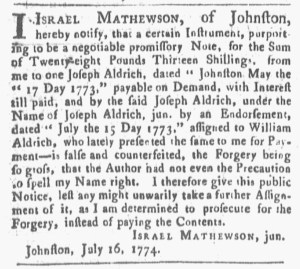
“The Forgery being so gross, that the Author had not even the Precaution to spell my Name right.”
As readers flipped through the August 6, 1774, edition of the Providence Gazette, they encountered news and editorials on the first three pages, followed by advertisements in the final column on the third page and filling the entire final page. The news and editorials included an “Address to the Citizens of New-York on the present critical Situation of Affairs … here inserted by Request” signed by “ANGLUS AMERICANUS,” a letter from London’s Morning Post addressed to Lord North, the prime minister, by “A SOLDIER,” and updates from Paris, London, Philadelphia, New York, and Boston. The short section for news with the header “PROVIDENCE, August 6” relayed six items, including a note that “the Honourable JAMES BOWDOIN, Esq; of Boston, one of the Delegates appointed for the General Congress,” now known as the First Continental Congress, “passed through this Town” two days earlier “on a Journey Southward.” Most of those items did not relate to local news at all; instead, they drew from reports received in Providence. For instance, the final item mentioned “a provincial Meeting of Deputies, from the several Counties of Pennsylvania, … held at Philadelphia” with a promise to print the “Resolves and Proceedings” in the next issue.
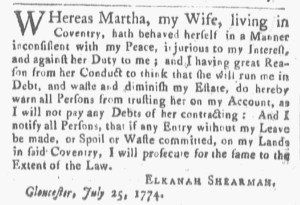
That did not mean that the Providence Gazette did not carry local news. Indeed, the advertisements, including legal notices, kept readers updated about some of what was occurring in Providence and nearby towns. In Johnston, Israel Mathewson, Jr., contended with a case of fraud and sought to warn the public against becoming victims of an unscrupulous forger. He described a “negotiable promissory Note, for the Sum of Twenty-eight Pounds Thirteen Shillings, from me to one Joseph Aldrich.” That instrument, Mathewson exclaimed, “is false and counterfeited, the Forgery being so gross, that the Author had not even the Precaution to spell my Name right.” He cautioned others not to “unwarily” accept the note because “I am determined to prosecute for the Forgery, instead of paying the Contents.” Reading that news among the advertisements in the Providence Gazette had the potential to prevent trouble and inconvenience. In another notice, Elkanah Shearman of Glocester revealed discord within his household, asserting that his wife, Martha, then “living in Coventry, hath behaved herself in a Manner inconsistent with my Peace, injurious to my Interest, and against her Duty to me.” He feared that she “will run me in Debt” as well as “diminish my Estate.” Accordingly, he issued instructions that he would pay “any Debts of her contracting,” expecting merchants, shopkeepers, and other purveyors of goods and services to take note. Furthermore, he threatened to prosecute for any “Spoil or Waste” on his land or even “Entry without my Leave.” Martha did not possess any authority to grant access on behalf of her husband. Her husband expected others to take note of this news.
Several other advertisements delivered local news to readers of the Providence Gazette. Although John Carter, the printer, limited the amount of local news he selected to publish under the header “PROVIDENCE, August 6,” that did not mean that the newspaper did not contain news from nearby towns. Advertisers placed notices for a variety of purposes, many of them delivering news in an alternate format.