September 29

What was advertised in a colonial American newspaper 250 years ago today?
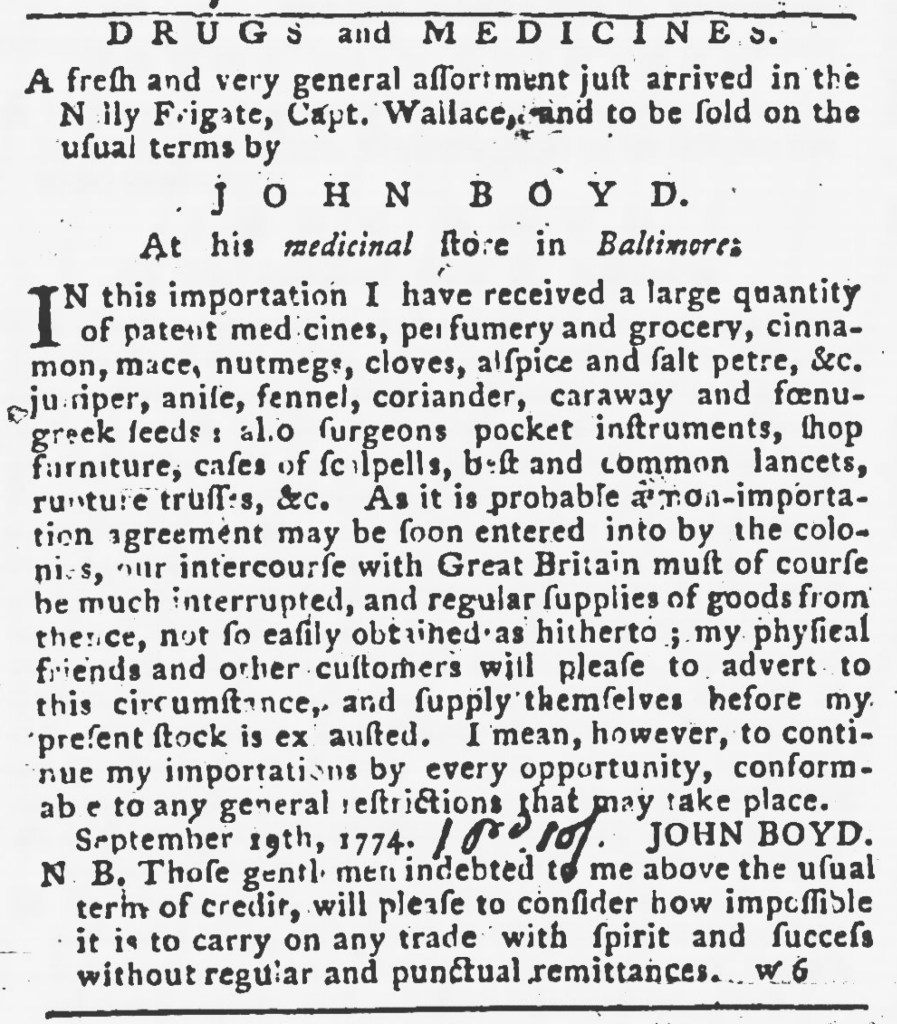
Maryland Gazette (September 29, 1774).

“It is probable a non-importation agreement may be soon entered into by the colonies.”

In the fall of 1774, John Boyd advertised the “DRUGS and MEDICINES” available at “his medicinal store in Baltimore” in both the Maryland Gazette, published in Annapolis, and the Maryland Journal, published in Baltimore.  The latter was still so new that the apothecary realized many of his prospective customers still relied on the former as their local newspaper.  He reported that he just imported a “fresh and very general assortment” of patent medicines, “perfumery and grocery” items, spices, and medical equipment.

Boyd also leveraged current events in hopes of moving his merchandise.  At that moment, the First Continental Congress was meeting in Philadelphia, deliberating over responses to the Coercive Acts passed after the Boston Tea Party.  He reminded readers that “it is probable a non-importation agreement may be soon entered into by the colonies” and when that happened “our intercourse with Great Britain must of course be much interrupted, and regular supplies of goods from thence, not so easily obtained as hitherto.”  That being the case, he advised doctors, his “physical friends,” and his other customers to “supply themselves before my present stock is exhausted.”  In other words, they needed to make purchases while the items they needed or wanted were still available.  A boycott would result in scarcity and, eventually, empty shelves, storerooms, and warehouses.  Boyd was not the only entrepreneur making that argument.  In Charleston, Samuel Gordon recommended to “the Ladies” that they needed to buy his textiles, accessories, and housewares while supplies lasted because “a Non-importation Agreement will undoubtedly take Place here.”  Boyd’s advertisement made clear that it was not solely “the Ladies” who needed to worry about politics causing disruptions in the marketplace.

He vowed to do what he could to limit the effects, stating that he would “continue my importations by every opportunity,” though he carefully clarified that he would do so “conformable to any general restrictions that may take place.”  He would continue accepting shipments for as long as possible, replenishing his stock to ward off scarcity, yet there would come a time that he would have to yield to whatever agreement colonizers adopted.  His advertisement preemptively suggested to prospective customers that they should check with him when they discovered that other apothecaries no longer stocked their usual wares.  Colonizers had experienced nonimportation twice in the past decade, first in response to the Stamp Act and later in response to the duties on certain imported goods in the Townshend Acts.  Savvy entrepreneurs like Boyd reminded them how to prepare for what looked to be inevitable disruptions.

June 5

What was advertised in a colonial American newspaper 250 years ago this week?

Jun 5 - 6:2:1768 Pennsylvania Journal
Pennsylvania Journal (June 2, 1768).

“JOHN BOYD, Druggist, Has just imported, and now sells, at BALTIMORE TOWN.”

John Boyd placed an advertisement for “A Neat and general assortment of Drugs, and Medicines” in the June 2, 1768, edition of the Pennsylvania Journal.  Unlike many others who advertised consumer goods and services in the Journal, Boyd did not operate a business in Philadelphia.  Instead, he sold his array of remedies “at BALTIMORE TOWN” in neighboring Maryland. Residents of Philadelphia were not the intended audience for Boyd’s advertisement, especially since several druggists and shopkeepers who stocked medicines among their general merchandise served that busy port city.  Some of them, including Nathaniel and John Tweedy and John Sparhawk, advertised in the same issue that carried Boyd’s notice.

Instead, Boyd sought the patronage of other residents of “BALTIMORE TOWN” as well as colonists who lived in the hinterlands between Baltimore and Philadelphia.  He depended on the wide distribution of the Pennsylvania Journal as a regional newspaper that served readers in Pennsylvania, New Jersey, Delaware, Maryland, and beyond. He expected that readers outside Philadelphia would at least skim the advertisements for local content in addition to reading news items that reported on events throughout the colonies, Europe, and the Atlantic world.  Yet he also realized that other advertisers, especially direct competitors who specialized in medicines, often provided mail order services. Accordingly, he assured potential customers that “The Prices will be the same, or as low as in Philadelphia.” Henry Stuber, a druggist in Lancaster, Pennsylvania, made the same promise in his own advertisement that ran once again in the supplement that accompanied the June 2 edition.

Boyd in Baltimore and Stuber in Lancaster vied for local and regional clients by advertising in a newspaper published in Philadelphia, seizing the best option available to them in the middle of the eighteenth century.  Yet that would not be the case for much longer.  Throughout the years of the imperial crisis and the American Revolution the number of newspapers printed in the colonies and the new nation fluctuated yet expanded over time, a trend that only intensified in the final decade of the eighteenth century as printers in an increasing number of cities and towns published local newspapers.  After all, the fate of the republic, an experiment with an uncertain outcome, relied on educated and informed citizens.  Both before and after the Revolution, the revenues from advertisements contributed to the publication and dissemination of the news, even though conceptions of what counted as a local newspaper for the purposes of advertising changed over time.