January 3

What was advertised in a colonial American newspaper 250 years ago today?

Boston-Gazette (January 3, 1774).

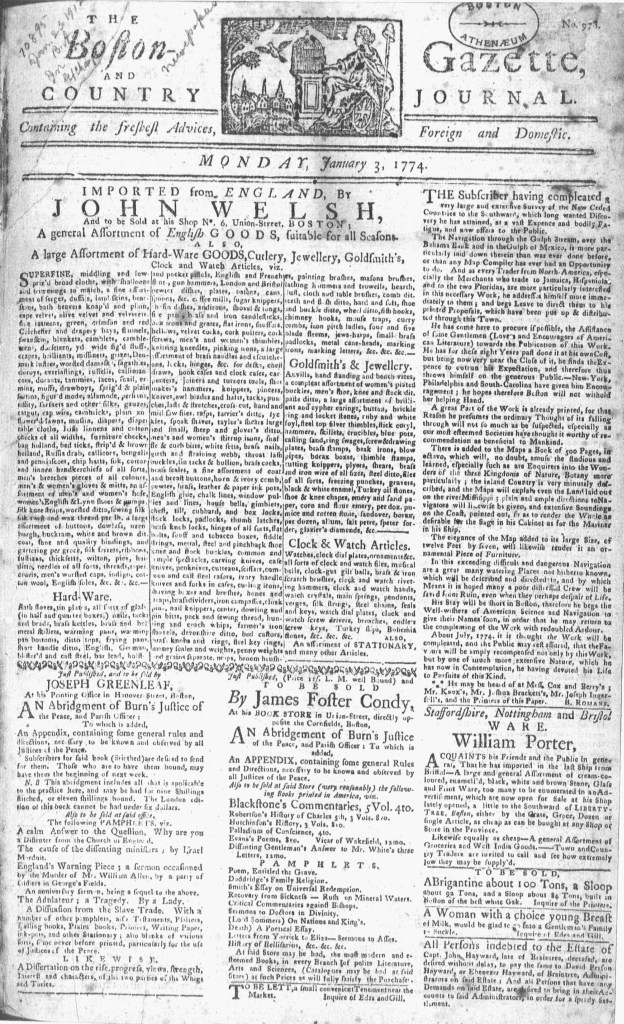
“A large Assortment of Hard-Ware GOODS, Cutlery, Jewellery, Goldsmith’s, Clock and Watch Articles.”

Readers almost certainly noticed John Welsh’s advertisement in the January 3, 1774, edition of the Boston-Gazette.  The shopkeeper announced that he imported and sold “A general Assortment of English GOODS, suitable for all Seasons” and “A large Assortment of Hard-Ware GOODS, Cutlery, Jewellery, Goldsmith’s, Clock and Watch Articles.”  To demonstrate the selection he offered to consumers, Welsh published an extensive list of his inventory.

The length of that list alone distinguished Welsh’s advertisement from others that ran in that issue of the newspaper.  More significantly, the format and placement made his notice notable.  Rather than extending in one column and continuing in the next, the advertisement spanned two of the regular columns, an unusual format in the Boston-Gazette or any other colonial newspaper.  Within the space occupied by the advertisement, the list of goods was divided into three columns with lines, but no space, separating them.  While that made the dense text more difficult to navigate, Welsh did provide some guidance with a series of headers.  The “English GOODS,” mostly textiles and accessories, that appeared first did not have a header, but “Hard-Ware,” “Goldsmith’s & Jewellery,” and “Clock & Watch Articles” each had headers that directed readers to items of interest.

The advertisement’s position on the page also enhanced its visibility.  It ran in the upper left corner on the first page, right below the masthead, making it the first item that readers saw when they perused the first issue of the Boston-Gazettepublished in 1774.  Even if readers who knew that the latest news often appeared on the second and third pages rather than the front page immediately flipped past the first page, they likely noticed Welsh’s advertisement as they skimmed to make sure they did not miss any news that might have appeared on the front page.  After all, the organization did vary from week to week depending on the amount of “intelligence” and advertisements submitted to the printing office.  Welsh’s advertisement dominated the first page, as it would have done on any page.  The unusual format underscored the wide selection of merchandise that he made available to customers.
Boston-Gazette (January 3, 1774).

August 30

What was advertised in a colonial American newspaper 250 years ago this week?

Massachusetts Gazette and Boston Weekly News-Letter (August 27, 1772).

“Many of the above Articles were bought by himself at London, Bristol and Birmingham.”

John Welsh took to the pages of the Massachusetts Gazette and Boston Weekly News-Letter to inform readers that he “Just IMPORTED … An Assortment of English GOODS and HARDWARE” in the summer of 1772.  He made choice a central element of his marketing efforts, providing a list of his merchandise that included “Silk and worsted Mitts and Gloves,” “Silk & Linen Handkerchiefs,” and “Ivory & Ebony Stick Fans.”  He also indicated that he offered choices among certain kinds of goods, including “A good assortment of Hosiery,” “a Variety of other Piece Goods,” “An Assortment of Handles & Escutcheons,” “Files of all sorts,” and “a Variety of other Braziery, and Cutlary.”  In other advertisements, Welsh described himself as a jeweler rather than a merchant or shopkeeper.  He included a separate listing for jewelry in this advertisement, including “A fine Assortment of Cypher, Brilliant, Earing, Button and Ring Stones” and “an Assortment of Jewelry, Stone, Shoe, Knee & Stock Buckles.”

Yet consumer choice was not the only appeal that Welsh made to prospective customers.  He also offered low prices.  A manicule directed readers to a note at the end of his advertisement, a note in which Welsh declared that “Many of the above Articles were bought by himself at London, Bristol and Birmingham, and will be sold low for Cash.”  Welsh suggested that he could offer bargains that customers might not encounter in other shops because he eliminated intermediaries.  Rather than purchase his wares from English merchants who raised the prices that they paid to producers, Welsh traveled to England and purchased much of his inventory directly from the manufacturers in three cities.  He then passed along the savings to his customers.  Merchants and shopkeepers often promoted low prices, but few gave any sort of explanation to convince consumers that they would find the best deals in their shops.  Welsh aimed to give prospective customers a reasonable expectation that he did indeed offer good bargains on an array of merchandise.

April 1

GUEST CURATOR:  Mary Aldrich

What was advertised in a colonial newspaper 250 years ago this week?

Apr 1 - 3:31:1766 Newport Mercury
Newport Mercury (March 31, 1766).

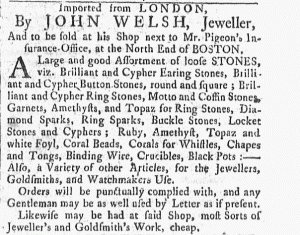
“A Large and good Assortment of loose STONES.”

I found a few things interesting about this advertisement: first, that Welsh’s goods were imported from London; second, the goods he sold; and, third, that his shop was located next to an insurance office.

Compared to other advertisements I chose for this week, Welsh explicitly stated that his goods were imported from London. While the Revolution had not officially started, there was a lot of unrest in the colonies and tension with Britain. On the other hand, from the goods he sold, Welsh would have wanted to let his potential customers know that they were getting a good product.

From the products he advertised, Welsh’s clients were likely elites or merchants with disposable income. I cannot imagine a farmer or shopkeeper with enough money to spend on garnets, topazes, or rubies. This is the first time I have seen an advertisement for such luxury items.

This leads me to the third thing that interested me about this advertisement: the location. Other than using the shop next door as a point of reference, I believe that John Welsh might have been trying to establish subconsciously a sense of security for his customers. By stating that his shop was located next to an insurance office he projected an air of reliability. He likely also has insurance with the office and he was well protected so his customers should have felt the same.

**********

ADDITIONAL COMMENTARY:  Carl Robert Keyes

Like Mary, I am interested in where “JOHN WELSH, Jeweller,” kept shop, but from a different angle. He indicated that he sold “Jeweller’s and Goldsmith’s Work” at “his Shop next to Mr. Pigeon’s Insurance-Office, at the North End of BOSTON.” The advertisement, however, appeared in the Newport Mercury! This caught me by surprise because in the 1760s most men and women who placed newspaper advertisements for consumer goods and services did so only in publications printed in the city or town where they operated their business. They targeted their marketing at relatively local consumers, those who resided in their city or the hinterland served by the city’s newspaper(s). An increasing standardization of goods in eighteenth-century American helps to explain this: shopkeepers in Newport by and large stocked the same merchandise as their counterparts in Boston, Philadelphia, and Charleston. Accordingly, advertisers focused on attracting local customers.

There were, however, some exceptions, including John Welsh. His specialized merchandise may help to explain why he advertised in a newspaper printed and distributed in a port city about seventy miles away.  He needed to reach a critical mass of potential customers. Certainly wealthy merchants who could afford his wares resided in Newport. Note that he stated that “any Gentleman may be as well used by Letter as if present.” Welsh offered a form of mail order shopping for customers who could not visit his shop.