November 21

What was advertised in a revolutionary American newspaper 250 years ago today?
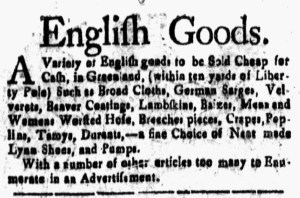
New-Hampshire Gazette (November 21, 1775).

“English Goods … within ten yards of Liberty Pole.”

An anonymous advertiser hawked “A Variety of English goods” in the November 21, 1775, edition of the New-Hampshire Gazette.  The notice included a short list of imported items, mostly textiles, such as “Broad Cloths, … Velverets, … Poplins, Tamys, [and] Durants,” as well as “Mens and Womens Worsted Hose [and] Breeches pieces.”  That list apparently did not cover everything available for sale; the advertisement concluded with a note about “a number of other articles too many to Enumerate in an Advertisement.”

That may have been the advertiser’s choice since some merchants and shopkeepers did occasionally resort to similar language, though it may have been a decision influenced by the printer, Daniel Fowle.  That issue of the New-Hampshire Gazette consisted of only two pages instead of the usual four.  It was the first issue of the New-Hampshire Gazette since November 8.  The printer did not produce and circulate an issue the previous week.  The Adverts 250 Project has tracked apparent disruptions in the supply of paper that had an impact on the New-Hampshire Gazette, yet that was not the only difficulty the printer faced.  In the monumental History and Bibliography of American Newspapers, 1690-1820, Clarence S. Brigham notes that Fowle announced that he printed the November 2 edition “‘with great difficulty’ because of the threatened British attack on Portsmouth” and that the printer “stated that the press ‘is removed to Greenland, about six miles from Portsmouth.”[1]  Those circumstances may have played a role in the decision to publish an abbreviated advertisement that promised a greater selection of goods than appeared in print.

The advertisement presents other questions about consumer culture during the era of the American Revolution.  The Continental Association, a nonimportation and nonconsumption agreement devised by the First Continental Congress, was in effect, yet the unnamed advertiser boldly marketed imported goods.  The headline, “English Goods,” appeared in a larger font than anything else in that issue except for the title of the newspaper in the masthead.  The advertiser conveniently did not mention when the goods had arrived in the colonies, whether they had been transported and delivered before the boycott went into effect.  Yet the advertiser did acknowledge current events when giving the location to purchase the imported goods: “within ten yards of [the] Liberty Pole” in Greenland.  In his recent book on the consumption and politics of tea during the era of the American Revolution, James R. Fichter argues that many tea retailers did not face repercussions while tea importers certainly did.  He further contends that advertisements revealed the reality of local commerce compared to the propaganda that appeared in news articles and editorials about tea.[2]  Perhaps something similar occurred with these “English Goods” in Greenland in the late fall of 1775.

**********

[1] Clarence S. Brigham, History and Bibliography of American Newspapers, 1690-1820 (American Antiquarian Society, 1947), 471.

[2] James Fichter, “Truth in Advertising,” in Tea: Consumption, Politics, and Revolution, 1773-1776 (Cornell University Press, 2023), 132-157.

October 26

What was advertised in a revolutionary American newspaper 250 years ago today?

Rivington’s New-York Gazetteer (October 26, 1775).

“We think proper to notify the public, that the charge against us is wholly and totally false.”

Rumors and misrepresentations spread in conversation and in print when the imperial crisis intensified and hostilities between the colonies and Britain commenced.  Upon finding themselves the subjects of gossip that damaged their reputations, Abraham Hatfield and William Lounsbery published a newspaper advertisement to set the record straight.  It started with an entry in the October 5, 1775, edition of the New-York Journal.  Among the news received from correspondents in the city,  John Holt, the printer, inserted this report: “We understand from North Castle, that on last Saturday night, Abraham Hatfield, Esq; of the White Plains, and Lieutenant William Lownsburry, of Mamaroneck, were discovered in the very act of endeavouring to cut down a Liberty Pole, which was so well fortified with iron that it occasioned their being found out, and for that time disappointed in their loyal attempt.”

Whether or not they held Tory sentiments, Hatfield and Lounsbery vigorously denied that they had acted on them by attempting to cut down the liberty pole.  In the next issue of Rivington’s New-York Gazetteer, published on October 12, they inserted an advertisement that identified the allegations and dismissed them as fabrications.  “WE the subscribers” (or undersigned) “having understood that Mr. Holt has inserted in his last week’s paper, a piece charging us with being concerned, and of even being detected in the fact of attempting to cut down a Liberty-pole – we think proper to notify the public, that the charge against us is wholly and totally false.”  It ran twice more, on October 19 and 26.  Hatfield and Lounsbery disseminated their denial that they had anything to do with the incident multiple times in their effort to combat an accusation made in the public prints just once.

Why didn’t they submit a correction to Holt or place a similar advertisement in the New-York Journal since that newspaper carried the piece that spread what they claimed was misinformation?  Perhaps they did, but Holt, a Patriot printer, felt confident enough in the source of the report that he declined to publish anything submitted by Hatfield and Lounsbery.  Alternately, they may have been so upset with Holt that they did not wish to give him the satisfaction of acknowledging the allegations in his newspapers (or contributing to his advertising revenue) that they instead opted for another newspaper, one with a circulation that rivaled or exceeded the New-York Journal.  Whatever the case, they did not allow the accusation that they were Loyalists who had attempted to cut down a liberty pole go unanswered.

The same issue of the New-York Journal that featured the report that identified Hatfield and Lounsbery as the culprits involved in the liberty tree incident in New Castle also carried letters addressed to Holt concerning rumors that colonizers had scalped a British soldier and cut off his ears after the battles at Lexington and Concord.  The correspondents believed that Holt could “serve the cause of truth and liberty” by publishing their accounts of the actual events, stating that they “buried the dead bodies of the king’s troops that were killed at the north bridge in Concord, on the 19th day of April, 1775,” and none of them “were scalped, not their ears cut off, as has been represented” by those who sought to “dishonour the Massachusetts people, and to make them appear to be savage and barbarous.”  In articles, letters, and advertisements, accusations and rebuttals about the misbehavior and even depravity of Patriots and Loyalists circulated in the public prints during the Revolutionary War.

February 15

What was advertised in a colonial American newspaper 250 years ago today?

Feb 15 - 2:15:1770 New-York Journal
New-York Journal (February 15, 1770).

“The Sons of Liberty in general, might there commemorate the Anniversary of the Repeal of the Stamp-Act.”

As the fourth anniversary of the repeal of the Stamp Act approached, the Sons of Liberty in New York prepared to commemorate the occasion. They encountered some obstacles, however, in planning their celebration. Newspaper advertisements first announced one plan, then later clarified a different one.

The first public notice appeared in the New-York Gazette and Weekly Mercury and the New-York Gazette or Weekly Post-Boy on Monday, February 5.   Advertisements in both newspapers extended a brief invitation: “THE sons of LIBERTY, are desired to meet at the house of Mr. De La Montanye’s, on Monday the 19th day of March next, to celebrate the repeal of the detestable and inglorious STAMP-ACT.” A slightly longer version appeared in the New-York Journal three days later. It advised that the “friends to Liberty and Trade, who formerly associated together at Barden’s, Jones’s and Smith’s to celebrate the anniversary of the repeal of the Stamp Act. Are requested to meet for that purpose on Monday the 19th of March next, at the house of Mr. Abraham De La Montagnie.”

Plans for a celebration were off to a good start, except that apparently no one had consulted with de la Montaigne about gathering at his house. He inserted his own advertisement in the February 8 edition of the New-York Journal in response to “AN Advertisement having appeared in last Monday’s papers, inviting the Sons of Liberty to dine at my house … to celebrate the anniversary of the repeal of the Stamp Act.” De la Montaigne did indeed plan to host a celebration, but not for those who had placed an advertisement without his knowledge. He asserted that his establishment had already been booked “by a great number of other gentlemen” and, as a result, he “shall not be able to entertain any other company than those gentlemen and their connections who engaged my house for that day.” The compositor thoughtfully positioned the two advertisements, with their conflicting information about an upcoming gather of the Sons of Liberty, one after the other.

A week later the organizers announced a new plan to “commemorate the Anniversary of the Repeal of the Stamp-Act.” When they discovered that de la Montaigne’s house was not available, a “Number of the Sons of Liberty in this City” set about “purchasing a proper House for the Accommodation of all Lovers of freedom on that Day, and for their Use on future Occasions, in the Promotion of the Common Cause.” They acquired a “Corner House in the Broad-Way,” appropriately located “near “Liberty-Pole.” In contrast to the event slated for de la Montaigne’s house, the celebration at this corner house was open “without Discrimination” to “all the Sons of Liberty … who choose to commemorate that Glorious Day.” In addition, the advertisement extended an invitation to “Sons of Liberty” to meet at the house on Tuesday evening as well, presumably to continue organizing against abuses inflicted on the colonies by Parliament.

This series of advertisements in New York’s newspapers demonstrates some disorder when it came to marking the anniversary of such an important event at a time when colonists in that city and elsewhere worked for the repeal of the Townshend Acts that infringed on their liberty much like the Stamp Act had done. One cohort of celebrants confined their event to a small number of gentlemen, while organizers of another event emphasized that all were welcome to participate in the “Promotion of the Common Cause.” Who participated in these two commemorative events? Was the one at de la Montaigne’s house limited only to the better sorts who claimed leadership of the Sons of Liberty? Did patriots from humble backgrounds plan and participate in the commemoration at the corner house “near Liberty-Pole”? Did participants in the two events share a vision of what they hoped to accomplish in their struggle against Parliament? These advertisements suggest that New Yorkers may have attached different meanings to the repeal of the Stamp Act and what they hoped to accomplish as they pursued further resistance efforts in the early 1770s.