April 16

What was advertised in a colonial American newspaper 250 years ago this week?

Rivington’s New-York Gazetteer (April 13, 1775).

“Being fully determined not to be undersold by any person whatever.”

A “NEW ADVERTISEMENT BY RICHARD DEANE, Distiller,” ran in the April 13, 1775, edition of Rivington’s New-York Gazetteer.  Even though it had a dateline from two months earlier, “Feb. 10, 1775,” and had been running for several weeks, it still merited being called a “NEW ADVERTISEMENT” because it displaced another advertisement that Deane regularly placed in New York’s newspapers for many months.

The distiller took to the pages of the newspaper with some fanfare to inform “the public, my friends and customers” that he would not be undersold by any of his competitors who marketed their own “brandy, Geneva, and cordials.”  He believed that he had lost some customers to other distillers, prompting him to proclaim that he “can afford to sell said liquors on as cheap terms as any others can theirs, of an equal quality.”  Moreover, he deserved special consideration because “it cannot be denied, that I was the first distiller that ever made brandy and geneva, for sale in this province, … introducing a business, whereby the country saves annually large sums of money, that must otherwise have gone to foreign parts.”  Consumers should purchase his liquor, he asserted, to support local industry and, especially, the entrepreneur who took the risk of establishing the trade in the colony.  In turn, they could depend on what they spent supporting the local economy.

At the same time, Deane made appeals to quality.  He declared that even though he lowered his prices considerably, he still made “brandy and geneva of a full quality, and a high proof, as usual.”  He also pledged that he would not “diminish the goodness of my cordials, in any respect whatever.”  Furthermore, the “great demand for my liquors in most parts of North-America … is sufficient proof of their excellence.”  Consumers should trust existing customers, the distiller reasoned.  To encourage them to do so, he offered a price match guarantee.  He listed the prices the prices per gallon of brandy, gin, and several cordials, but also declared “that if any other person sells liquors of an equal quality with mine, cheaper than the rates underneath, I will immediately sell at the same price, being fully determined not to be undersold by any person whatever.”  Deane recognized that he lost customers because other set lower prices, but he aimed to win them back and gain new ones in the process.

May 25

What was advertised in a colonial American newspaper 250 years ago today?
Pennsylvania Gazette (May 25, 1774).

“His Liquor shall ever be pure and unmixed.”

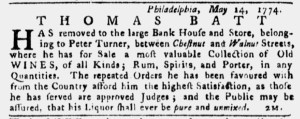
Thomas Batt believed in the power of advertising to yield success for his business.  In 1774, he took to the pages of the Pennsylvania Gazette to announce that he had “opened his WINE and SPIRIT STORE” on Water Street in Philadelphia, pledging “to render the retailing of Liquors as compleat and convenient to the Public, as it is in the Power of Expence and strict Attention to do.”  Not long after that advertisement concluded its run, Batt placed another advertisement, this one dated May 14, to alert the public to his new location at “the large Bank House and Store … between Chestnut and WalnutStreet.”

He took the opportunity to review his inventory with prospective customers, asserting that he stocked “a most valuable Collection of Old WINES, of all Kinds” as well as “Rum, Spirits, and Porter, in any Quantities.”  Batt made a similar appeal about customers purchasing whatever quantity they desired in his previous advertisement, declaring that he was “determined to sell any Quantity, from a Pipe [a large barrel] to a Gallon.”  Perhaps he sought to distinguish himself from local vendors known for selling only large quantities or only small quantities.  Batt emphasized convenience in his initial advertisement; allowing consumers to select the quantity that suited their needs helped him to deliver on that promise.

He also highlighted quality and satisfaction.  He concluded his advertisement with an assurance that “his Liquor shall ever be pure and unmixed.”  Batt did not water down his wine or dilute higher quality spirits with lesser quality ones to increase his profit margins by fooling customers.  The retailer was well on his way to securing a favorable reputation, especially considering the “repeated Orders” he received from “approved Judges” of wines and spirits.  Batt hoped that existing clientele would follow him to his new location as well as new customers seeking him there.  His advertisements suggested a variety of reasons for choosing him over other retailers.

June 19

What was advertised in a colonial American newspaper 250 years ago today?

Jun 19 - 6:19:1770 South-Carolina Gazette and Country Journal Supplement
Supplement to the South-Carolina Gazette and Country Journal (June 19, 1770).

“A Discount of 5 per Cent. at least.”

In the summer of 1770, David Baty and Company advertised a variety of liquors available at their store in Charleston.  Their notice in the supplement to the June 19 edition of the South-Carolina Gazette and Country Journal listed “RUM of different Qualities,” brandy, Madeira, claret, port, and “a Variety of other WINES.”  Customers could select the quantity they desired.  For rum and brandy, that meant by the hogshead, quarter cask, or “smaller Quantity,” but not less than three gallons.  For the wines, they could select among pipes, casks, and bottles.

Baty and Company encouraged customers to make larger purchases.  To that end, they offered “a Discount of 5 per Cent. at least” for buying “any considerable Amount,” suggesting that they applied even more significant discounts as customers increased their orders.  The partners did not list any prices to capture the attention of prospective customers; instead, they asked them to imagine a different kind of bargain available at their store.

They also provided a discount to customers who paid cash rather than made their purchases on credit.  The same issue of the South-Carolina Gazette and Country Journal included several notices calling on customers and others to settle overdue accounts.  Some of those advertisements included threats to place delinquent “Accounts in the Hands of a Lawyer.”  Baty and Company sought to avoid the hassle and expense of chasing down customers for payment at a later date, so they offered an incentive for paying with “Ready Money” at the time of sale.

Purveyors of goods and services frequently trumpeted their low prices in eighteenth-century newspaper advertisements.  Baty and Company took a different approach.  The partners asked prospective customers to consider how they could play a role in bringing down prices by ordering “any considerable Amount” or paying in cash, actions that provided even greater benefits to Baty and Company than simply making a sale.

March 2

GUEST CURATOR:  Trevor Delp

What was advertised in a colonial newspaper 250 years ago this week?

Mar 2 - 2:28:1766 New-Hampshire Gazette
New-Hampshire Gazette (February 28, 1766).

“AS many Persons Licenced to sell Spirituous LIQUORS … have neglected to render their Accounts of Sale of such Liquors.”

During the eighteenth century in North America the production and distribution of rum was becoming increasingly popular. In 1733, Great Britain enacted the Molasses Act as apart of the Navigation Acts. The Molasses Act imposed a tax on molasses, sugar, and rum imported to the colonies. This act was largely ignored by the colonists and loosely enforced by the British. Several years later it was replaced by the Sugar Act of 1764. This act was designed to impose taxes at half of the rate that the Molasses Act did, but be strictly enforced. Many of these acts were put into place to rescue Britain from the enormous debt it had allotted during the Seven Years War, although the colonists did not respond well to Britain’s acts. Many of the colonists felt that they were not responsible for the debt Britain had acquired over the Seven Years War and were reluctant to give in.

In addition, colonists were used to taxing themselves, such as through the local excise tax George Jaffrey mentions in this advertisement threatening prosecution against colonists who had been cheating the taxes. Advertisements like the one here are interesting because they were a broad way for officials to address the public without physical confrontation that could result in further uproar and unrest. As the local receiver of the colony’s excise taxes, Jaffrey made it known to colonists that they were no longer to break the law and go unnoticed and that they must now reconcile their actions or face prosecution.  He took this action at the same time Parliament cracked down on colonists with the Sugar Act.

**********

ADDITIONAL COMMENTARY:  Carl Robert Keyes

NH Gaz 2:28:1766 Notice from Printers
New-Hampshire Gazette (February 28, 1766).

Colonists were indeed accustomed to raising revenues through taxes they assessed internally via their colonial legislatures, which helps to explain why they bristled so much when Parliament stepped in and attempted to enact and better enforce new methods of raising revenues through collecting taxes throughout the empire.

Edward J. Perkins compiled a list of the “Types of Domestic Taxes, 1763-1775” enacted locally by colonial assemblies in the period between the Seven Years War and the Revolution.[1] Examining the many kinds of taxes colonists already paid (or were expected to pay but often avoided, as Jaffrey’s notice indicated) offers additional context for understanding why they reacted so vehemently to Parliament’s new efforts to tax and regulate the colonial economy in the 1760s and 1770s.

  • Land – unimproved: Rhode Island, Pennsylvania
  • Land – assed value: Massachusetts, Rhode Island, Connecticut, Pennsylvania, New Jersey
  • Land – per acre: Virginia, Maryland, South Carolina, Georgia
  • Other property – assessed: Massachusetts, New Jersey, South Carolina
  • Excise – liquor, etc. – New Hampshire, New York, Maryland, Virginia, North Carolina
  • Merchant profits – Massachusetts, New Hampshire, Pennsylvania, Connecticut, Rhode Island, South Carolina
  • Import – finished goods: Pennsylvania, New York, Georgia
  • Import – slaves: New York, Maryland, South Carolina
  • Export – tobacco: Maryland, Virginia
  • Poll – flat: Maryland, Virginia, North Carolina
  • Poll – linked to wealth: Connecticut, Massachusetts, Rhode Island
  • Poll – discriminatory toward free blacks: South Carolina, Georgia

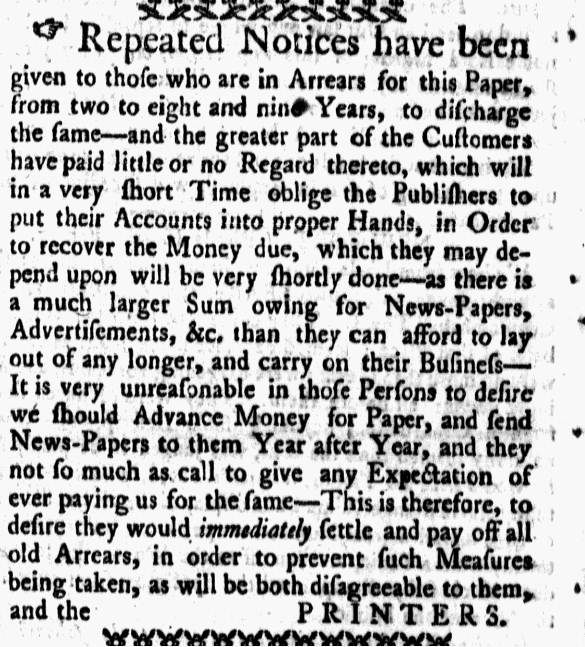
The advertisements in this particular issue of the New-Hampshire Gazette indicate that “Persons Licenced to sell Spirituous LIQUORS” were not the only people who neglected to settle up their accounts. The printers inserted this notice, stating that “there is a much larger Sum owing for News-Papers, Advertisement, &c., than they can afford to lay out any longer.” They called on debtors to “immediately settle and pay off old Arrears” and, not unlike Jaffrey, the printers threatened “such Measures being taken, as will be … disagreeable” to those who did not pay.

**********

[1] Edward J. Perkins, The Economy of Colonial America, 2nd ed. (New York: Columbia University Press, 1988), 191.