What was advertised in a revolutionary American newspaper 250 years ago today?
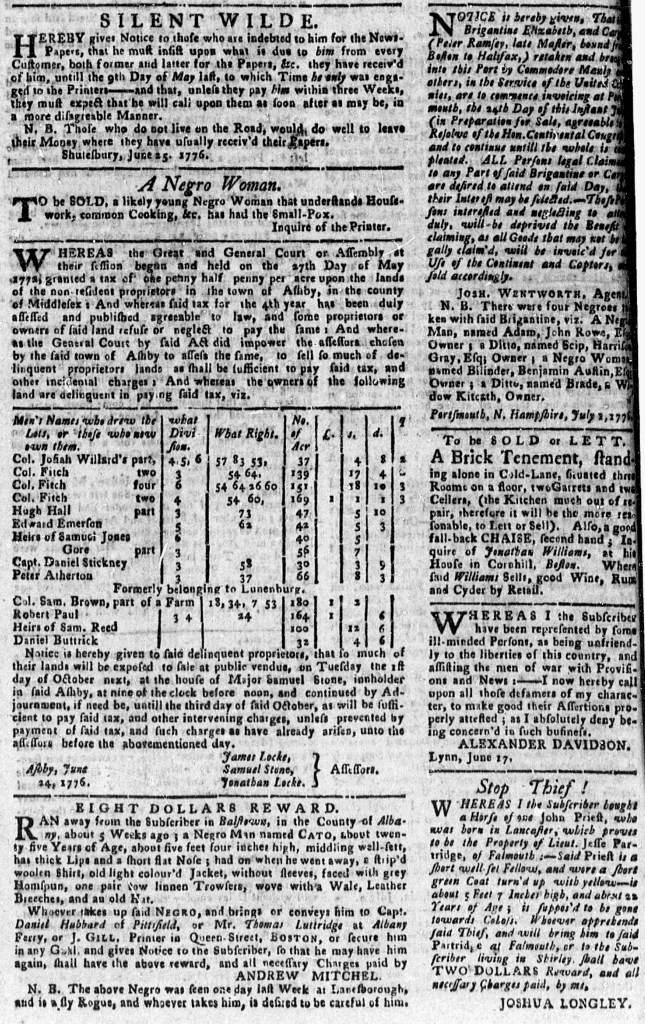
“WHEREAS the Great and General Court …”
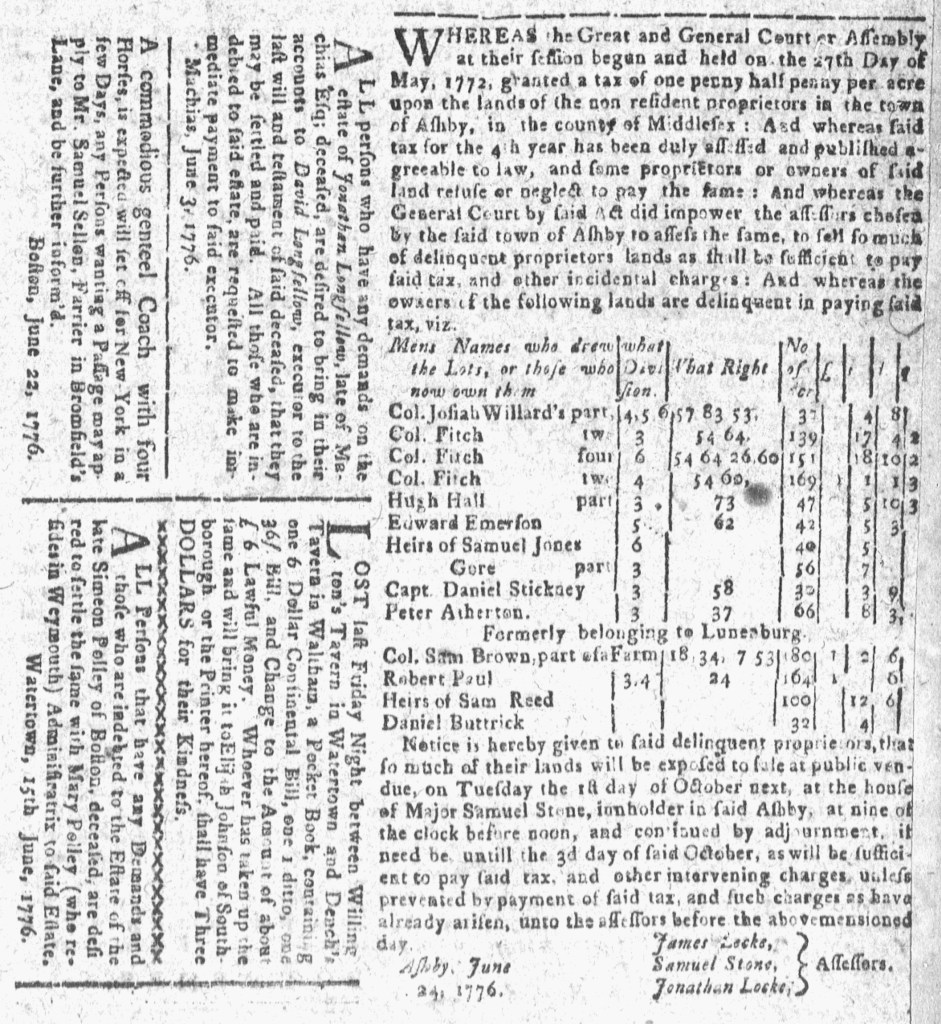
John Gill, the printer of the Continental Journal, faced the same dilemma as his former partner, Benjamin Edes, the printer of the Boston-Gazette, when he received a legal notice with so many columns that its width exceeded that of the columns in his newspaper. Edes had rotated some advertisements to run perpendicular to the rest of the text on the page, thus maximizing space while also eliminating the need to reset type for other advertisements that followed the standard column width. Gill made a different decision in his effort to cover every inch of the page with content. He opted for the same wider width for news and advertising that appeared in the same column as the legal notice the first time that it ran on July 4, 1776, and a narrower width for news and advertising in another column on the same page.
Three advertisements had wider widths: one placed by Silent Wilde, a post rider, calling on customers to make payment for his services, another in which Andrew Mitchel offered a reward for the capture and return of Cato, an enslaved man who liberated himself by running away, and an anonymous notice describing an enslaved woman for sale with instructions for interested parties to “Inquire of the Printer.” Those three advertisements remained in a block of text with the legal notice for each of its three appearances, though sometimes in different order. One advertisement that accompanied the legal notice the first time it appeared had a narrower width. Beneath a headline that exclaimed “Stop Thief!” Joshua Longley described a man who sold him a stolen horse. That advertisement also remained in the same block of text with the legal notice. Gill did not need to publish news that appeared in the narrow column a second time. Instead, he reset the type for three advertisements that previously appeared with the standard width, making them narrower but longer. This did not save time and effort as Edes had done in the Boston-Gazette, but it did have all the text on the page printed in the same direction instead of rotating some advertisements to run perpendicular to the rest of the content. Both solutions filled every inch of the page, an especially important consideration considering the shortages of paper during the Revolutionary War.