What was advertised in a revolutionary American newspaper 250 years ago today?
Constitutional Gazette (August 26, 1775).
“He proposes to continue his business of pickling oysters and lobsters.”
John Anderson’s effort to solicit advertisements in the August 23, 1775, edition of the Constitutional Gazette yielded results. When he published the next issue three days later, the final page carried four advertisements. The printer was responsible for two of them, one for a pamphlet, “Defensive War in a Just Cause Sinless,” and the other for “All sorts of Blanks used in this Province,” children’s books, and “New Pamphlets.” Another advertisement hawked “JOYCE’s Grand American Balsam,” a patent medicine sometimes advertised in other newspapers. Customers could acquire the medicine and directions from “Mrs. Joyce, at Brookland Ferry” and from “Messrs. Anderson, Gaine, and Rivington, Printers in New-York.” Although Edward Joyce’s widow or the other two printers may have played a role in placing the advertisement, Anderson certainly had a hand in publishing it.
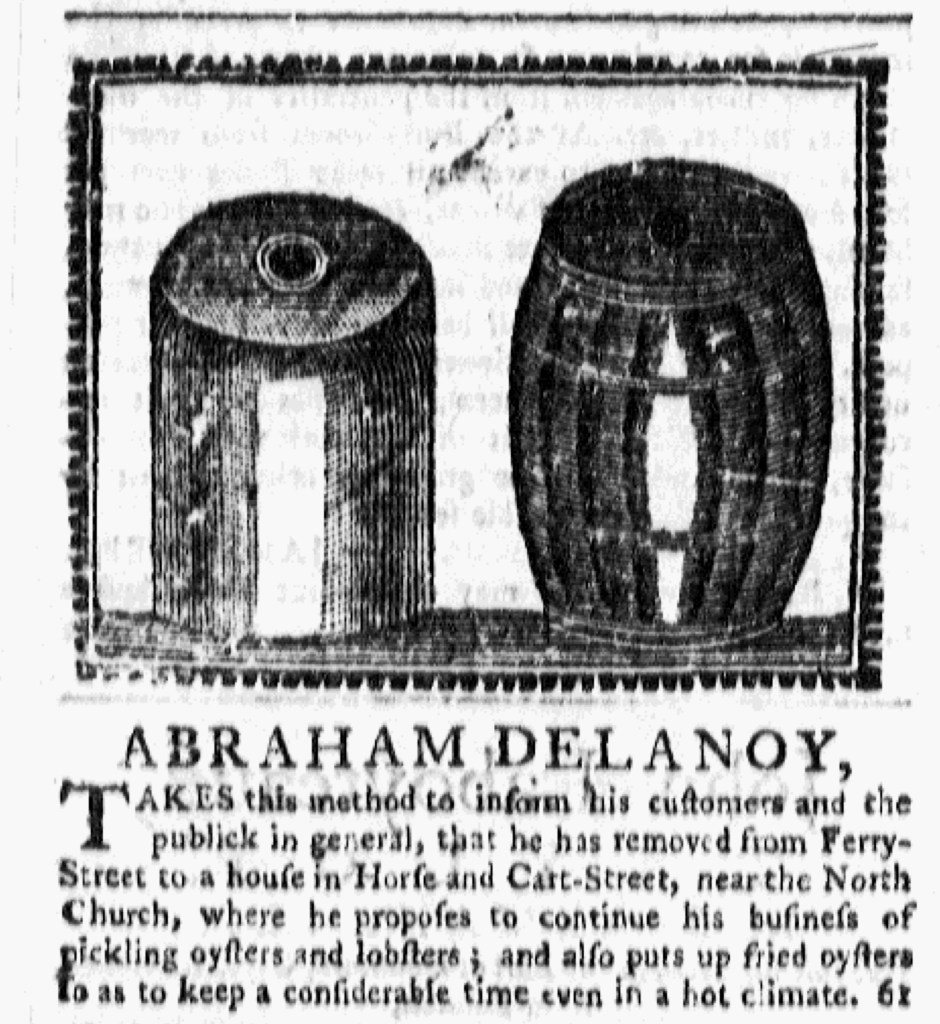
One advertisement, however, had not connection to the printer of the Constitutional Gazette. Abraham Delanoy placed a notice “to inform his customers, and the public in general, THAT … he proposes to continue his business of pickling oysters and lobsters; and also puts up fired oysters so as to keep a long time even in a hot climate.” His advertisement featured a woodcut depicting a lobster trap and an oyster cage, accounting for half the space and attracting attention in a newspaper that did not have any other visual images. That woodcut previously accompanied Delanoy’s advertisement in Rivington’s New-York Gazetteer. He either retrieved it from another printing office to deliver to Anderson or carefully stored it in anticipation of using it again. Delanoy also replicated much of the copy from that previous advertisement. The similarities suggest that he either copied directly from it, making minor revisions as he went, or indicated changes directly on a clipping of the advertisement. Some readers likely recognized Delanoy’s advertisement, but this time it generated revenue for John Anderson and the Constitutional Gazette. The printer must have been pleased that Delanoy set an example for others to advertise in this new publication.
What was advertised in a colonial American newspaper 250 years ago today?
Supplement to Rivington’s New-York Gazetteer (July 21, 1774).
“He proposes to continue his business of pickling oysters and lobsters.”
James Rivington had sufficient content to include in the July 21, 1774, edition of Rivington’s New-York Gazetteer that he distributed a two-page supplement with the standard four-page issue. The items in that supplement consisted entirely of paid notices, dozens of them. In addition, advertising accounted for several columns alongside the news in the standard issue. Only a few of those advertisements, however, featured visual images to aid in drawing the attention of readers. Three had stock images of ships at sea, one for a sloop for sale, one seeking passengers and freight for a voyage to South Carolina, and one that “WANTS A FREIGHT, To any part of EUROPE.” The printer supplied stock images for those notices.
Three other advertisements sported woodcuts commissioned by the advertisers for their exclusive use, each of them providing a visual representation of some aspect of their business. Thomas Ash, “WINDSOR CHAIR-MAKER,” once again incorporated the image of a chair that had accompanied his advertisements for several months. Abraham Delanoy and James Webb also deployed images that had become familiar sights to readers over several weeks. Delanoy advised readers that he moved to a new location where he “continue[d] his business of pickling oysters and lobsters” and “puts up fried oysters so as to keep a considerable time even in a hot climate.” A woodcut depicting a lobster trap and an oyster cage appeared above his message to consumers. Like Ash, Delanoy devoted as much space to his image as his copy, apparently believing that a picture was indeed worth a thousand words. He trusted that the woodcut would as effectively market his wares as anything he might write. He may have also figured that he had already established his reputation in the local marketplace so his primary purpose for the image could have been increasing the likelihood that customers saw his announcement that he had moved “from Ferry-Street to a house in Horse and Cart-Street.”
Supplement to Rivington’s New-York Gazetteer (July 21, 1774).
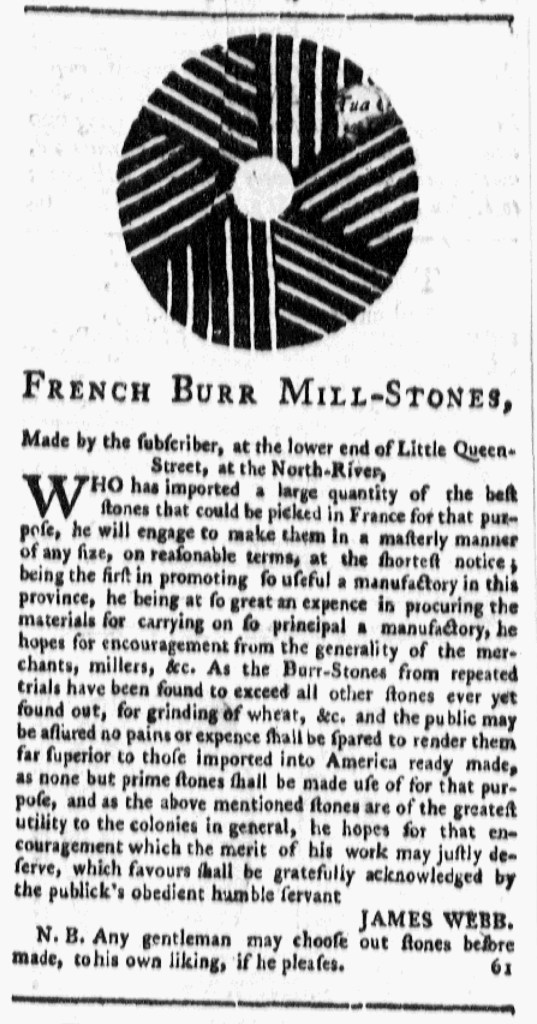
James Webb, on the other hand, used his woodcut of a millstone to advance a new endeavor unfamiliar to readers of Rivington’s New-York Gazetteer. Accordingly, he devised significantly more copy to sell the “FRENCH BURR MILL-STONES” that he made from “the best stones that could be picked in France for that purpose.” Webb claimed that he was “the first in promoting [or undertaking] so useful a manufactory in this province,” making it even more necessary that he provide an overview of his enterprise. He asserted that he made millstones “in a masterly manner of any size, on reasonable terms, at the shortest notice,” succinctly incorporating appeals to quality, price, and convenience. He suggested that millers, merchants, and others were already familiar with such millstones and knew that “from repeated trials [they] have been found to exceed all other stones ever yet found out.” His millstones had the added advantage of being made in the colonies at a time that colonizers discussed the prospects of boycotting goods imported from Britain in response to the Coercive Acts passed by Parliament following the destruction of tea now known as the Boston Tea Party. Webb pledged that “no pains or expence shall be spared to render [his millstones] far superior to those imported into America ready made,” while simultaneously reminding readers that they had a duty to support domestic manufactures. To that end, his millstones “are of the greatest utility to the colonies in general.” Just in case all of that did not convince prospective customers, Webb added a nota bene advising that “Any gentleman may choose out stones before made, to his own liking, if he pleases.” In the end, that would yield even greater satisfaction with the finished product.
In each instance, the woodcuts that Ash, Delanoy, and Webb included in their advertisements happened to be the only visual images that appeared on that page of the July 21 edition of Rivington’s New-York Gazetteer. Most likely that was by coincidence rather than design, yet it still helped in distinguishing their notices from others. (The three images of ships appeared in a cluster, one after the other, on another page.) Ash, Delanoy, and Webb had to pay additional fees to commission their woodcuts, but they very well may have determined that doing so was worth the investment.