August 3

What was advertised in a revolutionary American newspaper 250 years ago today?

Constitutional Gazette (August 3, 1776).

“Four weeks, for FIVE Shillings, and One Shilling, for each week afterwards.”

When the Constitutional Gazette completed its first year of publication, John Anderson, the printer, updated the masthead to include both a volume number and an issue number.  The masthead previously featured only an issue number.  The July 31, 1776, edition was the first with both: “VOL. II” AND “NUMB. 105.”  That was not the only way that Anderson marked the conclusion of one year and the beginning of another.  The advertisements in the August 3 edition started with a notice from the printer.

Anderson declared that he “takes this method, of returning his unfeigned thanks, to those Gentlemen, who, favoured him, with their custom, for the NEW-YORK CONSTITUTIONAL GAZETTE, of last year, and hopes for a continuance of their favours.”  In addition to expressing appreciation to his subscribers, Anderson encouraged them to renew their subscriptions.  To that end, he pledged that “he shall, still continue, to make it, his constant study and endeavour, that the CONSTITUTIONAL GAZETTE, shall be, a vehicle, of foreign, as well as domestic intelligence.”  In other words, he promised to publish all the news that was fit to print!

He also used the occasion to solicit advertisements.  “Those Gentlemen, who chuse to advertise in the CONSTITUTIONAL GAZETTE,” Anderson declared, “shall, (in a conspicuous manner) be inserted, (if short) four weeks, for FIVE Shillings, and One Shilling, for each week afterwards.”  Most printers did not regularly disclose the fees they charged for advertisement, though they sometimes mentioned “the usual rates” with an expectation that prospective advertisers were already familiar with them.  A few printers included the price of advertising in the masthead or the colophon, but most did not.  That made Anderson’s disclosure of what he charged to run advertisements a relatively rare occurrence.

Subscriptions and advertisements accounted for only two of the revenue streams that Anderson cultivated.  He concluded his notice with a reminder that “Printing, of all sorts,” including handbills, broadsides, trade cards, and other advertising ephemera, “is done, in the neatest manner, with care and expedition, and on the shortest notice” at his printing office.  Anderson commemorated a full year of publishing the Constitutional Gazette by simultaneously thanking his customers and encouraging all readers to place the orders for subscriptions, advertisements, and job printing necessary to keep his press busy and the newspaper in print.  He did not call on subscribers to make overdue payments, as printers often did in their notices, but instead focused on the services he provided.
July 31

What was advertised in a revolutionary American newspaper 250 years ago today?

Constitutional Gazette (July 31, 1776).

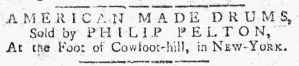
“AMERICAN MADE DRUMS.”

“Buy American” and “Made in America” are familiar marketing appeals in modern America.  They are also appeals with a lineage that goes back to the eighteenth century, emerging in advertisements in American newspapers even before the Revolutionary War and the Declaration of Independence.  Colonizers participated in a transatlantic consumer revolution that gained significant momentum by the middle of the century.  As part of the process, they followed the lead of their counterparts in Great Britain, both by purchasing an expanding array of clothing and housewares and by thinking about the role of the colonies in an empire defined by commerce rather than by conquest.  On both sides of the Atlantic, people thought of Great Britain as the producer of goods and the colonies as the consumer of goods.  That led to a trade imbalance that some colonizers sought to address by producing more good for their own consumption, rather than exporting raw materials, even before the imperial crisis.

Once Parliament attempted to regulate trade and impose duties on imported goods after the Seven Years War, some colonizers became more insistent that they should increase their “domestic manufactures” or goods produced in the colonies for local consumption.  A series of nonimportation agreements adopted for the purpose of gaining political leverage via commerce (or the lack of commerce) in the 1760s and 1770s made “Buy American” and “Made in America” appeals even more common as producers and consumers both imagined alternatives to goods imported from Great Britain.  Once the Revolutionary War began, such appeals had even greater significance.  Advertisers sometimes included short editorials in their newspaper notices to convince consumers to purchase their “domestic manufactures,” but not everyone considered that an essential part of their marketing efforts.  For instance, a brief advertisement in July 31, 1776, edition of the Constitutional Gazette – just three lines – proclaimed, “AMERICAN MADE DRUMS, Sold by PHILIP PELTON, At the Foot of Cowfoot-hill, in NEW-YORK.”  Pelton did not consider it necessary to elaborate on the drums he sold.  He apparently considered “AMERICAN MADE” a sufficient pitch to attract customers looking to outfit companies of soldiers fighting the war for independence.

July 10

What was advertised in a revolutionary American newspaper 250 years ago today?

Constitutional Gazette (July 10, 1776).

“A Choice Collection of American Liberty Songs and Pamphlets to be sold by the Printer.”

On July 10, 1776, the Constitutional Gazette became the first newspaper published in New York to print the Declaration of Independence.  John Anderson, the printer, devoted the first two pages of that issue to “A Declaration by the Representatives of the United States of America, in General Congress assembled.”  The same day, Mary Katharine Goddard printed the Declaration of Independence in the Maryland Journal and the Baltimore Advertiser.  Unlike most other printers, Goddard inserted as triumphant headline: “THE THIRTEEN United STATES OF AMERICA, Have declared INDEPENDENCY.”  She used decorative type to draw attention to the headline and manicules at either end of the phrase “Have declared INDEPENDENCY” for even more emphasis.  The Declaration of Independence appeared in Dunlap’s Maryland Gazette, also published in Baltimore, the previous day.  The Pennsylvania Gazette and the Pennsylvania Journal, both printed in Philadelphia, also published the Declaration of Independence on July 10, joining other newspapers from that city that already published it.

Maryland Journal (July 10, 1776).

News about independence spread quickly.  No doubt word of mouth carried the news more quickly than printers set type for their newspapers, yet printing the Declaration of Independence in newspapers gave citizens of the new nation the opportunity to examine the complete text for themselves, engaging with the theory of government established in the first paragraphs of the document, the many grievances against the king in the middle, and, finally, the bold action taken by the Continental Congress.  The copy of July 10 edition of the Constitutional Gazette that has been digitized for America’s Historical Newspapers includes a handwritten note above the masthead on the first page: “A Good thing.”  One reader not only perused the Declaration of Independence but also recorded their endorsement of it.

On the final page of that issue, Anderson offered another chance for that reader and everyone else to demonstrate their patriotism.  In a brief but well-timed advertisement, he announced, “A Choice Collection of American Liberty Songs and Pamphlets to be sold by the Printer.”  He likely hoped that the excitement caused by the Declaration of Independence would inspire readers to become consumers of patriotic memorabilia.  After all, they now had even more reason to learn “American Liberty Songs” and join in singing them with their friends and neighbors.

Constitutional Gazette (July 10, 1776).

March 10

What was advertised in a revolutionary American newspaper 250 years ago this week?

Constitutional Gazette (March 9, 1776).

“The surest means to acquire a speedy sale … is to make them of full quality at a moderate charge.”

In March 1776, Richard Deane, a distiller in New York, took to the pages of the Constitutional Gazette to promote the spirits that he “has now ready for sale at his distillery between the College and the North Rover, in Murray Street, near Vaux-Hall.”  He listed a variety of products, including “Cherry Brandy,” “Shrub of the best quality,” “Royal Usquebaugh,” and “Cinamon water.”  Deane expressed confidence in the reputation his spirits earned in the early 1770s.  “The good quality of said DEANE’s liquors,” he proclaimed, “has for several years past been so well experienced, mostly throughout this continent, that they need no other recommendation.”  Consumers far beyond New York, he suggested, had enjoyed the spirits produced at his distillery.  Not content to rest on his laurels, however, Deane declared that “still he is determined, if possible, to make better.”  If customers liked the liquors he previously produced, then they would be even more satisfied with his current and future endeavors.

As part of this promotion, Deane shared his business philosophy, an aspect of his marketing that may have been familiar to readers who had encountered his advertisements in the New-York Gazette and Weekly Mercury and the New-York Journal over the years.  “Being fully convinced by long experience,” the distiller confided, “that the surest means to acquire a speedy sale of the above articles, is to make them of full quality at a moderate charge.”  Accordingly, he was “determined to sell on as reasonable terms as any one else” and give “good attendance” or customer service to “all his Friends and Customers.”  Such pledges became more powerful through repetition.  Deane built his brand by publishing his business philosophy often so consumers would associate the combination of experience, quality, and reasonable prices with him and his distillery.  He apparently considered it an effective marketing strategy since he published advertisements with the same content in multiple newspapers over the course of several years.

February 14

What was advertised in a revolutionary American newspaper 250 years ago today?

Constitutional Gazette (February 14, 1776).

The Devil drives Lord North, and Lord North drives the People.”

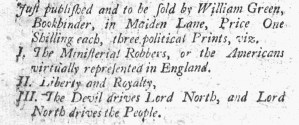
In the February 14, 1776, edition of the Constitutional Gazette, William Green, a bookbinder, advertised “three political Prints” for sale for one shilling each at his shop in Maiden Lane in New York.  He listed the titles, but he did not describe them to prospective customers.  Perhaps he did not wish to pay for the additional space in the newspaper.  Perhaps he thought the titles provided sufficient description.  Perhaps he considered the titles evocative enough to spark curiosity among readers, prompting them to visit his shop to discover for themselves what exactly each print depicted.  After all, titles like “The Ministerial Robbers, or the Americans virtually represented in England” and “The Devil drives Lord North, and Lord North drives the People” simultaneously told a story and expressed support for the American cause.  Notably, the purveyor of these “political Prints” was the first person to advertise Thomas Paine’s Common Sense outside of Philadelphia, doing so just eleven days after Robert Bell, the publisher of the first edition, announced its publication.

Readers may have been familiar with some of the political cartoons that Green advertised.  In the fall of 1775, William Woodhouse, John Norman, and Robert Bell placed an advertisement in the Pennsylvania Journal to promote “The MINISTERIAL ROBBERS; or AMERICANS VIRTUALLY Represented in ENGLAND,” a “SATYRICAL PRINT” that “LATELY ARRIVED FROM LONDON.”  Green may have sold copies from London or an American edition of the print.

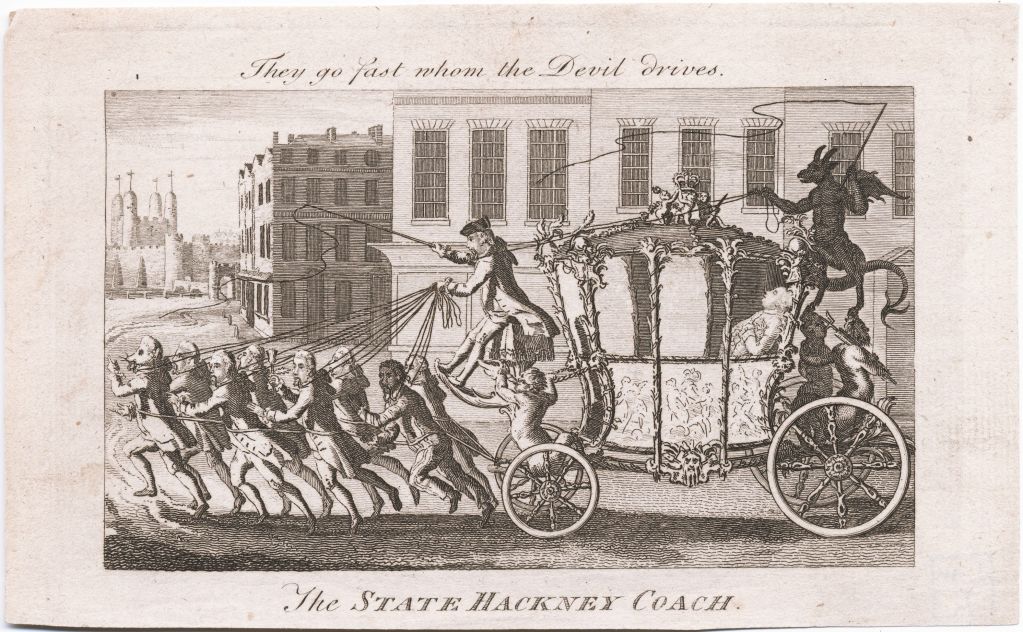
Another of those political cartoons, “The Devil drives Lord North, and Lord North drives the People,” originated in London as “The State Hackney Coach,” a plate that adorned the London Magazine for December 1772.  The print depicted a coach pulled by eight men rather than horses with Lord North, the prime minister, driving them.  Most of those men did not have distinguishing features; they represented any of the members of Parliament and other officials who allowed the prime minister to dominate them.  The first figure had a face that looked more like a rat than a man, additional commentary on the character of those members of Parliament.  Henry Fox, one of North’s proteges, and Jeremiah Dyson, Lord of the Treasury, were recognizable.  Although North drove the men with a whip, a devil perched on the back of the coach had his own whip that he used to steer North’s course.  A caption above the image declared, “They go fast whom the Devil drives.”  Inside the carriage, George III slept, apparently oblivious to any problems.

Green almost certainly displayed these political cartoons in his shop.  Customers who came to purchase Common Sensewould have seen images that worked in tandem with Paine’s attitudes toward monarchy and calls to declare independence.  They may even have decided to purchase both a print and a pamphlet, expressing their own political principles through the choices they made in the marketplace.

“The State Hackney Coach,” a print that adorned the London Magazine (December 1772). Courtesy Lewis Walpole Library, Yale University.

February 7

What was advertised in a revolutionary American newspaper 250 years ago today?

Constitutional Gazette (February 7, 1776).

A new and correct Edition, of that justly esteemed Pamphlet, called COMMON SENSE.”

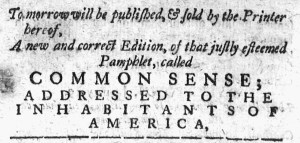
As Robert Bell, the publisher of the first edition of Thomas Paine’s Common Sense, hawked an unauthorized second edition and William Bradford and Thomas Bradford, the printers who collaborated with Paine to publish a new edition with additional content prepared that edition for press, an advertisement for the first edition of Common Sense published beyond Philadelphia appeared in the February 7, 1776, issue of the Constitutional Gazette in New York.  John Anderson, the printer of the Constitutional Gazette, ran a notice announcing, “Tomorrow will be published, & sold by the Printer hereof, A new and correct Edition, of that justly esteemed Pamphlet, called COMMON SENSE; ADDRESSED TO THE INHABITANTS OF AMERICA.”  His advertisement did not go into greater detail about the contents.  Anderson knew very well that other advertisements in the Constitutional Gazette and other newspapers published in New York provided an overview of the sections in Bell’s first edition.  The “justly esteemed Pamphlet” required no further introduction.

Only four weeks passed between Bell’s advertisement promoting the publication of Common Sense in the January 9, 1776, edition of the Pennsylvania Evening Post and Anderson informing readers in New York that they could purchase a local edition.  His newspaper carried the first advertisement for Common Sense in New York, listing William Green, a bookseller, as Bell’s local agent for distributing the pamphlet.  Anderson likely acquired a copy from Green, either purchasing it or accepting it in lieu of payment for the advertisement.  His advertisement for his “new and correct Edition” did not mention the dispute and controversy around the publication of Bell’s unauthorized edition that unfolded in Philadelphia in newspaper advertisements there, though he had likely seen some of those notices.  After all, printers carefully perused newspapers printed in other cities to select content to reprint in their own newspapers.  Anderson focused solely on giving the public greater access to Common Sense (and generating revenue in his printing office).  His local edition met with sufficient success that he eventually published a second edition.

January 31

What was advertised in a revolutionary American newspaper 250 years ago today?

Constitutional Gazette (January 31, 1776).

“BEST Geneva, made and distilled from rye.”

Advertisements for consumer goods and services crowded the pages of early American newspaper.  Did they work?  Unfortunately, that question is difficult to answer.  The advertisements reveal what kinds of marketing appeals merchants, shopkeepers, artisans, and other entrepreneurs thought would resonate with consumers and influence them to make purchases, but they rarely indicated how readers responded.

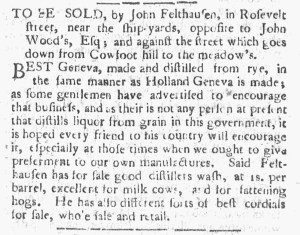
That so many entrepreneurs advertised and that they invested in advertising regularly suggests that they believed that they received a sufficient return on their investment to make the expense worth it.  Consider John Felthausen and his advertisement for “BEST Geneva [or Jenever, a type of gin], made and distilled from rye,” in the January 31, 1776, edition of the Constitutional Gazette.  That was not the first time that Felthausen placed that advertisement.  Three months earlier, he ran an advertisement with nearly identical copy in the New-York Gazette and Weekly Mercury.  If Felthausen believed that previous advertisement had not yielded results, would he have run it again in another newspaper a few months later?

That new advertisement had nearly identical copy, though the compositor for the Constitutional Gazette made very different decisions about the format than the compositor for the New-York Gazette and Weekly Mercury.  Felthausen may have even clipped the advertisement from one newspaper and delivered it to the printing office for the other, making marks on it to indicate copy he wished to update.  Those revisions amounted to adding a sentence at the end: “He has also different sorts of best cordials for sale, wholesale and retail.”  He retained his appeal to “every friend to this country” to “encourage” or support his business, “especially at those times when we ought to give preferment to our own manufactures.”  The distiller apparently believed that his previous advertisement met with sufficient success to merit repeating it to hawk both his “BEST Geneva” and additional products not previously included.

January 20

What was advertised in a revolutionary American newspaper 250 years ago today?

Constitutional Gazette (January 20, 1776).

“Now selling by WILLIAM GREEN, Bookseller, in Maiden Lane, New-York.  COMMON SENSE.”

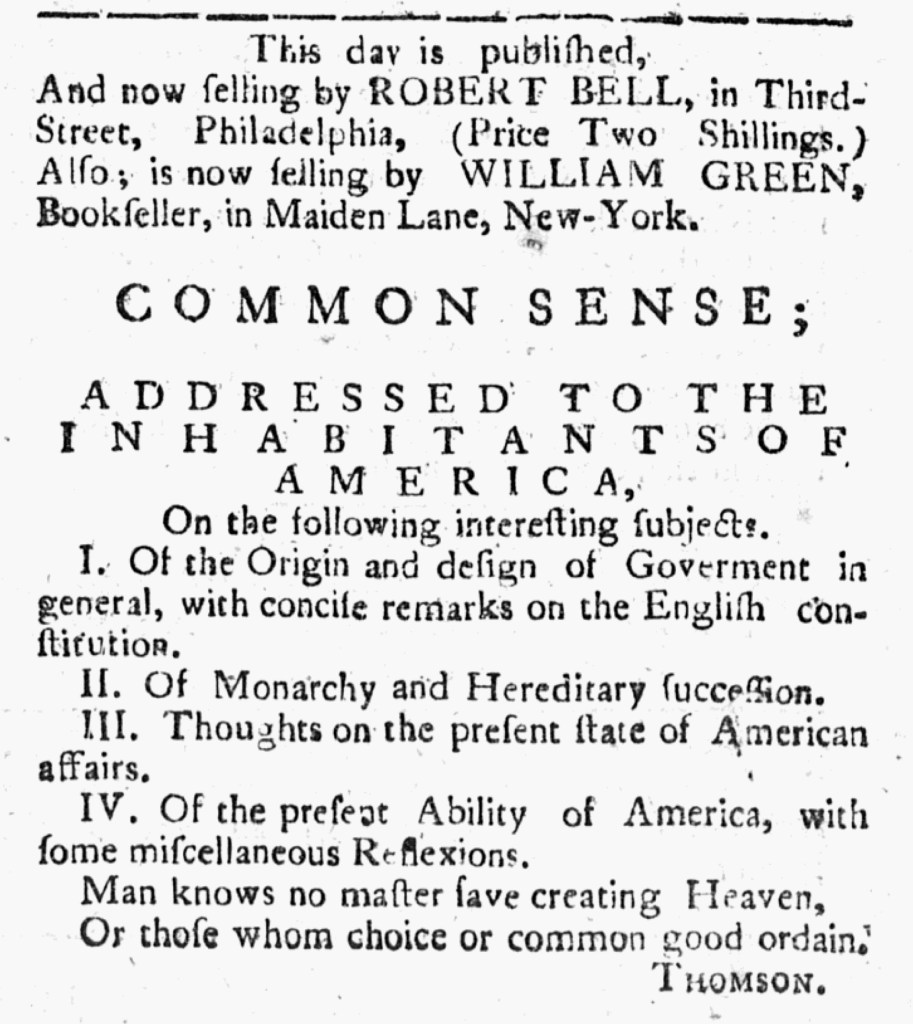
Just eleven days after the first newspaper advertisement for Thomas Paine’s Common Sense appeared in the January 9, 1776, edition of the Pennsylvania Evening Post, the first advertisement for the inflammatory political pamphlet ran in a newspaper outside of Philadelphia.  Within a week, Robert Bell, the publisher of the first edition, inserted advertisements in all six newspapers printed in Philadelphia, including Henrich Millers Pennsylvanischer Staatsbote.  One of the most savvy and influential American printers and booksellers of the eighteenth century, Bell quickly dispatched copies of the pamphlet to New York.  On January 20, the Constitutional Gazette carried an advertisement that nearly replicated those in Philadelphia’s newspapers.

That notice announced the publication of the pamphlet and stated that it was “now selling by ROBERT BELL, in Third-Street, Philadelphia” for two shillings per copy.  Yet prospective customers did not need to send to Philadelphia to acquire copies because the pamphlet was “now selling by WILLIAM GREEN, Bookseller, in Maiden Lane, New-York.”  Like the other advertisements, the notice in the Constitutional Gazette did not identify Paine as the author.  It gave the title of the work, “COMMON SENSE; ADDRESSED TO THE INHABITANTS OF AMERICA,” and listed the various headings for the sections of the pamphlet.  Readers may have already heard about a new pamphlet that took Philadelphia by storm and some of the arguments for declaring independence that it contained, yet such an outline likely told them more than they already knew and whetted their appetites for more.  What did the pamphlet say about “Monarchy and Hereditary succession”?  What kinds of “Thoughts on the present state of American affairs” did it contain?  What did the author think of “the present Ability of America” in its contest against Great Britain?  Even before they saw anything in print, most residents of New York probably first learned about Common Sense via word of mouth.  The advertisement in the Constitutional Gazette offered readers an opportunity to move beyond excited conversations about what they heard the pamphlet said about monarchy, government, and the prospects for declaring independence to obtaining their own copies and reading the treatise for themselves.  It did not take long for advertisements for Common Sense to move beyond Philadelphia’s newspapers to the Constitutional Gazette in New York and other newspapers in other cities and towns.

January 17

What was advertised in a revolutionary American newspaper 250 years ago today?

Constitutional Gazette (January 17, 1776).

“I applied to the French Doctor Blouin, who advised me to make use of his Anti-Venereal Pills.”

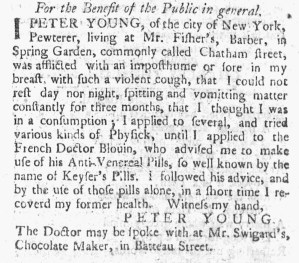
Peter Young, a pewterer in New York, went through quite an ordeal.  According to the advertisement he placed in the January 17, 1776, edition of the Constitutional Gazette, he “was afflicted with an imposthume or sore in my breast, with such a violent cough, that I could not rest day or night.”  In addition, he was “spitting and vomitting matter constantly for three months,” so much so that he thought he “was in a consumption.”  Young sought out medical assistance from several providers and “tried various kinds of Physick,” but none of them could alleviate the disorder that he suffered … at least not until he “applied to the French Doctor Blouin.”  That doctor advised Young “to make use of his Anti-Venereal Pills, so well known by the name of Keyser’s Pills.”  The pewterer followed Blouin’s advice and “by the use of those pills alone, in a short time [he] recovered [his] former health.”

According to the advertisement’s header, Young inserted his testimonial in the Constitutional GazetteFor the Benefit of the Public in general.”  Beneath his signature, a note advised, “The Doctor may be spoke with at Mr. Swigard’s, Chocolate Maker, in Batteau Street.”  The advertisement gave no indication about who added that note.  It could have been Young or it could have been John Anderson, the printer of the Constitutional Gazette, out of his own desire to assist the public.  Most likely, Blouin added that detail and engineered publishing the testimonial while seeking to make it appear that Young published it independently.  After all, if Young pursued that course on his own, solely “For the Benefit of the Public in general,” that made the recommendation even more noteworthy for readers who hoped for relief from similar symptoms.  Blouin previously placed advertisements in the Constitutional Gazette, introducing himself and his pills “TO THE PUBLIC.”  Young’s testimonial supplemented his previous marketing efforts.

November 15

What was advertised in a revolutionary American newspaper 250 years ago today?

Constitutional Gazette (November 15, 1775).

“DR. BLOUIN … makes and sells the Antivenereal Pills, so well known … by the name of Keyser’s Pills.”

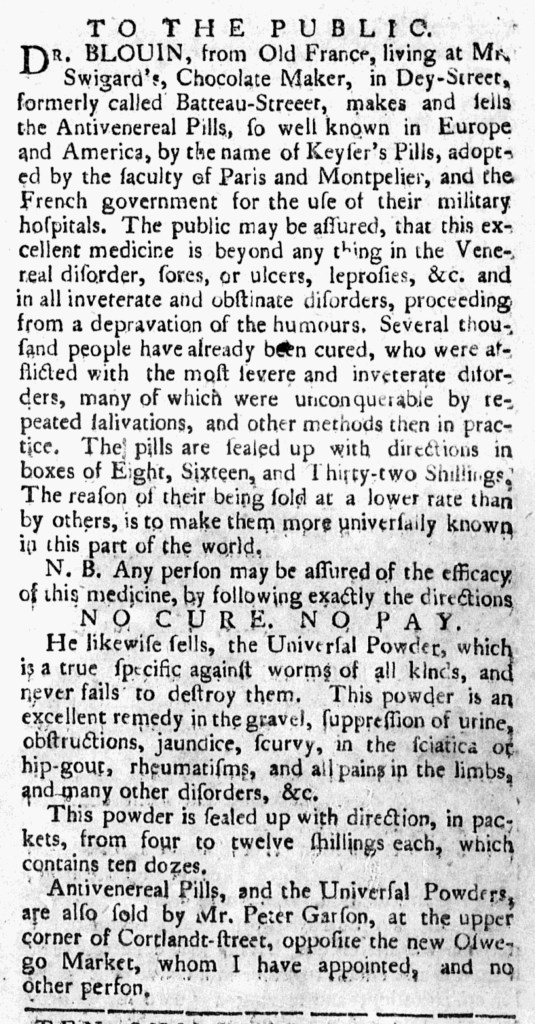
It was the eighteenth-century version of offering a generic medication at a lower price than the name brand in hopes of attracting customers.  An entrepreneur who identified himself as “DR. BLOUIN, from Old France,” placed an advertisement in the November 15, 1775, edition of the Constitutional Gazette to inform readers in New York that he makes and sells the Antivenereal Pills, so well known in Europe and America, by the name of Keyser’s Pills.”  Indeed, that medication was popular in the colonies, advertised frequently by apothecaries, shopkeepers, and even printers who sold patent medicines as an alternate revenue stream.  At the same time that Blouin ran his advertisement, James Rivington, the printer of Rivington’s New-York Gazetteer, continued running his notice that proclaimed, “EVERY ONE THEIR OWN PHYSICIAN, By THE USE OF Dr. KEYSER’s PILLS.”  Rivington had been using that familiar refrain in his advertisements for years.

Blouin offered a brief history of the original medication as a means of marketing his generic version, noting that Keyser’s Pills had been “adopted by the faculty of Paris and Montpelier, and the French government for the use of their military hospitals.”  Furthermore, “[s]everal thousand people have already been cured, many of which were unconquerable by … other methods” of treatment.  Prospective customers, Blouin claimed, could not find a more effective remedy: “The public may be assured, that this excellent medicine is beyond any thing in the Venereal disorder, sores, or ulcers, leprosies, &c. and in all inveterate and obstinate disorders, proceeding from a depravation of the humours.”  He was so certain that he offered a guarantee: “NO CURE.  NO PAY.”

Readers interested in purchasing the pills that Blouin made in New York rather than imported ones would receive printed directions and could choose among boxes costing eight, sixteen, and thirty-two shillings.  The efficacy of the cure, he cautioned, depended on “following exactly the directions.”  Rivington sold Keyser’s Pills for ten, twenty, and forty shillings.  Blouin explained that he gave a discount “to make [his generic pills] more universally known in this part of the world.”  For those who wavered in choosing his pills over the name brand version, he hoped that the lower price would help convince them.  Blouin also noted that an associate, Peter Garson, “at the upper corner of Cortlandt-street, opposite the new Oswego Market,” sold the pills, but “no other person.”  Many advertisements for Keyser’s Pills warned prospective customers about counterfeits.  Blouin freely admitted that he “makes and sells” his own version … and advised readers to avoid any attributed to him but not sold by him or his appointed agent.