May 28

What was advertised in a revolutionary American newspaper 250 years ago this week?

New-York Journal (May 25, 1775).

He has settled a Correspondence in London, whereby he acquires the first fashions of the Court.”

Richard Norris, a “STAY MAKER, from LONDON,” regularly placed advertisements in New York’s newspapers during the era of the American Revolution.  Even as the imperial crisis heated up following the battles at Lexington and Concord in the spring of 1775, he emphasized his connections to London and knowledge of the current fashions there as he marketed the corsets he made.  After all, most colonizers still looked to the largest and most cosmopolitan city in the empire for the latest trends even if they happened to have concerns with how the Coercive Acts and other abuses perpetrated by Parliament.

In an advertisement in the May 25, 1775, edition of the New-York Journal, for instance, Norris declared that he fitted his clients “by methods approved by the Society of Stay Makers in London” and noted that he “has had the honour of working for several ladies of distinction, both in England and this City, with universal applause.”  By that time, he had been in New York for nearly a decade.  He placed an advertisement in the New-York Mercury on March 3, 1776.  The Adverts 250 Project first featured Norris with his advertisement that ran in the New-York Journal on June 23, 1768.  Even though he continued to describe himself as a “STAY MAKER, from LONDON” in 1775, it had been quite some time since he practiced his trade there.  Yet his clients did not need to worry about that because Norris “has settled a Correspondence in London, whereby he acquires the first fashions of the Court.”  That being the case, he proclaimed with confidence that he delivered the “newest fashions from London.”  In addition, he asserted “his work to be as good as any done in these parts, for neatness [and] true fitting.”

Norris also resorted to a familiar marketing strategy, encouraging women to feel anxious about their appearance, especially the shape of their bodies, to convince them to seek out his services.  He addressed “Ladies who are uneasy in their shapes” and emphasized that wearing his stays “prevents the casts and risings in the hips and shoulders of young Ladies and growing Misses, to which they are often subject.”  Norris considered this copy so effective that he recycled it several times over the years, honing a strategy that eventually became a staple of marketing in the modern beauty industry.

February 25

What was advertised in a colonial American newspaper 250 years ago today?

New-York Gazette and Weekly Mercury (February 25, 1771).

“Just received advice from London of the fashions advanced for the court ladies this year.”

Thomas Hartley made stays or corsets for “the LADIES” of New York in the early 1770s.  In his efforts to cultivate a clientele, he placed an advertisement in the February 25, 1771, edition of the New-York Gazette and Weekly Mercury, advising prospective customers that “he makes STAYS OF ALL SORTS, in the newest and best fashion.”  Staymakers as well as tailors, milliners, and others who made garments frequently emphasized that they followed the latest fashions, assuring clients that they did not need to worry about appearing behind the times and out of style after visiting their shops and hiring their services.

Hartley enhanced such appeals with additional commentary in his advertisement, first describing himself as “LATE FROM LONDON” in a portion of his advertisement that served as a headline.  Colonists looked to London, the cosmopolitan center of the empire, for the latest fashions.  The gentry in New York and other colonies sought to demonstrate their own sophistication by keeping up with styles popular in London.  In proclaiming that he was “LATE FROM LONDON,” Hartley established a connection that suggested he had special insight into the current trends in the metropolis.  Later in the advertisement, he extended “humble thanks to all ladies that have favoured me with their commands,” calling into question just how recently he had arrived in New York.

The staymaker, however, suggested that something else mattered more.  After migrating across the Atlantic, he maintained contact with correspondents who kept him informed about the newest styles.  He trumpeted that he had “just received advice from London of the fashions advanced for the court ladies this year.”  As a result, Hartley felt confident that he could “give universal satisfaction” to his clients.  In making a pitch to “the LADIES” of New York, he claimed to have access to information about the garments the most elite women in London would be wearing in the coming months.  Prospective clients in New York could not expect anything more cutting edge than that!

Fashion often played a role in the appeals made by staymakers, tailors, milliners, and others.  In some instances, advertisers included generic statements using formulaic words and phrases, a shorthand intended to reassure prospective clients that they understood their trade and provided satisfactory services.  Hartley, on the other hand, elaborated on his appeal to “the very newest and best fashion,” seeking to convince customers that he did indeed possess special insights into current trends in the most cosmopolitan city in the empire.

June 23

What was advertised in a colonial American newspaper 250 years ago today?

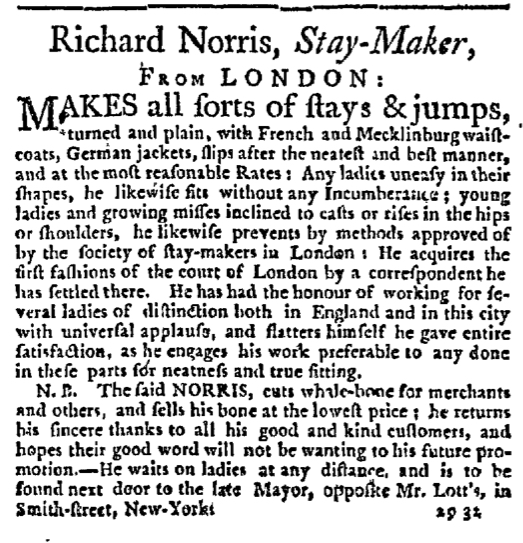
Jun 23 - 6:23:1768 New-York Journal
New-York Journal (June 23, 1768).

“Young ladies and growing misses inclined to casts or rises in the hips or shoulders, he likewise prevents.”

Richard Norris, a “Stay-Maker, FROM LONDON,” followed many of the usual conventions in the advertisement he placed in the June 23, 1768, edition of the New-York Journal, but he also included one significant innovation. After informing prospective clients of the variety of stays and other garments he made, he also noted that “Any ladies uneasy in their shapes, he likewise fits without any Incumberances.” Furthermore, “Young ladies and growing misses inclined to casts or rises in the hips or shoulders, he likewise prevents by methods approved of by the society of stay-makers in London.” Staymakers regularly offered implicit commentary about women’s appearances in their advertisements, but Norris explicitly named reasons that women might feel uncomfortable about their bodies. He purposefully attempted to induce anxiety about their physical features among female readers as a means of attracting clients.

He gave priority to that marketing strategy before turning to more common appeals made by staymakers and others in the garment trades. He asserted that he produced apparel as fashionable as any currently worn in London, rather than lagging behind the styles en vogue in the cosmopolitan center of the empire. Prospective patrons could be confident this was the case because Norris “acquires the first fashions of the court of London by a correspondent he has settled there.” Norris realized some sort of research was necessary and cultivated a relationship to make sure he received the most current information about the fashions currently popular among the most influential women in England. In addition, he had previously served prominent women of taste, having “had the honour of working for several ladies of distinction both in England and in this city.” Not only had he made stays and other garments for the elite, his efforts had earned him “universal applause” among his clients.

Like many artisans, Norris emphasized skill and quality in addition to his extensive experience. He pledged that he made garments “after the neatest and best manner,” but in addition to invoking that familiar phrase he proclaimed “his work preferable to any done in these parts for neatness and true fitting.” In other words, Norris considered himself the best staymaker in New York – and encouraged readers of the New-York Journal to adopt that attitude as well.

Norris combined several common appeals with an innovative marketing strategy designed to cause or enhance uneasiness among women by explicitly mentioning various qualities of their bodies. He offered the standard appeals as a remedy to those concerns. Like many modern advertisers, especially advertisers of products intended primarily for women, he attempted to create anxiety among prospective customers and then conveniently provided consumption of his goods and services as the remedy.