January 12

What was advertised in a colonial American newspaper 250 years ago today?

Supplement to the New-York Journal (January 12, 1775).

“A GENERAL and complete assortment of MUFFS and TIPPETS.”

Lyon Jonas, a “FURRIER, from LONDON,” was consistent in his advertising in two newspapers published in New York on the eve of the American Revolution.  He ran notices with identical copy in the New-York Gazette and Weekly Mercury in November 1774 and the New-York Journal in January 1775.  As was often the case when advertisers purchased space in more than one publication, the notices featured variations in format at the discretion of the compositor, including line breaks and capitalization.  Otherwise, the copy in Jonas’s advertisement was identical.  Rather than writing it out twice, the furrier may very well have clipped his advertisement from one newspaper to submit to the printing office of the other.

The two notices featured another striking similarity.  Both were adorned with a woodcut depicting a muff and a tippet enclosed within a decorative border, the size of the image accounting for approximately half of the space of the advertisement and certainly drawing attention.  Advertisers commissioned such distinctive woodcuts to promote their businesses, making additional investments in their marketing efforts.  In most instances that they incorporated images into advertisements in more than one newspaper, they collected their woodcut from one printing office and delivered it to another.

Jonas, however, commissioned a second woodcut.  Though similar at a glance, enough so that consumers would recognize the devise that represented Jonas’s business, the woodcuts had several variations.  The one in the New-York Gazette and Weekly Mercury was rectangular while the one in the New-York Journal was nearly a square.  The borders had different decorative elements, especially the corners.  The muffs faced opposite directions.  The ends of the tipped almost touched the border in the woodcut in the New-York Journal, but much more space appeared between the ends and the border in the version in the New-York Gazette and Weekly Mercury.

Most advertisers who adorned their newspaper notices with custom images limited their investment to one woodcut, transferring it from printing office to printing office when they wished to include those images in more than one publication.  Jonas, however, opted for a second woodcut.  Doing so allowed him, if he wished, to circulate advertisements with identical copy accompanied by distinctive images in two newspapers simultaneously without having to worry about the logistics of the printing offices sharing a single woodcut.
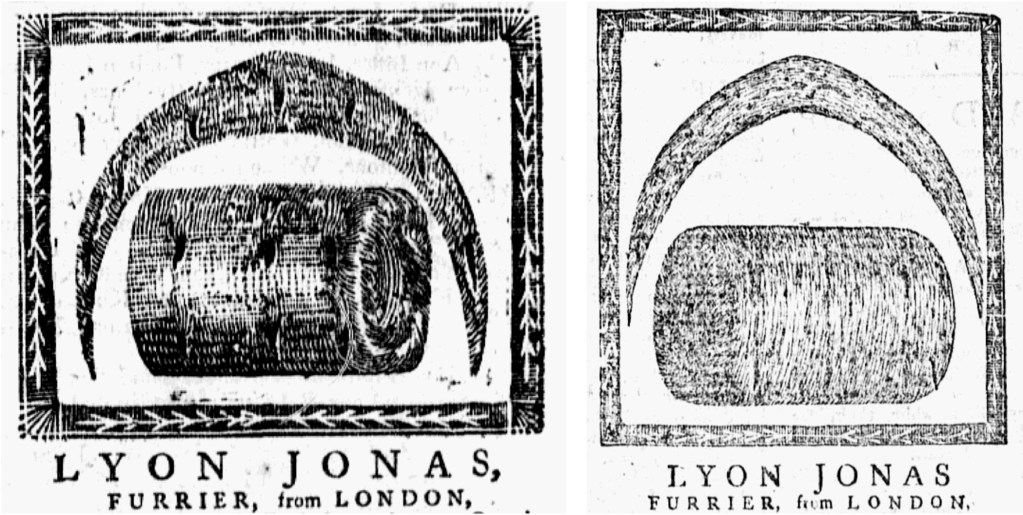
Left: New-York Gazette and Weekly Mercury (November 21, 1774); Right: Supplement to the New-York Journal (January 12, 1775).

November 21

What was advertised in a colonial American newspaper 250 years ago today?

New-York Gazette and Weekly Mercury (November 21, 1774)

“A General and compleat assortment of muffs and tippets in the newest taste.”

As winter approached in 1774, Lyon Jonas, a “FURRIER, from LONDON,” took to the pages of the New-York Gazette and Weekly Mercury to advertise the “General and compleat assortment of muffs and tippets in the newest taste” available at his shop on Little Dock Street.  He also “manufactures and sells gentlemens caps and gloves lined with furr, very useful for travelling,” “trims ladies robes and riding dresses,” and “faces and lappels gentlemens coats and vests.”  In addition to those services, Jonas “buys and sells all sorts of furrs, wholesale and retail.”

To attract attention to his advertisement, the furrier adorned it with a woodcut that depicted a muff and a tippet (or scarf) above it with both enclosed within a decorative border.  It resembled, but did not replicate, the woodcut that John Siemon included in his advertisements in the New-York Journal, the Pennsylvania Chronicle, and the Pennsylvania Journal three years earlier.  That image did not include a border, but perhaps whoever carved Jonas’s woodcut recollected it when the furrier commissioned an image to accompany his notice.

Whatever the inspiration may have been, Jonas’s woodcut represented an additional investment in his marketing efforts.  First, he paid for the creation of the image.  Then, he paid for the space it occupied each time it appeared in the newspaper.  Advertisers paid by the amount of space rather than the number of words.  The woodcut doubled the amount of space that Jonas required in the New-York Gazette and Weekly Mercury, incurring additional expense.  Jonas presumably considered it worth the cost since the woodcut distinguished his notice from others.  In the November 21 edition and its supplement, five other advertisements featured stock images of ships and Hugh Gaine, the printer, once again ran an advertisement for Keyser’s “Famous Pills” with a border composed of ornamental type.  Beyond that Jonas’s notice was the only one with an image as well as the only one with an image depicting an aspect of his business and intended for his exclusive use.  Readers could hardly have missed it when they perused the pages of the New-York Gazette and Weekly Mercury.