January 15

What was advertised in a revolutionary American newspaper 250 years ago today?

New-York Gazette and Weekly Mercury (January 15, 1776).

“Dr. Hill’s American Balsam; whose great efficacy is so well known.”

Nine months after his advertisements first appeared in newspapers in New York, shopkeeper Michael Hoffman continued receiving shipments of “DOCTOR HILL’s newly improved great STOMACHIC TINCTURE” and “Dr. Hill’s American Balsam” from an associate in Philadelphia.  His advertisement in the January 15, 1776, edition of the New-York Gazette and Weekly Mercury echoed the one he previously placed in the May 4, 1775, edition of the New-York Journal, though it featured slightly different copy.  Hoffman reminded prospective customers that the tincture was “a very excellent medicine for all weak stomach, as it procures a good healthy appetite, and a sound digestion.”  In addition, it supposedly prevented all sorts of diseases since most, according to the advertisement, “have their origin contracted in a weak stomach.”  The balsam, on the other hand, “is so well known to cure the most inveterate disorder in the breast, as shortness of breath, colds, coughs, and whooping coughs in children.”  Yet that was not all!  Through “a proper use and continuing the same a reasonable time,” the balsam “effectually cured … the most painful rhumatisms, cholic, gravel [kidney stones] and consumption.”

Yet Hoffman did not promote just the efficacy of these patent medicines.  In his effort to attract customers, he assured them that “Doctor Hill’s own directions, printed in London, are wrapt about each bottle” to prevent confusion about the dosage once they took the medicines home.  Those directions, however, included the price in “sterling money,” but Hoffman’s customers could ignore that.  He had worked out a deal for bargain pricing for the benefit of “the poor and indigent” in New York.  In that city, the medicines sold for four shilling and ten pence per bottle.  Even better, those who bought a dozen bottles received a discount, only four shillings and four pence per bottle.  Those customers saved ten percent, a good deal for those who intended to follow Hoffman’s directions to continue taking the medicine for “a reasonable time.”  As had been the case all along, Hoffman had an exclusive appointment to sell Dr. Hill’s tincture and balsam in New York.  He directed customers to his shop “in the Broad-Way, near the Oswego-Market” so they could avoid counterfeits peddled elsewhere.
May 4

What was advertised in a revolutionary American newspaper 250 years ago today?

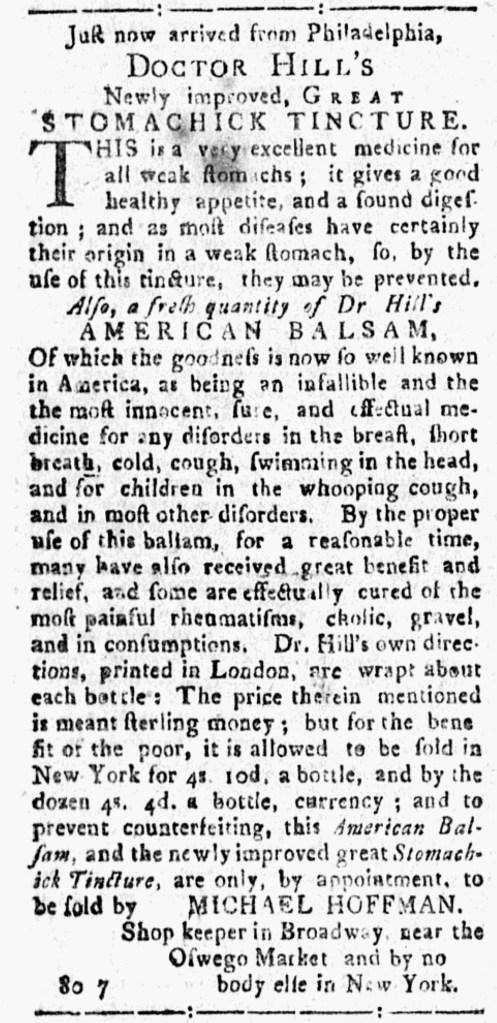
New-York Journal (May 4, 1775).

“To be sold by MICHAEL HOFFMAN … and by no body else in New-York.”

In the spring of 1775, Michael Hoffman took to the pages of the New-York Journal to advertise two patent medicines, “DOCTOR HILL’S Newly improved, GREAT STOMACHICK TINCTURE” and “Cr. Hill’s AMERICAN BALSAM.”  Even though he asserted that the goodness of that second remedy “is now so well known in America, as being an infallible … end effectual medicine” for a variety of “disorders,” Hoffman listed symptoms that it alleviated.  He also advised that the tincture prevented “most diseases” since they tended to have “their origin in a weak stomach.”

Hoffman declared that his supply had “Just now arrived from Philadelphia.”  He likely received it from William Young, an associate who advertised both the tincture and the balsam in the Pennsylvania Journal in November 1774 and in the first issue of Story and Humphreys’s Pennsylvania Mercury in April 1775.  Those advertisements included a short list of five local agents who sold Dr. Hill’s medicines in Philadelphia, Germantown, Kingsessing, Lancaster, and New York.  The shopkeeper did not incorporate that list into his notice, but he did underscore that “to prevent counterfeiting” the remedies were sold “only, by appointment … by MICHAEL HOFFMAN … and by no body else in New-York.”  Judging by an advertisement in the Pennsylvania Packet in May 1772, he held that exclusive “appointment” for at least three years.  As another means of guaranteeing authenticity, “Dr. Hill’s own directions, printed in London, are wrapt about each bottle.”

In addition to the patent medicines, Hoffman apparently received copy for his advertisement from Young.  Much of it repeated the notices that ran in Philadelphia’s newspapers word for word.  In the initial advertisement in November, Young stated that the medicines had been “Lately imported from London.”  Hoffman updated that to “Just now arrived from Philadelphia,” not mentioning when his associate there imported them even though he could have affirmed that Young had received the shipment before the Continental Association went into effect on December 1, 1774.  Perhaps he depended on his own reputation as sufficient testimony that he did not sell goods in violation of the nonimportation agreement.