June 7

What was advertised in a revolutionary American newspaper 250 years ago today?
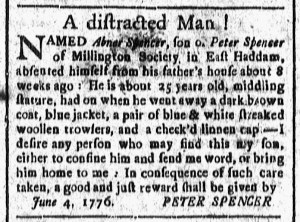
Connecticut Gazette (June 7, 1776).

“A distracted Man!”

Peter Spencer sought the public’s assistance in locating his son Abner.  He placed an advertisement in the June 7, 1776, edition of the Connecticut Gazette because Abner “absented himself from his father’s house” in East Haddam “about 8 weeks ago.”  This does not seem to have been a case of any sort of discord that resulted in a rebellious son running away from the obedience demanded by his father.  Instead, the headline described Abner as “A distracted Man,” suggesting that he had cognitive, intellectual, or developmental disabilities.  Somehow, Abner had “absented himself” from the care of his father’s household.

Spencer published an alert, just as Elizabeth Fales of Walpole, Massachusetts, had done in the summer of 1774 when Jonathan Fales, a “Non Compos Mentis” man, “did … leave his House and Family … and has not been Home since.”  Fales offered a reward to anyone “so kind to a distress’d Woman as to bring him home (without abusing him) or give Information that he may be found.”  Similarly, Spencer promised a “good and just reward” to “any person who may find this my son, either to confine him and send me word, or bring him home to me.”  To help identify Abner, his father described him as “about 25 years old, middling stature,” and wearing a “dark brown coat, blue jacket, a pair of blue & white streaked woollen trowsers, and a check’d linnen cap.”

Spencer’s advertisement about Abner happened to appear immediately below James Rogers’s notice offering a reward for the capture and return of a “Mustee Fellow named SY,” also “about 25 Years of Age,” who had liberated himself by running away from his enslaver in March.  Rogers provided a lengthy description of Sy, even noting that he took a fiddle with him, and warned that “Masters of Vessels are forbid to carry off said Slave.”  These notices that ran one after the other both concerned missing persons, yet the advertisers who placed them had very different purposes in doing so.  Rogers aimed to use the power of the press to return a young man to slavery, while Spencer treated his advertisement as a means of disseminating news that was exceptionally important to a household responsible for providing care for a son who needed their support.  One young man would benefit if the advertisement was successful, while the other certainly would not.
August 22

What was advertised in a colonial American newspaper 250 years ago today?

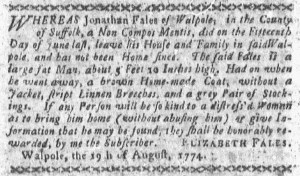
Boston-Gazette (August 22, 1774).

Bring him home (without abusing him) or give Information that he may be found.”

Newspaper advertisements carried all sorts of local news that printers did not otherwise select for inclusion in their publications, keeping readers apprised of both ordinary and extraordinary occurrences.  A variety of legal notices, for instance, provided news about the finances and deaths of colonizers, while other advertisements revealed marital discord when husbands decreed that they would not pay the debts of their wives.  Some advertisements provided coverage of thefts and burglaries.  Many described runaway apprentices and indentured servants or enslaved men and women who liberated themselves by running away from their enslavers.  In most colonial newspapers, the local news section was quite short, especially compared to the amount of space devoted to news from England, Europe, and other colonies.  Many historians have explained that news of local events of consequence spread via word of mouth before printers had the chance to take their weekly newspapers to press.  Yet that perspective overlooks the extensive local news that appeared among advertisements.

Among their other purposes, advertisements sometimes served as missing persons notifications.  Such was the case in June 1774 when Jonathan Fales of Walpole, a “Non Compos Mentis” or a man with cognitive disabilities, disappeared from “his House and Family … and has not been Home since.”  Elizabeth Fales, perhaps his mother, sister, or wife, placed an advertisement in the August 22 edition of the Boston-Gazette, stating that Jonathan had not been seen for more than two months and requesting aid in finding and returning him to his family.  She gave a short physical description and described the clothes he wore “when he went away.”  Her concern was apparent, both in calling herself a “distress’d Woman” and pleading that anyone who found Jonathan “bring him home (without abusing him).”  Elizabeth and her family cared for and protected the “large fat Man” at home, but he risked others taking advantage of him or treating him cruelly on his own.  Elizabeth promised a reward to anyone who brought Jonathan home or provided “Information that he may be found.”  Placing an advertisement allowed her to disseminate local news that was most important to her and her family.

February 26

GUEST CURATOR:  Mary Aldrich

What was advertised in a colonial newspaper 250 years ago this week?

Feb 26 - 2:24:1766 New-York Mercury
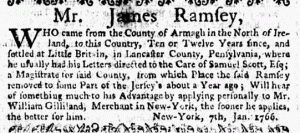
New-York Mercury (February 24, 1766).

“Mr. James Ramsey … Will hear of something much to his Advantage.”

Mr. James Ramsey originally from the North of Ireland, who were you and what did Mr. William Gilliland want with you? Could this William Gilliland be the prosperous merchant who bought land in the Champlain Valley where he planned to build an estate and after whom the town of Willsborough is named?

I wonder what he could have wanted with James Ramsey, whom he obviously knew a deal about: where he was born, when he came to the colonies, and where he was living for a while. Yet he does not know where he went and for some reason  Ramsey did not leave a forwarding address with the man whom he previously had his letters directed to, Samuel Scott, Esq. Maybe he did not want to be found by Gilliland. This advertisement is not addressed only to Ramsey but instead to the population at large, as if Gilliland is hoping that someone will see this advertisement and bring it to the attention of Ramsey.

**********

ADDITIONAL COMMENTARY:  Carl Robert Keyes

This advertisement testifies to the mobility that was part of everyone’s experience in eighteenth-century America. Some colonists moved around quite regularly as they pursued opportunities to improve their lives or fled from debtors, to name just a couple of the many reasons for migration in the colonies and throughout the Atlantic world. Anyone who remained in one village, town, or city throughout his or her lifetime would have certainly witnessed others moving in, moving out, or passing through.

For instance, William Moraley migrated from England to Philadelphia and, eventually, Burlington, New Jersey, when he became an indentured servant after a series of misfortunes (some of his own making) befell him. After “earning” his freedom, he wandered around the Middle Colonies, half-heartedly seeking work, before returning to England and publishing a memoir and travelogue about his experiences.

James Ramsey also appears to have been a mobile fellow, moving from County Armagh, Northern Ireland, to Lancaster County, Pennsylvania, to an unknown location in New Jersey. Today we have many tools for locating long lost friends and relatives, but the situation was much more difficult in the eighteenth century. A newspaper advertisement like this one, an open announcement for all readers to see and pass along, would have been William Gilliland’s best option for contacting Ramsey. No newspapers were published in New Jersey in 1766, but issues printed in New York would have circulated in the colony. Again, Gilliland deployed one of the best technologies and most sophisticated methods of disseminating information available at the time, but his efforts still relied on chance.