April 15

What was advertised in a colonial American newspaper 250 years ago today?
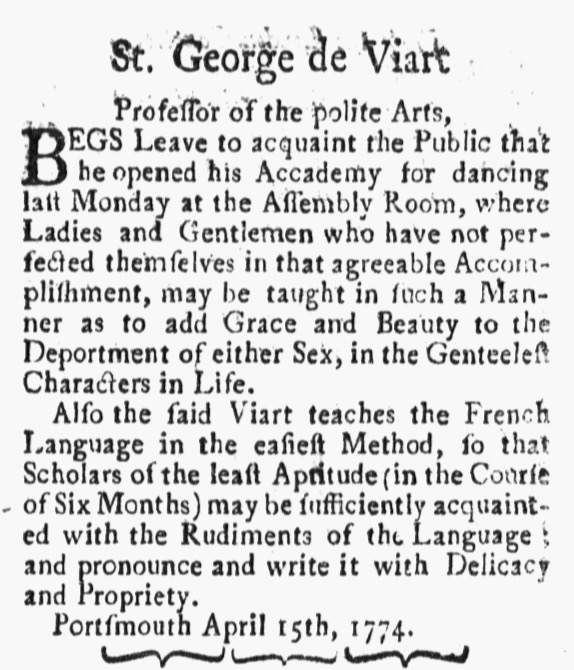
New-Hampshire Gazette (April 15, 1774).

“Taught in such a Manner as to add Grace and Beauty to the Deportment of either Sex.”

Monsieur Viart once again took to the pages of the New-Hampshire Gazette in the spring of 1774, announcing that he “opened his Accademy for dancing last Monday at the Assembly Room” in Portsmouth.  Viart had previously advertised in that newspaper in the summer of 1772 and as spring approached in 1773, but by the end of the summer he was running notices in the Pennsylvania Journal.  Perhaps he had experienced too much competition with Edward Hackett and decided that he might have better prospects in Philadelphia, the largest and most genteel city in British North America.  Whatever his motivation, Viart’s time in the Quaker City did not last long.  That city had plenty of dancing masters and French tutors, a factor that may have influenced Viart’s decision to return to a place where he had cultivated a reputation among prospective students.

His presence in Portsmouth suggests a market for his services even in smaller towns, not just the largest urban ports like Boston, Charleston, New York, and Philadelphia.  Viart described himself as a “Professor of the polite Arts,” signaling that his instruction aided students in maintaining or improving their status as they strove to display their gentility to others.  He provided dancing lessons to “Ladies and Gentlemen who have not perfected themselves in that agreeable Accomplishment,” promising that he taught “in such a Manner as to add Grace and Beauty to the Deportment of either Sex, in the Genteelest Characters in Life.”  In addition to dancing, Viart “teaches the French Language in the easiest Method.”  He reassured even the most anxious prospective students, those “Scholars of the least Aptitude,” that in just six months they “may be sufficiently acquainted with the Rudiments of the Language” that they would “pronounce and write it with Delicacy and Propriety.”  Viart’s advertisements in the New-Hampshire Gazette demonstrate that just as the consumer revolution reached far beyond major port cities and into smaller towns and even the countryside, so too did concerns with refinement of character and comportment.  As colonizers acquired more goods and associated meaning with them, they also recognized that dancing well and speaking French testified to their gentility and validated their choices to wear fine clothing and purchase fashionable housewares.  As a “Professor of the polite Arts,” Viart marketed skills that helped his students complete the picture of their “Genteelest Characters.”

August 18

What was advertised in a colonial American newspaper 250 years ago today?

Pennsylvania Journal (August 18, 1773).

“This important part of the education of their children.”

In the summer of 1773, Monsieur de Viart introduced himself to the residents of Philadelphia with an advertisement in the Pennsylvania Journal.  He informed “Gentlemen and Ladies of this City, that he proposes to open an ACADEMY OF DANCING,” underscoring that “he has, for many years, with approbation, professed in several parts of France.”  Accordingly, parents of prospective pupils should consider him “capable of qualifying the youth of both sexes committed to his care, in a very short time, for any assembly whatsoever.”  Viart described himself as “lately arrived from Paris,” conveniently not mentioning that he had been in the colonies for at least a year and offered lessons in Portsmouth, New Hampshire.  Paris certainly had greater cachet in the minds of genteel Philadelphians than Portsmouth did!  Similarly, Viart realized that he would likely enroll more students in the largest and most cosmopolitan city in the colonies.

Whether in Philadelphia or Portsmouth, Viart’s marketing strategy remained the same.  He played on the anxieties of parents who wanted to prepare their children to represent themselves and their families well at balls and, more generally, in all sorts of social encounters.  In his effort to set himself apart from other dancing masters, Viart republished copy from his advertisement in the New-Hampshire Gazette earlier that year: “It is not everyone, who pretends to teach this delicate art, who will take pains to instruct their pupils, in those rules of decorum and politeness, which are so absolutely necessary to be inculcated into them, before they can step abroad, into the world, with elegance and ease.”  In a single sentence, Viart called into question the abilities of his competitors to teach dancing while simultaneously asserting that their flawed instruction in the steps distracted them from focusing on comportment.  Viart knew that graceful movement and impeccable manners reinforced each other.  He warned that “it often happens, that scholars (through the ignorance or negligence of their masters) are guilty of great rudeness, and commit gross blunders, on their first appearance, in company.”  Concerned parents could avoid such a travesty, instead depending on Viart’s “utmost care and assiduity, in this important part of the education of their children.”  When they completed their lessons, his pupils would hold their own in Paris rather than look like backwater provincials from Portsmouth.

March 5

What was advertised in a colonial American newspaper 250 years ago today?

New-Hampshire Gazette (March 5, 1773).

“Instruct their Scholars in those Rules of Decorum and Politeness.”

Monsieur de Viart, a dancing master, sought to cultivate a sense of anxiety among prospective clients when he offered his services in an advertisement in the March 5, 1773, edition of the New-Hampshire Gazette.  In particular, he suggested that parents needed to tend to the best interests of their children by enrolling them in classes taught by an expert who emphasized comportment as well as learning the steps of “Minuets, French Jiggs, Horn-Pipes, Rigadoons, and English Country Dances of all Kinds.”  His students, he promised, would exhibit grace in their interactions as well as in their movements.

In making that pitch, Viart asserted that he “has always endeavoured to merit the Approbation of those who have hitherto favoured him with their Custom,” especially parents of his young students, “by having at all Times obliged himself to instruct his PUPIULS in those Principles which he received in that Profession himself.”  The dancing master declared that he incorporated “Rules of Decorum and Politeness” into his curriculum, recognizing that dancing was part of much more extensive social interactions.  He cautioned parents of prospective pupils that their children needed such lessons, “which are absolutely necessary to be known, begore Young Persons can step abroad into the World with Elegance and Ease.”

Viart claimed that other dancing masters did not focus on the relationship between dancing and manners that he did, leaving their students to clumsily stumble through encounters with others.  He lamented that “not every one who pretends to teach this delicate Art … will take the Pains to instruct their Scholars” in manners.  As a result, parents had reason to fear that their children might embarrass themselves.  “[I]t often happens that Scholars,” Viart confided, “through the Ignorance of the Masters, are guilty of great Rudeness and commit gross Blunders on their first going into Company.”  Viart prepared his pupils for much more than moving across the dance floor, helping them avoid various kinds of awkwardness and difficulties when they gathered for social events.

Dancing masters in the largest cities in the colonies – Charleston, New York, Philadelphia – made similar appeals to prospective pupils and their parents.  They touted the gentility that their “Scholars” would exhibit upon taking lessons.  Viart suggested that this was not merely a concern for colonizers who resided in urban ports.  Instead, he encouraged students and, especially, their parents in Portsmouth, New Hampshire, to experience a sense of apprehension that they did not meet the standards expected in cosmopolitan society.

June 12

What was advertised in a colonial American newspaper 250 years ago today?

New-Hampshire Gazette (June 12, 1772).

“Those Accomplishments which are so necessary for entring the World with Advantage.”

Many colonizers sought to demonstrate that they belonged to genteel society through their fashions, possessions, and comportment.  They participated in the consumer revolution, purchasing textiles, garments, accessories, and housewares according to the latest tastes in English cities, especially London.  They also concentrated on their comportment, putting into practice good manners and learning a variety of genteel skills, including dancing, fencing, speaking French, and playing musical instruments.  Merchants, shopkeepers, artisans, and tutors aided colonizers in acquiring both the things and the knowledge necessary for displaying their gentility.

This was not solely an urban phenomenon.  Far beyond the major port cities of Boston, Charleston, New York, and Philadelphia, purveyors of goods advertised their wares and consumers acquired them.  Similarly, colonizers in smaller towns had opportunities to take lessons in dancing, fencing, and other genteel pursuits.  As summer arrived in 1772, Monsieur Viart placed an advertisement in the New-Hampshire Gazette to inform the public, especially parents, that he taught “DANCING, FENCING, the FRENCH LANGUAGE, and the VIOLIN … in the most perfect and polite manner.”  He cautioned parents against overlooking the benefits of enrolling their children in his classes, arguing that his curriculum yielded “those Accomplishments which are so necessary for entring the World with Advantage.”  Even colonizers in Portsmouth, Viart declared, needed these skills.

Viart listed the tuition for each kind of lesson, both an initial entrance fee and additional payment for each quarter.  He also offered a discount if “a Scholar learns in two Branches,” encouraging pupils and their parents to sign up for more than one subject.  He anticipated the most interest in dancing and French, holding “School” for each at set times on Mondays, Thursdays, and Saturdays.  He may have also provided private tutoring, but he did not mention those lessons in his advertisement.  He gave fencing and violin lessons “at such times as may be convenient for his Scholars.”

Tutors like Viart attempted to entice colonizers to become even more immersed in the consumer revolution and the culture of gentility and cosmopolitanism often associated with it.  He expected that his pronouncement that learning to dance or speak French was “so necessary” in preparing children to successfully make their way in the world that it would resonate with parents and other readers in Portsmouth and nearby towns.  Such skills, he suggested, were not reserved for the gentry in New York and Philadelphia.