
What was advertised in a colonial American newspaper 250 years ago today?
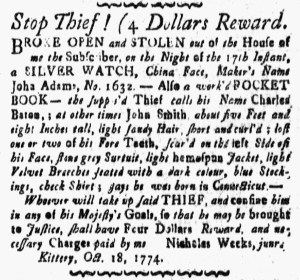
“Stop Thief!”
Sometimes advertisements in colonial newspapers could have doubled as an eighteenth-century version of a local police blotter. The October 21, 1774, edition of the New-Hampshire Gazette, for instance, included an advertisement that raised an alarm: “Stop Thief!” Nicholas Weeks, Jr., reported that four days earlier someone “BROKE OPEN” his house in Kittery and stole a silver watch and a pocketbook. Weeks alleged that the burglar was a man who sometimes went by the name Charles Baton and other times by John Smith. No matter which alias the culprit used, the public could recognize him by his “light sandy Hair, short and curl’d,” missing front teeth, and the scars on the left side of his face. Weeks offered a reward to anyone who “will take up said THIEF, and confine him in any of his Majesty’s [Jails], so that he may be brought to Justice.”
In another column on the same page, John Davenport of Portsmouth also proclaimed, “Stop Thief.” Sometime during the night of October 12, a “THIEF or Thieves … broke open” his shop and stole a variety of merchandise, “some Cash,” and about five gallons of rum. The shopkeeper listed several of the stolen items, hoping that would help in identifying the criminals if they attempted to sell them. After all, theft gave some people an alternate means of participating in the transatlantic consumer revolution that extended to even small towns in the colonies. Like Weeks, Davenport offered a reward to readers who “shall discover and bring to Justice” the perpetrators. In yet another advertisement, Nicholas Boussard described a “St[r]ayed or Stolen” horse that went missing in Exeter. He did not know for certain that someone took the “dark Bay HORSE,” but he did not dismiss the possibility.
Such incidents usually did not receive coverage among the news items in colonial newspapers, yet inserting advertisements allowed colonizers to bring them to the attention of the public and enlist the aid of the community in recovering stolen goods and prosecuting the offenders. Advertisements delivered local news.