October 21

What was advertised in a colonial American newspaper 250 years ago today?
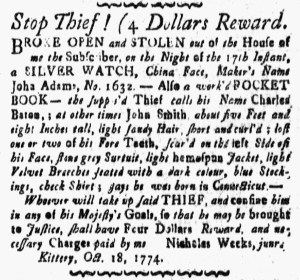
New-Hampshire Gazette (October 21, 1774).

Stop Thief!

Sometimes advertisements in colonial newspapers could have doubled as an eighteenth-century version of a local police blotter.  The October 21, 1774, edition of the New-Hampshire Gazette, for instance, included an advertisement that raised an alarm: “Stop Thief!”  Nicholas Weeks, Jr., reported that four days earlier someone “BROKE OPEN” his house in Kittery and stole a silver watch and a pocketbook.  Weeks alleged that the burglar was a man who sometimes went by the name Charles Baton and other times by John Smith.  No matter which alias the culprit used, the public could recognize him by his “light sandy Hair, short and curl’d,” missing front teeth, and the scars on the left side of his face.  Weeks offered a reward to anyone who “will take up said THIEF, and confine him in any of his Majesty’s [Jails], so that he may be brought to Justice.”

In another column on the same page, John Davenport of Portsmouth also proclaimed, “Stop Thief.”  Sometime during the night of October 12, a “THIEF or Thieves … broke open” his shop and stole a variety of merchandise, “some Cash,” and about five gallons of rum.  The shopkeeper listed several of the stolen items, hoping that would help in identifying the criminals if they attempted to sell them.  After all, theft gave some people an alternate means of participating in the transatlantic consumer revolution that extended to even small towns in the colonies.  Like Weeks, Davenport offered a reward to readers who “shall discover and bring to Justice” the perpetrators.  In yet another advertisement, Nicholas Boussard described a “St[r]ayed or Stolen” horse that went missing in Exeter.  He did not know for certain that someone took the “dark Bay HORSE,” but he did not dismiss the possibility.

Such incidents usually did not receive coverage among the news items in colonial newspapers, yet inserting advertisements allowed colonizers to bring them to the attention of the public and enlist the aid of the community in recovering stolen goods and prosecuting the offenders.  Advertisements delivered local news.

August 28

What was advertised in a colonial American newspaper 250 years ago today?

Providence Gazette (August 28, 1773).

“A large Quantity of Ordure, supposed to have been taken from some Privy-House Vault.”

Samuel Young and William Tyler were not happy.  Who could blame them?  Who, that is, except for “some evil-minded Person or Persons” who had befouled their well?  Upon making an unpleasant discovery, Tyler and Young took to the pages of the Providence Gazette with an advertisement describing how the perpetrators had, “in a most filthy Manner, bedaub[ed] the Stones, Curb and Bucket, of Tyler and Young’s Well, with a large Quantity of Ordure.”  The victims of such a disgusting act of vandalism suspected that the miscreants had taken the excrement “from some Privy-House Vault.”  What explained such an assault?  Tyler and Young attributed it to “the Instigation of the Devil.”

The aggrieved colonizers did not exclude any possible suspects, describing the “Party or Parties concerned” as “he, she, or they.”  Whoever was responsible for carrying out the devil’s work, Tyler and Young wanted them held accountable.  They had not published their advertisement to advise the public about what had happened to their well but rather to enlist the aid of anyone with information that would allow them to identify or “discover” the perpetrators that they “may be brought to Justice.”  Tyler and Young offered a reward, conditional on the conviction of the “Offender or Offenders.”

As was often the case, an advertisement supplied readers with a combination of local news and gossip … and perhaps even a bit of amusement, depending on their predilections for scatological humor or how they felt about Tyler and Young.  Other advertisements in the August 28, 1773, edition of the Providence Gazette also delivered news, gossip, or a combination of the two.  Uzal Green, for instance, advised others not to extend credit to his wife, Martha, because he would not pay any of her bills since she “hath eloped from me, and refuses to return to my Bed and Board.”  Another advertisement recounted how “the Shop of Robert Leonard, Taylor, was feloniously broke open … and robbed.”  That notice offered rewards for recovering the stolen goods and capturing the thief.  In an estate notice, the executors of Dr. Samuel Carew encouraged “all those who have unsettled Accounts” to “pay their respective Debts” or face legal action.  In yet another advertisement, Nehemiah Underwood promised a reward for the capture and return of his sixteen-year-old runaway apprentice, Daniel Sanders.  None of those advertisements may have been as remarkable as Tyler and Young’s effort to identify the villain or villains who defiled their well, but each of them did incorporate local news that did not appear elsewhere in the newspaper.

September 22

What was advertised in a colonial American newspaper 250 years ago today?

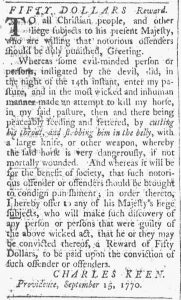
Providence Gazette (September 22, 1770).

Cutting his throat, and stabbing him in the belly.”

The advertising section of the Providence Gazette in the early 1770s sometimes read like a late nineteenth-century police blotter.  Consider the September 22, 1770, edition.  Among the advertisements for consumer goods and services, legal notices, and one advertisement offering a good price for a flying squirrel, several other advertisements relayed stories of thefts and worse crimes.

The first recorded a theft, its tone suggesting unpleasant consequences for the thief.  An anonymous advertiser suggested that the “Person who took a new Beaver Hat out of the Court-House” on the previous Thursday evening “will do well to leave it” at the printing office for the owner to retrieve.  By doing so, the thief “may thereby prevent the disagreeable Circumstance of a personal Application.”  Whether or not the advertiser actually knew the identity of the thief, he suggested that he did.  The prospect of a “personal Application” suggested retribution for refusing to voluntarily return the hat.

In an advertisement that had already been running for many weeks, Seth Wetmore of Middletown, Connecticut, described how his house “was broke open … by some Person or Persons unknown” at the beginning of July.  The burglars absconded with a variety of clothing and other personal articles.  Wetmore suspected that they may have been the same men who escaped from the jail in New Haven the previous night, John Armstrong and John Galloway, and their accomplice, James Burne.  Wetmore offered a reward for the return of his goods “or the greater Part of them” and the capture of the “Felons” over and above the reward offered by the jailer.

In the most disturbing of these advertisements, Charles Keen of Providence described the depraved acts of “notorious offenders … instigated by the devil.”  An “evil-minded person or persons” had entered his pasture in the dead of night and attempted to kill his horse.  The unfortunate horse had been “peaceably feeding and fettered” when the perpetrators set about “cutting his throat, and stabbing him in the belly, with a large knife, or other weapon.”  The horse initially survived the ordeal, but Keen suspected that he could still die of the wounds.  Keen offered a substantial reward to anybody “who will make such discovery of any person or persons that were guilty of the above wicked act.”

When it came to crime reporting, from a hat nicked at the courthouse to a brutal attack on a horse in the middle of the night, the advertisements in this issue of the Providence Gazette carried far more news than the rest of the newspaper.

January 3

What was advertised in a colonial American newspaper 250 years ago today?

Essex Gazette (January 3, 1768).

The Declaration and Confession of Ruth Blay will be printed To-morrow.”

Infanticide and a public execution: read all about it! When compiling the contents for the first issue of the Essex Gazette for 1769, printer Samuel Hall devised one item that was part news and part advertisement. “We hear from Portsmouth,” the notice began, “That last Friday the unfortunate Ruth Blay was executed there, pursuant to her Sentence.” Hall did not go into great detail about the sequence of events, likely assuming that most readers were already familiar with the infamous case of an unmarried schoolmistress who had been convicted of concealing the birth of an illegitimate child in southern New Hampshire. The printer did report that Blay “behaved in a very penitent Manner, but denied … Murdering her Infant Child.” Before her execution, the schoolmistress “sign’d a Declaration and Confession.” Hall reprinted a portion of that document, both to inform readers and to entice them to purchase a copy of their own. The notice ended with an announcement, printed in italics and larger type to garner attention, that “The Declaration and Confession of Ruth Blay will be printed To-morrow.”

Hall leveraged current events in the service of earning revenues. He stoked interest in the Blay case by providing a teaser from the “Declaration and Confession” in advance of publishing his own edition. Daniel Fowle and Robert Fowle, the printers of the New-Hampshire Gazette, had already published Blay’s appeal early in the morning on the day of her execution, at “2 o’clock Friday morning December 30, 1768” according to the imprint. Hall apparently acquired a copy, perhaps from the same messenger who brought news that Blay’s execution had finally occurred after she had received a series of reprieves. No known copy of an edition printed by Hall survives, but the Peabody Essex Museum and the Harry Ransom Center at the University of Texas at Austin both have copies of the broadside attributed to the Fowles. The promised edition advertised in the Essex Gazette may never have gone to press, but Hall certainly could have printed copies of the broadside to offer for sale shortly after prospective customers saw the notice in the newspaper. He certainly would not have been the only printer who marketed memorabilia related to crimes and executions. First Thomas Green and Samuel Green and later printers in Boston printed and advertised a pamphlet about “the Life and Abominable Thefts” of Isaac Frasier in the wake of his execution for burglary in September 1768. Hall’s notice, part news and part advertisement, suggests that he also saw an opportunity to profit from print culture that entertained readers with the story of an infamous criminal.

For more on Ruth Blay, see Sharon L. Jansen’s “Ruth Blay and the Crime of Concealing the Birth of a ‘Bastard’ Child,” which includes an image of the Portsmouth Athenaeum’s photocopy of the “Declaration & Confession of Ruth Blay” printed by the Fowles.

September 29

What was advertised in a colonial American newspaper 250 years ago today?

Sep 29 - 9:29:1768 Boston Weekly News-Letter Postscript
Postscript to the Boston Weekly News-Letter (September 29, 1768).

The Account contains some Particulars of his robbing Mr Davis’s Shop at Roxbury.”

Less than three weeks after Thomas Green and Samuel Green, the printers of the Connecticut Journal, first promoted a pamphlet about the “LIFE, and abominable THEFTS, of the notorious Isaac Frasier,” who had just been executed in Fairfield, printers in Boston ran an advertisement for the same pamphlet in the Postscript to the Boston Weekly News-Letter. It announced that the pamphlet was “JUST RE-PRINTED and Sold at Kneeland & Adams’s Printing Office in Milk-Street; and R. Draper’s Office in Newbury Street.” The Boston printers most likely sold a second edition produced by the Greens rather than one they printed themselves.

Just as the Greens had attempted to draw on popular interest in an event that had just occurred in their colony, the Boston printers adapted the advertisement to focus on a local connection. The contents of the pamphlet were certainly provocative already: an account given by the Frasier “(under Sentence of Death for Burglary) penned from his own Mouth, signed by him, a few Days before his Execution: With his dying SPEECH.” Yet some of the details were especially relevant to readers of the Boston Weekly News-Letter. The advertisement in that newspaper specified that “The Account contains some Particulars of his robbing Mr Davis’s Shop at Roxbury, and other Places in Roxbury, Boston, &c.” Furthermore, the contents of the pamphlet answered lingering questions about crimes that had occurred in Massachusetts. According to Anthony Vaver, author of Early American Criminals, the pamphlet recorded more than fifty thefts and burglaries committed by Frasier as he “toured all over New England and into New York, covering hundreds of miles at a time.” As far as his thefts in Roxbury, Boston, and other local towns were concerned, the advertisement stated, “The Articles that he stole are mentioned very particularly at his Desire, that the Owners may know the Articles taken by him, in order to exculpate others.” The pamphlet presented information about those thefts that would not otherwise appear in news coverage in the public prints. It offered an exclusive look at Frasier’s crime spree.

The printer-booksellers who sold the “brief Account” in Boston encouraged readers to simultaneously marvel at Frasier’s audacity and condemn his crimes. They transformed his narrative of his thefts and his “dying SPEECH” into a form of entertainment. In their promotion, they heralded the genre of true crime and its power to provoke interest and sell merchandise.

September 9

What was advertised in a colonial American newspaper 250 years ago today?

Sep 9 - 9:9:1768 Connecticut Journal
Connecticut Journal (September 9, 1768).

“Brief Account of the LIFE, and abominable THEFTS, of the notorious Isaac Frasier.”

True Crime! In early September of 1768, Thomas Green and Samuel Green, printers of the Connecticut Journal and New-Haven Post-Boy, sold a pamphlet about an execution of a burglar that had just taken place. “Just published, and to be sold by the Printers hereof,” the Greens announced, “Brief Account of the LIFE, and abominable THEFTS, of the notorious Isaac Frasier, (Who was executed at Fairfield, on the 7th of September, 1768) penned from his own Mouth, and signed by him, a few Days before his Execution.” This advertisement first ran in the September 9 issue, just two days after the execution and presumably less than a week after the infamous thief had dictated his life’s story.

The Greens marketed memorabilia about an event currently in the news. To help sustain the attention Frasier and his trial and execution had generated, they ran a short article about the burglar, offering prospective customers a preview of the pamphlet. “Last Wednesday,” the Connecticut Journal reported, “Isaac Frasier, was executed at Fairfield, pursuant to the Sentence of the Superior Court, for the Third Offence of Burglary; the lenitive Laws of this Colony, only Punishing the first and second Offences with whipping, cropping, and branding. He was born at North-Kingston, in the Colony of Rhode-Island. It is said, he seem’d a good deal unconcerned, till a few Hours before he was turn’d off—and it is conjectured, by his Conduct, that he had some secret Hope of being cleared, some Way or other.” The Greens likely intended that this teaser provoke even more interest in Frasier, stimulating sales of the pamphlet.

To that end, all of the news from within the colony focused on thieves and burglars who had been captured and punished. Two days before Frasier’s execution, David Powers had been “cropt, branded and whipt” in New Haven after being discovered “breaking open a House.” He had previously experienced the same punishment in Hartford, where James Hardig was “whipt ten stripes at the public whipping post … for stealing.” The Greens described Hardig as “an old offender, as it appears he has already been cropt, branded and whipt.” If they did not change their ways, Powers and Hardig would find themselves “Candidate[s] for a greater Promotion” at their own executions. Frasier’s case offered a cautionary tale for anyone who chose to purchase and read his pamphlet.

Although Frasier was executed upon his third conviction for burglary, he recorded more than fifty burglaries and thefts in the Brief Account. According to Anthony Vaver, Frasier had “toured all over New England and into New York, covering hundreds of miles at a time and committing burglaries all along the way.” Vaver provides and overview of Frasier’s case at Early American Crime, including the circumstances of all three burglaries that led to his execution and a map of the route he followed on his crime spree.