
What was advertised in a revolutionary American newspaper 250 years ago today?
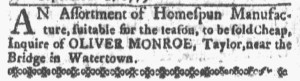
“AN Assortment of Homespun Manufacture.”
It was a short advertisement, just four lines in the September 18, 1775, edition of the Boston-Gazette, but it spoke volumes about the times in which the advertiser placed it and colonizers read it. “AN Assortment of Homespun Manufacture, suitable for the season,” the notice announced, “to be sold Cheap. Inquire of OLIVER MONROE, Taylor, near the Bridge in Watertown.” Even before the battles at Lexington and Concord marked a new chapter in the imperial crisis, homespun cloth became a symbol of resistance to British abuses, especially duties on imported goods imposed by Parliament. Over the past decade, colonizers had participated in a series of boycotts, first to protest the Stamp Act in 1765, then in response to the Townshend Acts in the late 1760s, and again when they learned of the Coercive Acts in 1774. Each time, consumers opted for homespun cloth produced in the colonies as an alternative to textiles imported from England.
At the time that Monroe ran his advertisement, the Continental Association remained in place. It had gone nine months earlier. In addition to prohibiting merchants and shopkeepers from selling goods received after December 1, 1774, it called on colonizers to “promote Agriculture, Arts, and the Manufactures of this Country.” That included purchasing homespun rather than the “Fine assortment” of imported textiles, ranging from corduroys to striped hollands to cambrics, listed in a longer advertisement that appeared in the same column as Monroe’s short notice. Monroe did not need to invest much effort in marketing his “Homespun Manufacture” because the times spoke for themselves. Prospective customers already recognized the political significance of the choices they made in the marketplace. That they read his advertisement in the Boston-Gazette, now published in Watertown as the siege of Boston continued, only underscored the importance of practicing politics when they went shopping.