
GUEST CURATOR: Nicholas Arruda
What was advertised in a colonial American newspaper 250 years ago today?
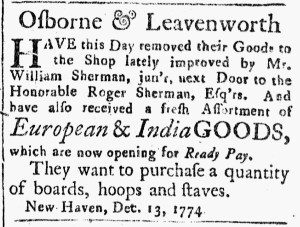
“A fresh Assortment of European & India GOODS.”
Osborne and Leavenworth advertised a “fresh Assortment of European & India GOODS” in the Connecticut Journalon January 11, 1775. Their advertisement was dated December 13, 1774, very shortly after the implementation of the Continental Association on December 1. In October 1774, the First Continental Congress organized that nonimportation agreement in response to the oppressive policies of Great Britain, especially the Coercive Acts. Osborne and Leavenworth may have been undertaking a clearance sale on stock acquired prior to the importation ban. In The Colonial Merchants and the American Revolution, 1763-1776, Arthur M. Schlesinger observes that merchants had to comply with boycott agreements while they had preexisting inventories to manage. He observes that “the enforcement of non-importation agreements placed merchants in a precarious position, compelling them to balance between patriotic compliance and economic survival.”[1] Osborne and Leavenworth probably advertised goods imported before the Continental Association went into effect and colonists refused to import British goods as a sign of unity.
**********
ADDITIONAL COMMENTARY: Carl Robert Keyes
Osborne and Leavenworth’s advertisement does indeed raise questions about when they received their goods compared to when the Continental Association went into effect. They placed their notice to advise prospective customers that they had moved to a new location and received a new shipment that they “are now opening.” They did not specify when that “fresh Assortment” arrived, though they likely hoped that readers would assume they acquired their wares before December 1. After all, it took time to unpack goods and prepare them for sale, especially when setting up shop in a new location. Alternately, the goods may have arrived in the colonies, likely New York, prior to December 1 before merchants there dispatched them to Osborne and Leavenworth in New Haven.
The date that appeared in their advertisement made it possible to reach the conclusion that they peddled only wares imported before December 1. Other merchants and shopkeepers who advertised in the same issue of the Connecticut Journal did not give any indication about when they received merchandise that they promoted as new arrivals. Jeremiah Atwater, for instance, “just received a fresh Assortment of GOODS.” Similarly, Anthony Perit “just received a large and general Assortment of English and India GOODS.” Yet neither of them included any dates nor mentioned the Continental Association. Josiah Burr proclaimed that he “just receiv’d a large Assortment of GOODS” and gave an extensive list of imported textiles, housewares, and groceries (including tea) in an advertisement dated “Jan. 1775,” well after the Continental Association commenced. Perhaps each of these local retailers had received new goods from merchants in New York rather than directly from English ports. After all, five out of six ships that the custom house in New Haven listed as “ENTERED IN” in the January 11 edition of the Connecticut Journal arrived from New York. In that case, neither advertisers nor readers may have been concerned about breaking the prohibition on buying and selling imported goods. Six weeks after the Continental Association went into effect, advertisements for consumer goods in the Connecticut Journal looked much the same as they had for years, unlike some advertisements in newspapers published in major ports that announced the sales of imported goods under the direction of local Committees of Inspection.
**********
[1] Arthur M. Schlesinger, The Colonial Merchants and the American Revolution, 1763-1776 (New York: Frederick Ungar Publishing Company, 1957), 240.