March 23

What was advertised in a colonial American newspaper 250 years ago today?

Supplement to the Pennsylvania Gazette (March 23, 1774).

“Remarkable old Spirits, West-India Rum, and Brandy.”

Thomas Batt advertised his “WINE and SPIRIT STORE” in the Pennsylvania Gazette for three months in 1774.  He stocked a “large and valuable Collection” that included “Old genuine Madeira, Lisbon, Mountain and Teneriffe Wines; remarkable old Spirits, [and] excellent Claret.”  He pledged to “sell any Quantity, from a Pipe [a large barrel] to a Gallon” to suit the needs of his customers.

When it ran on March 23, 1774, Batt’s advertisement appeared in the Supplement to the Pennsylvania Gazette rather than in the standard issue for that week.  Colonial newspapers typically consisted of four pages created by printing two pages on each side of a broadsheet and then folding it in half.  On occasion, printers had more news, letters, advertisements, and other content than would fit within four pages.  Sometimes they inserted notices that material which they did not publish that week would appear in the next issue.  Other times, however, they had enough content to justify publishing a supplement, either two or four pages.

In this instance, the printers opted for a four-page supplement, doubling the content they distributed to subscribers and other readers that week.  The revenue generated from advertisements likely made the supplement a viable endeavor since paid notices filled ten of the twelve columns.  Those advertisement had not merely been displaced to the supplement by news that appeared in the standard issue.  News items accounted for slightly less than six of those twelve columns.  Overall, that meant that the standard issue and the supplement carried eight columns of news and sixteen columns of advertising.  More than one hundred paid notices, including Batt’s advertisement for his “WINE and SPIRIT STORE,” occupied two-thirds of the space in that issue of the Pennsylvania Gazette and its supplement.  Quite often, eighteenth-century newspapers served as vehicles for delivering advertising even more so than for disseminating news.
May 10

What was advertised in a colonial American newspaper 250 years this week?

May 10 - 5:7:1767 Pennsylvania Gazette
Supplement to the Pennsylvania Gazette (May 7, 1767).

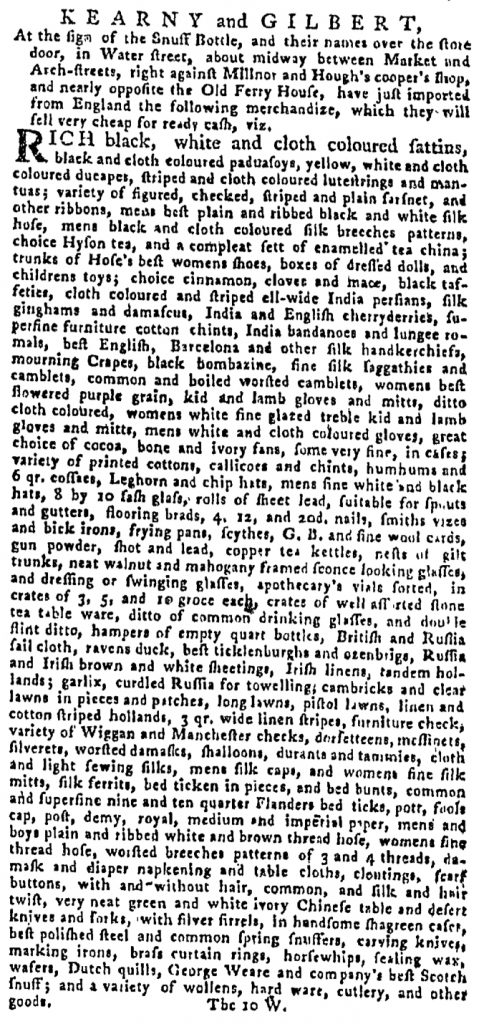
“KEARNY and GILBERT, At the sign of the Snuff Bottle, and their names over the store door.”

Newspaper advertisements from the period suggest visual elements of marketing erected in eighteenth-century cities and villages. Residents and visitors alike encountered an array of shop signs that retailers used to identify their businesses. Such was the case in the first issue of the Pennsylvania Gazette published in May 1767. Although their signs have been lost to time, several advertisers included descriptions of them alongside other directions intended to guide customers to their shops.

Nathaniel Tweedy, a druggist, announced that he could he sold medicines “At the Golden Eagle, in Market-street, near the Court-house.” Dyers Joseph Allardyce and Company practiced their trade “at the Sign of the Blue Hand, in Race-street, between Front and Second Streets.” Edward Penington, an attorney, advertised a real estate auction to be held “at the house of John Biddle, at the sign of the Indian King, in Market-street.” William Dawson, a cutler, not only stated that he made a various kinds of knives and other implements “At the sign of the Scythe and Sickle” but also included a woodcut depicting those instruments suspended from a signpost. Each of these, especially Dawson’s advertisement, hints at the rich visual cityscape of marketing in Philadelphia in the decade before the Revolution.

In many instances, such signs provided the sole means of identifying a shop or tavern, but other advertisers stated that they also labeled their places of business with their own names. Kearny and Gilbert, for instance, stocked an array of merchandise “At the sign of the Snuff Bottle … in Water Street.” To alleviate any potential confusion, customers could also look for “their names over the store door.” George Frederick Boyer, one of Dawson’s competitors in the cutlery business, displayed “a Sign in Front-street, and another in Water-street, with his Name thereon, and on which are painted Swords, Knives, Lancets, Razors, and Grinding Tools.”

How often did eighteenth-century shopkeepers, artisans, and other entrepreneurs label their locations with their own names or include them on their fanciful signs? Did most signs provide visual identification exclusively? Or did they also tend to incorporate at least a minimal amount of text, even if just the name of the proprietor? In the absence of devices like the Golden Eagle or the Blue Hand, did others at least post placards with their names so potential customers knew they had arrived at the correct destination? Or did they assume the extensive directions provided in advertisements sufficed?

I do not have satisfactory answers to these questions, but they remind me that the history of advertising in eighteenth-century America requires research along multiple trajectories, utilizing multiple sorts of sources. Newspaper notices and other printed ephemera (magazine wrappers, broadsides, trade cards, catalogs) tell much of the story, but material culture (such as shop signs or packaging materials, both more likely in museum collections rather than archives) reveals other important aspects of how marketing worked in early America.