February 4

GUEST CURATOR:  Nicholas Arruda

What was advertised in a revolutionary American newspaper 250 years ago this week?
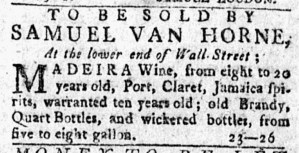
New-York Journal (February 1, 1776).

“MADEIRA Wine.”

Samuel Van Horne advertised “MADEIRA Wine, from eight to 20 years old, Port, Claret, Jamaica spirits, [and] old Brandy” in the New-York Journal on February 1, 1776.  Mentioning that the Madeira was aged between eight and twenty years might have meant that Van Horne was focusing on elite consumers who used imported wines to show their refinement since Madeira wine was not an everyday beverage.  As David Hancock explains, in the eighteenth century, Madeira was “an expensive, exotic, status-laden, and highly processed wine produced on the Portuguese island of Madeira, 500 miles west of Morocco.”[1]  Its status came from its position in Atlantic trade networks. Hancock argues that the status of the wine was created through “an Atlantic network of producers, distributors, and consumers in intense conversation with one another,” which transformed Madeira into a commodity that was recognized across the British Empire.[2]  Van Horne’s advertisement thus shows that selling aged Madeira was not just about selling alcohol but even more importantly participating in elite identity.

**********

ADDITIONAL COMMENTARY:  Carl Robert Keyes

Regular readers of the New-York Journal saw Samuel Van Horne’s advertisement for Madeira and other wines and spirits three times before they encountered it in the February 1, 1776, edition.  As the colophon at the bottom of the final page explained, “Advertisements of no more Length than Breadth are inserted for Five Shilling[s for] four Weeks, and One Shilling for each Week after, and larger Advertisements in the same Proportion.”  Many newspapers printed in the colonies solicited advertisements, but they did not always indicate the fees.  John Holt, the printer of the New-York Journal, hoped to entice advertisers by letting them know how much they would pay to insert notices in his newspaper.  The initial charge covered the space that an advertisement occupied in four consecutive issues at one shilling per week and an additional shilling for setting the type, keeping the books, and other work undertaken in the printing office.

That makes it easy to determine that Van Horne invested five shilling in running his advertisement.  Its length certainly was no more than its breadth, so the printer did not increase the fee in proportion as he did for longer advertisements.  The notation in the lower right of the advertisement, “23-26,” makes clear that Van Horne intended for the advertisement to run only for the four weeks covered by the initial expense.  “23” referred to the issue number for the first issue that carried the advertisement, “NUMBER 1723” on January 11, while “26” indicated the final issue to carry the advertisement, “NUMBER 1726” on February 1.  At a glance, the compositor knew whether to include Van Horne’s advertisement in a new issue or remove it.  The notation, intended for employees in the printing office rather than readers of the newspaper, made it unnecessary to consult a ledger, instructions from the advertiser, or other documents.  Van Horne apparently decided that he did not wish to extend the run of this advertisement.  The compositor did indeed remove it rather than publish it once again in the February 8 edition.

**********

[1] David Hancock, “Commerce and Conversation in the Eighteenth-Century Atlantic: The Invention of Madeira Wine,” Journal of Interdisciplinary History 29, no. 2 (Autumn 1998): 197.

[2] Hancock, “Commerce and Conversation,” 197.

June 18

What was advertised in a colonial American newspaper 250 years ago today?

New-Hampshire Gazette (June 18, 1773).

“(6 w.)”

In the spring and summer of 1773, George Deblois ran an advertisement to inform readers of the New-Hampshire Gazettethat he stocked a ‘GENERAL ASSORTMENT of English, India and Hard Ware GOODS” at his shop in Newburyport, Massachusetts.  Like many other merchants and shopkeepers of the era, he listed a variety of items in an effort to demonstrate the array of choices he made available to consumers.  One element of his advertisement, however, was not intended for prospective customers.  A notation, “(6 w.),” on the final line provided the compositor and others working in the printing office information about how long Deblois’s advertisement should appear in the New-Hampshire Gazette.  The merchants made arrangements for it to run for six weeks.

Curiously, the advertisement did not appear in six consecutive issues.  Dated May 5, it first ran in the May 14 edition.  It then appeared in the next two issues on May 21 and May 28, but did not run on June 4 and June 11.  The newspaper revived the advertisement for another three consecutive issues, June 18, June 25, and July 2, before discontinuing it following the sixth insertion.  One the type had been set, the compositor could include the advertisement (or not) and move it around within each edition.  An error, “the SIGN of the GOLNEN EAGLE,” remained consistent throughout the run of the advertisement.

The publication history of this advertisement raises questions about the business of advertising and communications between advertisers and printing offices.  Did Deblois intend for his advertisement to appear in six consecutive issues?  Or did he send instructions to Daniel Fowle, the printer of the New-Hampshire Gazette, that he wished for it to run six times over the course of a couple of months but not necessarily for six consecutive weeks?  Did Deblois consult the New-Hampshire Gazette each week to confirm whether his advertisement appeared?  If so, did he note the error in the name of his shop sign?  How accommodating would the printing office have been to fixing such an error at the request of an advertiser, especially one who placed such a lengthy advertisement for so many weeks?  What kind of bookkeeping system did the Fowle and others in the printing office use to keep track of how many times each advertisement appeared?  What kind of system, such as entering that information into a ledger or adding it to a running list of recent advertisements, became part of the weekly ritual of publishing the New-Hampshire Gazette?  When it came to adding and removing advertisements, what kind of coordination among the printer and other workers occurred within the printing office? Surviving primary sources may provide partial answers to some of these questions, but other aspects of the day-to-day operations of colonial printing offices, especially the business of advertising, may never have definitive answers.

July 18

What was advertised in a colonial American newspaper 250 years ago today?

New-York Journal (July 18, 1771).

“86—.”

For several weeks in 1771, Nesbitt Deane promoted “HATS, MANUFACTURED by the Advertiser” in the New-York Journal.  His advertisements concluded with “86—,” a notation intended for the compositor rather than readers.  Most advertisements in the New-York Journal included two numbers, the first corresponding to the issue in which the advertisement first appeared and the other indicating the final issue for the advertisement.  That allowed the compositor to quickly determine whether an advertisement belonged in the next issue when arranging notices and other content on the page in advance of going to press.

George Ball’s advertisement for “A Neat Assortment of CHINA, GLASS, STONE and DELPH WARES” in the same column as Nesbitt’s advertisement for hats in the July 18 edition, for instance, concluded with “88 91.”  That signaled to the compositor that Ball’s advertisement first appeared in “NUMB. 1488” on July 11 and would continue through “NUMB. 1491” on August 1.  That was the standard run, four issues, for many advertisements.  According to the colophon, John Holt, the printer, charged “Five Shillings, four Weeks, and One Shilling for each Week after.”  Many advertisers tended to pay for the minimum number of issues and then discontinued their notices.  Others, like Jacobus Vanzandt and Son, arranged for their advertisements to appear for longer durations.  Their notice for imported textiles, garments, and housewares in the column next to Nesbitt’s notice concluded with “79 87,” indicating that they specified that it should run for nine weeks.

Deane apparently did not select an end date when he initially placed his advertisement in “NUMB. 1486” on June 27.  Instead, he opted to let it run indefinitely until he decided to remove it.  The dash instead of a second number communicated to the compositor to continue inserting the advertisement until instructed otherwise, while the “86” aided in keeping the books.  The printer did not need to consult previous editions when calculating how much Deane owed when he eventually stopped running his advertisement.  Many, but not all, printers included similar notations in advertisements that appeared in American newspapers in the eighteenth and early nineteenth centuries.

March 3

What was advertised in a colonial American newspaper 250 years ago this week?

New-York Journal (February 21, 1771).

“To all the Friends of LIBERTY … 61 71.”

Last week the Adverts 250 Project featured this advertisement calling on “all the Friends of LIBERTY” to mark the fifth anniversary of “the Repeal of the oppressive Stamp-Act.”  That initial examination of the advertisement focused on the importance that colonists placed on commemorating the events the culminated in the American Revolution even before the skirmishes took place at Lexington and Concord or the Continental Congress declared independence.  Another aspect of this advertisement, however, caught my attention when I first selected it for the Adverts 250 Project.

The notation on the final line – “61 71” – presented a mystery.  Similar notations appeared on the final lines of most advertisements in the New-York Journal.  Either the printer, John Holt, or the compositor inserted these numbers to indicate the first and last issues in which an advertisement should appear.  They replicated the last two digits of the issue numbers of those newspapers.  For example, the February 28, 1771, edition of the New-York Journal was “NUMB. 1469,” so any advertisements with “69” as the first number in the notation ran for the first time in that issue and any advertisements with “69” as the second number in the notation ran for the last time.  The notations, therefore, were intended for those who worked in the printing office rather than for readers.

I noticed the “61 71” notation for a couple of reasons.  First, it indicated that the advertisement ran for eleven weeks, an odd number in general, made even more odd by the fact that Holt’s pricing structure of “Five Shillings, four Weeks, and One Shilling for each Week after” (listed in the colophon every week) resulted in most advertisements running for four weeks because advertisers incurred the lowest possible cost.  Eleven weeks seemed like a long time to run the advertisement, but it had interesting implications.  Issue 1461 happened to be the first issue of the new year, published on January 3, 1771.  Had those who planned the commemorations of the fifth anniversary of the repeal of the Stamp Act considered the event worthy of notice so far in advance?

While possible, that did not seem right.  After all, I previously examined every issue of the New-York Journal published in January and February 1771 to identify advertisements to feature on the Adverts 250 Project and advertisements about enslaved people for the Slavery Adverts 250 Project.  I did not recall seeing this particular advertisement in any of those issues before selecting it from the February 21 edition.  I doubted that I had managed to skip over it in seven consecutive issues of the New-York Journal.  When I examined each edition in search of this particular advertisement, I discovered that it did not appear prior to February 21.  It ran in four consecutive issues, starting on February 21 and concluding on March 14, in issue 1471.  The advertisement appeared in the last edition of the New-York Journal before the commemoration of the repeal and the celebration of “so general and important a Cause.”

It turned out that the advertisement first appeared in issue 1468, not 1461.  The notation contained an error, probably the result of the compositor substituting the last digit of the second issue for the last issue of the first.  Few if any readers of the New-York Journal likely noticed this error.  After all, such notations in any advertisements were not intended for them.  For this historian of advertising and early American newspapers more than two centuries later, however, the notation contained a lot of potential meaning, especially in terms of how extensively those who planned the commemoration of the repeal of the Stamp Act advertised the upcoming fifth anniversary.  Although the advertisement did not as many times or for as long as the notation suggested, it still signaled an important act of remembering on the part of many colonists.

August 3

What was advertised in a colonial American newspaper 250 years ago today?

Aug 3 - 8:3:1769 New-York Journal
Supplement to the New-York Journal (August 3, 1769).

“79–.”

Like many other eighteenth-century printers, John Holt, the printer of the New-York Journal, inserted numbers at the end of advertisements. These numbers were not intended for readers but instead for those who worked in the printing office. They indicated how long an advertisement should run. For instance, an advertisement announcing that the brigantine Rebekah would sail for Jamaica appeared in the supplement that accompanied the August 3, 1769, edition of the New-York Journal. The compositor inserted the numbers 85 and 88 on the final line, 85 indicating that the advertisement first ran in issue 1385 on July 20 and 88 indicating that it would make its final appearance in issue 1388 on August 10. After that, the compositor would remove it. Similarly, Jonathan Hampton’s advertisement featuring a woodcut that depicted a Windsor chair also included 85 and 88 on the final line, though an earlier iteration included the numbers 63 and 72 instead. Hampton had inserted the advertisement for ten weeks earlier in the year, apparently determined it had been worth the investment, and then inserted it again for a shorter run.

Other advertisements, however, included a single number and a dash. Samuel Francis (better known today as Samuel Fraunces) ran an advertisement that concluded with “79–“ instead of two numbers. Similarly, Jarvis Roebuck had “62–“ on the final line of his advertisement. In each case, the number indicated the issue that the advertisement first appeared: issue 1362 on February 2 for Jarvis and issue 1379 on June 8 (the same date at that opened the advertisement) for Francis. What did the dash mean? How did the compositor interpret it when deciding which items belonged in an issue and which should be removed?

The publication history of these two advertisements reveals that the dash did not indicate that an advertisement should run continuously. Francis’s advertisement ran for five consecutive issues (June 8, 15, 22, and 22 and July 6) before appearing sporadically in six more issues (July 20, August 3 and 24, September 7, and October 12 and 26). Roebuck’s advertisement ran sporadically from the start, appearing on February 2 and 9, March 2 and 30, April 13 and 27, May 25, June 1, 8, and 29, July 27, August 3, 24, and 31, September 14, and October 12. Seemingly no particular plan corresponds to the publication schedule for the sixteen insertions of Roebuck’s notice over the course of nine months.

Perhaps the dash indicated that the compositor had carte blanche to insert the advertisement when necessary to complete a page. These two advertisements were the final items in the August 3 supplement, though they did not always appear at the end of an issue or supplement. Moderate in length, they may have been convenient filler when the compositor estimated that an issue or supplement ran short of other content. Paired numbers, like “85 88,” streamlined bookkeeping and production of the New-York Journal, but this arrangement for continued yet sporadic insertions required careful attention to bookkeeping. The printer or another employee in the printing office would have had to peruse each issue to see which advertisements with dashes appeared and then update the ledger accordingly.

What role did advertisers play in this process? Could they instruct the printing office to insert an advertisement on a week-by-week basis? If compositors made decisions about including advertisements, did advertisers pay for every insertion? Did advertisers receive any sort of discount for this arrangement? Did advertisements every run after advertisers no longer wished for them to appear? It seems unlikely that Francis would have been enthused about an advertisement promoting the summer entertainments at Vauxhall Gardens to appear in the New-York Journal in late October.

Some of the numbers compositors inserted at the end of advertisements clearly indicated their purpose in the operation of a printing office and the production of colonial newspapers. Other notations, however, only hinted at their purpose and now raise tantalizing questions about how printers, compositors, advertisers, and others used them. The dash at the end of some advertisements certainly served some purpose; otherwise compositors would not have taken the time to include such notation. A more systematic survey of advertisements combined with careful examination of printers’ ledgers may reveal some of the practices that printers found efficient and effective in running their shops in the eighteenth century.