What was advertised in a colonial American newspaper 250 years ago today?
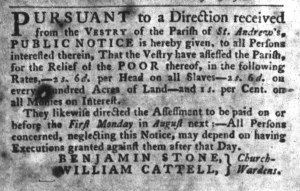
“The Vestry have assessed the Parish, for the Relief of the POOR.”
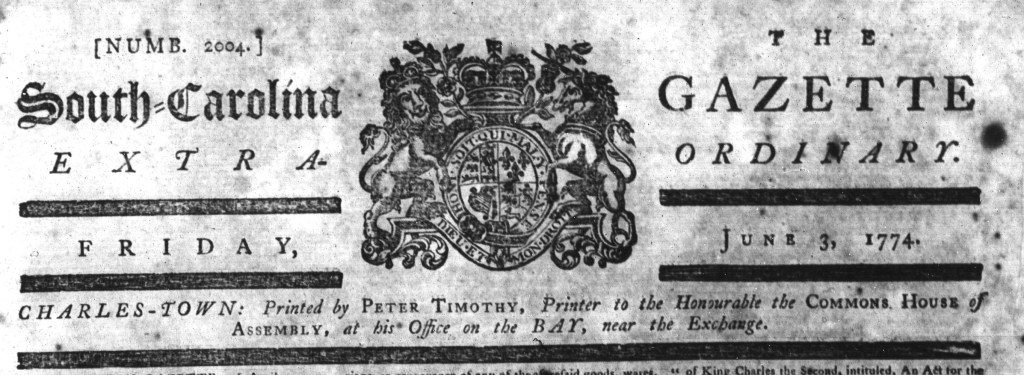
Peter Timothy usually published the South-Carolina Gazette on Mondays in 1774, but upon receiving the text of the Boston Port Act he considered the news momentous enough to merit an extraordinary edition on Friday, June 3. Word certainly circulated via conversations among colonizers, yet Timothy gave them the opportunity to read the act for themselves and see all the details that might otherwise have been distorted as the news traveled. The masthead for the extraordinary featured thick black lines, a symbol of mourning that usually signified the death of a prominent official but in this case lamented the death of liberty in the colonies.
The “Act to discontinue … the landing and discharging, lading or shipping of Hoods, Wares, or Merchandize, at the Town, and within the Harbour of Boston” accounted for the entire front page of the extraordinary. News and editorials originally published in Boston and Philadelphia ran on the second page and most of the third. Timothy had too much content for a two-page supplement, so he opted for four pages. That left a page and a half to fill. The printer opted for advertisements, items with type already set. He certainly had enough of that kind of content at his printing office. Advertising comprised three of the twelve columns in the previous standard edition of the South-Carolina Gazette and all four pages of the supplement distributed on the same day. Yet Timothy may have been selective with which advertisements he chose to deliver with confirmation of the Boston Port Act. The extraordinary did not include any notices from purveyors of goods and services hawking their wares. Instead, Timothy chose advertisements that delivered news, including the “PRESENTMENTS of the GRAND-JURORS” for several districts in the colony, an announcement that the Recess Society would hold its quarterly meeting, and a “PUBLIC NOTICE” about taxes “for the Relief of the POOR” in the Parish of St. Andrew’s. Given the significance of the news that the extraordinary carried, Timothy may have aimed to accompany the Boston Port Act with advertisements that also delivered news rather than attempts to convince consumers to make purchases. The following Monday, he returned to business as usual with all manner of advertising in the standard issue and supplement published on June 6.