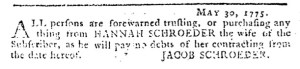
What was advertised in a revolutionary American newspaper 250 years ago today?
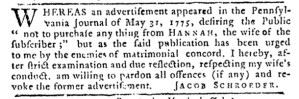
“I hereby … am willing to pardon all offences (if any) and revoke the former advertisement.”
It was a rare retraction. Jacob Schroeder asked the public to disregard the advertisement he placed regarding his wife, Hannah, a few months earlier. Some sort of marital discord occurred within the Schroeder household, prompting Jacob to run an advertisement with these instructions: “ALL persons are forewarned trusting, or purchasing any thing from HANNAH SCHROEDER the wife of the Subscriber, as he will pay no debts of her contracting from the date hereof.” Similar advertisements regularly appeared in newspapers throughout the colonies, sometimes more than one in a single issue. Usually, they indicated that a wife had “eloped” or run away from her husband. In turn, the husband instructed merchants, shopkeepers, artisans, and others not to allow his wife access to his credit. Such advertisements often alleged various kinds of bad behavior perpetrated by the wife. However, husbands set the narrative. In many instances, the wife likely removed herself from an unhappy or even abusive marriage. Deprived of credit, most did not have an opportunity to publish their side of the story, though occasionally a wife did find the means to respond in an advertisement.
Retractions made by the husbands were also few and far between in early American newspapers, making Jacob’s advertisement even more noteworthy. “WHEREAS an advertisement appeared in the Pennsylvania Journal of May 31, 1775, desiring the Public ‘not to purchase any thing from HANNAH, the wife of the subscriber,’” he wrote, “but as the said publication has been urged to me by the enemies of matrimonial concord, I hereby, after strict reflection, respecting my wife’s conduct, an willing to pardon all offences (if any) and revoked the former advertisement.” He did not offer additional details. A shorter advertisement cost less, but a desire to avoid as much public scrutiny as possible may have been the deciding factor in not elaborating on the “offences (if any)” or the insinuations made to Jabob by “the enemies of matrimonial concord.” After all, it would have been embarrassing enough to resort to an advertisement in the first place, an admission that Jacob had been unable to exercise proper authority within his own household. That the details of Jacob and Hannah’s did not appear in print did not mean that they did not circulate in their neighborhood and beyond. Those “enemies of matrimonial concord,” whether relatives, friend, or acquaintances, likely gossiped about the couple, as did others. The appearance of both Jacob’s original advertisement and his retraction may have sparked more conversations and speculation about what occurred in the Schroeder household. The newspaper notices captured only part of the story.