October 13

What was advertised in a revolutionary American newspaper 250 years ago today?
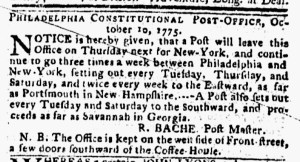
Story and Humphreys’s Pennsylvania Mercury (October 13, 1775).

“PHILADELPHIA CONSTITUTIONAL POST-OFFICE.”

At the same time that Mary Katharine Goddard, postmaster and printer of the Maryland Journal, advertised the Baltimore branch of the Constitutional Post Office in the fall of 1775, Richard Bache ran a notice for the “PHILADELPHIA CONSTITUTONAL POST-OFFICE” in the October 13 edition of Story and Humphreys’s Pennsylvania Mercury. Although Bache was not the printer of that newspaper, his advertisement received a privileged place similar to the one that Goddard’s notice enjoyed in her newspaper.  It appeared first among the advertisements that readers encountered when they perused the newspaper from start to finish, immediately below the “SHIP NEWS” and list of “ARRIVALS” in Philadelphia.  A double line did separate news from advertising, yet this item delivered news relevant to the imperial crisis that had become a war with the battles at Lexington and Concord the previous spring.  Over the summer, the Second Continental Congress established the Constitutional Post Office as an alternative to the imperial post office.  Enoch Story and Daniel Humphreys, the printers of the newspaper that carried Bache’s advertisement, apparently considered it in their best interest to increase the likelihood readers would take note of the information about the Constitutional Post Office by placing the notice right after the news.

Compared to Goddard’s advertisement, Bache’s notice gave readers a much more expansive glimpse of the scope of the enterprise.  Rather than simply stating which days the post arrived and departed, Bache reported that the Constitutional Post carried letters and newspapers “as far as Portsmouth in New-Hampshire” to the north and “as far as Savannah in Georgia” to the south.  The system linked the thirteen colonies.  On Tuesdays, Thursdays, and Saturdays, a rider set out for New York from Philadelphia.  On Tuesdays and Saturdays, another rider headed “to the Southward” to Baltimore, arriving there, according to Goddard’s advertisement, on Mondays and Thursdays.  This new system did more than move mail.  “Establishing a new post office,” Joseph M. Adelman argues, “placed the levers of information circulation in the hands of Americans.  …  Forming a ‘continental’ post office that could properly embody an intercolonial union and its resistance to imperial tyranny was crucial to Patriot mobilization at the height of the imperial crisis.”  Furthermore, “Patriot printers and their radical friends” played an integral role in establishing the new postal system.[1]  No wonder that Story and Humphreys placed Bache’s advertisement about the “PHILADELPHIA CONTSITUTIONAL POST-OFFICE” right after the “SHIP NEWS.”

**********

[1] Joseph M. Adelman, “‘A Constitutional Conveyance of Intelligence, Public and Private’: The Post Office, the Business of Printing, and the American Revolution,” Enterprise and Society 11, no. 4 (December 2010): 747-748.
December 14

What was advertised in a colonial American newspaper 250 years ago today?

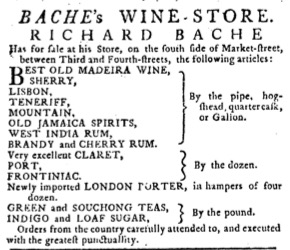
Pennsylvania Journal (December 14, 1774).

“GREEN and SOUCHONG TEAS.”

A year after the Boston Tea Party, advertisements for tea continued to appear in newspapers throughout the colonies.  They even continued to run after the Continental Association, a nonimportation agreement adopted by the First Continental Congress, went into effect on December 1, 1774.  The December 14, 1774, edition of the Pennsylvania Journal, for instance, carried two advertisements, side by side at the top of the final page, that included tea among the commodities offered for sale.  “BACHE’s WINE-STORE” stocked more than just wine and spirits.  Richard Bache also promoted “GREEN and SOUCHONG TEAS … By the pound.”  Similarly, “JOHN MITCHELL’s Wine, Spirit, Rum and Sugar STORES” provided consumers with “Bohea Tea, warranted good, by the chest, half chest or dozen” and “Best Green and Hyson Tea, by the dozen or pound.”  These advertisements apparently did not meet with the sort of ire that resulted in Bache or Mitchell quickly discontinuing them.  Instead, James R. Fichter documents in Tea: Consumption, Politics, and Revolution, 1773-1776, that “between May 1774 and March 1775 their ads appeared most weeks.”[1]

That seems incongruous considering the editorial position of the Pennsylvania Journal and the actions of William Bradford, one of its printers.  Fichter explains that Bradford “hosted in his home the meeting which decided how to oppose the East India Company’s shipment to Philadelphia in 1773.  Furthermore, he published “John Dickinson’s denunciation of the 1773 tea scheme, the broadsides from ‘Committee on Tarring and Feathering,’ which threatened pilots” who brought ships carrying tea up the Delaware River, and the “JOURNAL OF THE PROCEEDINGS” of the First Continental Congress.  On July 27, 1774, the Pennsylvania Journal altered its masthead to include a woodcut depicting a severed snake, each segment labeled to represent one of the colonies, and the motto, “UNITE OR DIE.”  How did advertisements that offered tea for sale find their way into such a newspaper so regularly?  Fichter explains that Bradford “was also a business” as well as a Patriot.  Like other newspaper printers who shared his political principles, he “did not censor tea ads” but instead “ran these ads as long as they were politically permissible.”  Even so late in 1774, “discourse and consumption were only partially politicized,” Fichter asserts, “and advertisements remained separate from but parallel to political debate.”[2]  While that was the case for advertisements about tea, other advertisements did take positions, either implicitly or explicitly, about the politics of consumption, yet Fichter demonstrates the complexity and nuance in how printers, advertisers, and the public approached such issues.  Neither the Boston Tea Party nor the Continental Association resulted in colonizers immediately giving up tea or other imported goods.

**********

[1] James R. Fichter, Tea: Consumption Politics, and Revolution, 1773-1776 (Ithaca: Cornell University Press, 2023), 143.

[2] Fichter, Tea, 143.

May 10

What was advertised in a colonial American newspaper 250 years ago this week?

Pennsylvania Journal (May 7, 1772).

“JUST IMPORTED in the ship Britannia, Capt. Falconer from London.”

Readers of the Pennsylvania Journal and other colonial newspapers did not have to rely solely on the list of vessels “Entered In” that appeared in the shipping news from the customs house to learn which ships recently arrived in port.  Advertisements often carried that information as well.  Consider, for instance, the first advertisement in the May 7, 1772, edition of the Pennsylvania Journal.  It included a standard introduction that named the ship that transported the goods offered for sale before naming the purveyor of those goods or listing the merchandise.  Richard Bache began his advertisement for an assortment of textiles with “JUST IMPORTED in the ship Britannia, Capt, Falconer from London.” His notice appeared on the first page, two pages before the shipping news.

Even if readers skipped over that advertisement, it would have been difficult for them to miss every reference to the arrival of the Britannia from London.  Several other advertisements included introductions nearly identical to the one in Bache’s notice.  George Fullerton began his advertisement (on the third page, one column to the right of the shipping news) with “IMPORTED in the ship Britannia, Capt. Falconer, from London.”  The fourth and final page featured four more advertisements that mentioned the Britannia.  Mark Freeman and Townsend Speakman both opened their advertisements with that introduction, while John White and the partnership of Duffield and Delany listed their names first and then credited “the Britannia, Captain Falconer, from London” for delivering their “FRESH” merchandise.  On the first page, Daniel Roberdeau hawked “A COMPLEAT EDITION of the GENUINE LETTERS of the Late Rev. Mr. GEORGE WHITEFIELD … Received from his Executors, per Capt. Falconer.”  He did not need to provide more information since other advertisements provided context about Falconer.

Prospective customers likely found such notes helpful as they perused newspaper advertisements, especially when merchants and shopkeepers ran advertisements for weeks or even months.  Noting which vessel transported the merchandise in an advertisement helped readers determine if it was still “FRESH” or if other shops carried textiles, garments, housewares, and other goods that arrived more recently and, as a result, might include more recent fashions and styles.  This standard introduction to so many advertisements thus yielded its greatest advantage for advertisers when their notices first appeared in the public prints, but contained to provide useful context for consumers throughout the entire run of those advertisements.

February 9

What was advertised in a colonial American newspaper 250 years ago today?

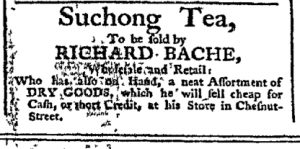
feb-9-291767-pennsylvania-chronicle
Pennsylvania Chronicle (February 9, 1767).

“A neat Assortment of DRY GOODS, which he will sell cheap.”

Today the Adverts 250 Project features its first advertisement from the Pennsylvania Chronicle, and Universal Advertiser. Likewise, the Slavery Adverts 250 Project includes its first advertisement from that newspaper. William Goddard had been publishing proposals for the Pennsylvania Chronicle in Philadelphia’s newspapers (and even the Providence Gazette) for weeks before it commenced publication on January 26, 1767. The third issue, published February 9, 1767, is the first included in Readex’s America’s Historical Newspapers database, though copies of the first two issues are extant in the collections of the American Antiquarian Society.(*)

Goddard’s proposal included a call for advertisers to submit notices they wished to appear in the Pennsylvania Chronicle. In addition, the colophon advised readers that Goddard “gratefully received” all sorts of submissions for his newspaper, including advertisements, articles, and letters of intelligence. He achieved early successes attracting advertisers, devoting nearly half (seven of sixteen columns) of the third issue to thirty-five paid notices of varying lengths. Most promoted consumer goods and services, but some offered real estate for sale or called on debtors to settle accounts. One even offered a reward upon the return of “a young DOG of the Spaniel Breed” that had strayed from its master.

Compared to newspapers published in some smaller towns, the new Pennsylvania Chronicle overflowed with advertising, especially advertisements for consumer goods and services. The third issue even included advertisements from two entrepreneurs who branded their businesses with woodcuts that presumably replicated the shop signs that marked their locations: saddler John Young, Jr., “At the sign of the ENGLISH HUNTING SADDLE” and druggist Nathaniel Tweedy “At the GOLDEN-EAGLE.”

feb-9-291767-tweedy-detail-pennsylvania-chronicle
Detail of Nathaniel Tweedy’s advertisement in the Pennsylvania Chronicle (February 9, 1767).

This stands in stark contrast to other newspapers, such as the Providence Gazette that seemed to struggle to attract advertisers in late 1766 and early 1767. Goddard appears to have experienced no difficulty generating advertising from entrepreneurs in the busy urban port of Philadelphia. The third issue of the Pennsylvania Chronicle offered dozens of advertisements to its readers. A quarter of a millennium later, I am simultaneously excited by the range of advertisements that could potentially be incorporated into the Adverts 250 Project and disappointed to choose only one at a time.

I am also frustrated to skip over so many interesting and significant advertisements, though I continue to affirm the methodology that requires doing so. Part of this disappointment stems from the dearth of advertisements available at other times during the week. For instance, since the Providence Gazette was the only newspaper published on Saturdays in 1767 and no newspapers were published on Sundays, each week the Adverts 250 Project gives disproportionate attention to advertisements from the Providence Gazette in the process of featuring advertisements published exactly 250 years ago that day or as close to that day as possible. As a result, the Providence Gazette is overrepresented and other newspapers with much more advertising remain underrepresented. On the other hand, this means that marketing efforts in at least one smaller city are subject to examination alongside the copious newspaper advertisements published in Boston, Charleston, New York, and Philadelphia.

Again, I stand by the project’s methodology, but recognize that both researchers and readers must take into account both its strengths and limitations.

**********

(*) Although this project relies primarily on digitized primary sources, I also examined original copies of the first two issues of the Pennsylvania Chronicle. From the very first issue William Goddard managed to attract advertisers.  A total of twenty-two advertisements spread over five (out of sixteen) columns appeared in the first issue (January 26, 1767), including an advertisement by Nathaniel Tweedy (without the woodcut).  The second issue (February 2, 1767) included thirty-three advertisements amounting to nearly seven columns, including advertisements by John Young, Jr., and Nathaniel Tweedy (both with woodcuts).