November 7

What was advertised in a colonial American newspaper 250 years ago today?

Newport Mercury (November 7, 1774).

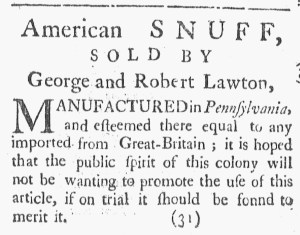
“American SNUFF … equal to any imported from Great-Britain.”

George Lawton and Robert Lawton hoped that their marketing strategy would help them to edge out the competition when they advertised “American SNUFF” in the November 7, 1774, edition of the Newport Mercury.  They explained that the product they sold was “MANUFACTURED in Pennsylvania, and esteemed there equal to any imported from Great-Britain.”  Apparently, it was not yet familiar to consumers in Rhode Island, but the Lawtons hoped that the enthusiasm for the snuff in another colony would convince local customers to give it a try.  Furthermore, they suggested that patriotic consumers had a duty to select this “American SNUFF” and support domestic manufactures over imported alternatives.  “[I]t is hoped,” the Lawtons declared, “that the public spirit of this colony will not be wanting to promote the use of this article, if on trial it should be found to merit it.”  They allowed for some wiggle room, leaving it to consumers to assess the quality of the snuff for themselves, yet proposed that those who did consider it “equal to any imported from Great Britain” should shift their allegiance to the product from the colonies.

Elsewhere on the same page, John Bell a shopkeeper who frequently advertised in the Newport Mercury, hawked “ENGLISH and INDIA GOODS” that he sold “as cheap as can be bought in any shop in AMERICA.”  Following a catalog of some of his inventory, he concluded with a separate entry for “Best Tilloch’s snuff, just imported from Glasgow.”  That city was well known for the quality of the tobacco products made there and then shipped to consumers on both sides of the Atlantic.  Bell expected that customers in Newport recognized “Tilloch’s snuff” as a familiar brand, not an unreasonable supposition considering that other entrepreneurs also advertised that product.  Bell’s effort to market imported snuff did not have the same visual appeal as the advertisement placed by the Lawtons.  Their notice featured “American SNUFF” as a headline in a larger font, calling attention to both the product and the argument about the political principles associated with it at a time that many colonizers advocated for boycotts of British goods as a means of resisting the Coercive Acts passed by Parliament earlier in the year.  They seemingly considered this strategy effective, resorting to it once again after using it several months earlier.
June 13

What was advertised in a colonial American newspaper 250 years ago today?

Supplement to the Newport Mercury (June 13, 1774).

“American SNUFF … MANUFACTURED in Pennsylvania.”

George Lawton and Robert Lawton advertised “American SNUFF” in the Newport Mercury as colonizers from New England to Georgia discussed how to respond to the Boston Port Act, legislation that closed the harbor as punishment for the destruction of tea in December 1773.  Simultaneously, newspapers covered other abuses perpetrated by Parliament.  The June 13, 1774, edition of the Newport Mercury, for instance, featured “A BILL for better regulating the Government of the Province of the Massachusetts-Bay, in North-America” and “A BILL for the impartial Administration of Justice in the Cases of Persons questioned for any Acts, done by them in the Execution of the law, or for the Suppression of Riots & Tumults in the Province of the Massachusetts-Bay, in New-England.”  Although neither had yet been passed when the ship that carried them departed from Bristol more than five weeks earlier, the printer, Solomon Southwick, noted “there is no doubt of their having passed before this time.”  In colorful commentary, he added that “the — [devil] himself can suggest nothing too horrid to be expected from the present administration.”  Another note followed the second bill: “God save the PEOPLE from such Laws!

It was in that context that the Lawtons marketed “American SNUFF … MANUFACTURED in Pennsylvania” as an alternative to snuff imported from Great Britain.  They asserted that consumers in Pennsylvania “esteemed” this snuff “equal to any imported,” so customers did not have to sacrifice quality in their support of “domestic manufacturers,” goods produced in the colonies.  The Lawtons presented trying this snuff as the patriotic duty of consumers who had concerns about current events.  “[I]t is hoped,” they implored, “that the public spirit of this colony will not be wanting to promote the use of this article, if on trial it should be fo[u]nd to merit it.”  In other words, the Lawtons encouraged prospective customers to try the snuff, taking into account the endorsements from colonizers in Pennsylvania, and see for themselves if they liked it as much as imported snuff.  If they did, their subsequent purchases could serve two purposes: acquiring a product they enjoyed while putting political principles into practice.  In many places, colonizers already discussed another round of nonimportation agreements, drawing on a strategy deployed in response to the Stamp Act and the Townshend Acts.  Immediately above the Lawtons’ advertisement, the resolutions from “a town meeting held at Providence” called for “an universal stoppage of all trade with Great-Britain, Ireland, Africa, and the West-Indies” until Parliament opened Boston Harbor once again.  Colonizers sought to use commerce for political leverage.  Similarly, decisions about which products to consume had political implications.  Even with no boycott currently in place, the Lawtons encouraged consumers to think about how they could support the colonies in their contest against Parliament.