
What was advertised in a revolutionary American newspaper 250 years ago today?
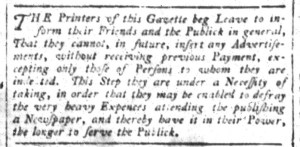
“They cannot … insert any Advertisements, without receiving previous Payment.”
The August 18, 1775, edition of the South-Carolina and American General Gazette included an update about how Robert Wells and Son would conduct business. “THE Printers of this Gazette,” they stated, “beg Leave to inform their Friends and the Publick in general, That they cannot, in future, insert any Advertisements, without receiving Payments” in advance. Wells and Son did make an exception for “persons to whom they are indebted.” Why did they change their policy? “This Stop they are under a Necessity of taking,” the printers explained, “in order that they may be enabled to defray the very heavy Expences attending the publishing a Newspaper, and therevy have it in their Power, the longer to serve the Publick.” That warning carried even more weight when readers and “the Publick in general” considered that the South-Carolina Gazette and Country Journal, one of three newspapers published in Charleston during the last decade, “discontinued” publication just a few weeks earlier.
This notice indicates that a common assumption about how printers managed their newspapers may be more complex than historians of the early American press previously realized. The usual narrative asserts that printers extended generous credit to subscribers, allowing them to go years without paying for their newspapers because the printers wanted to bolster their circulation numbers. In turn, that meant that they could attract more advertisers … and advertisements provided the most important revenue stream, especially since printers supposedly required advertisers to pay for their newspaper notices in advance. For several years, the Adverts 250 Project has tracked notices that seem to contradict that narrative, though references to “advertisements” in some of those notices may have referred to handbills, broadsides, and other media distributed separately rather than newspaper notices. In this notice, however, Wells and Son clearly referred to inserting advertisement in their newspaper. While they adopted a new policy of requiring payment for advertisements in advance, they previously extended credit to advertisers. More printers mya have done so than historians have realized.