January 10

What was advertised in a colonial American newspaper 250 years ago today?
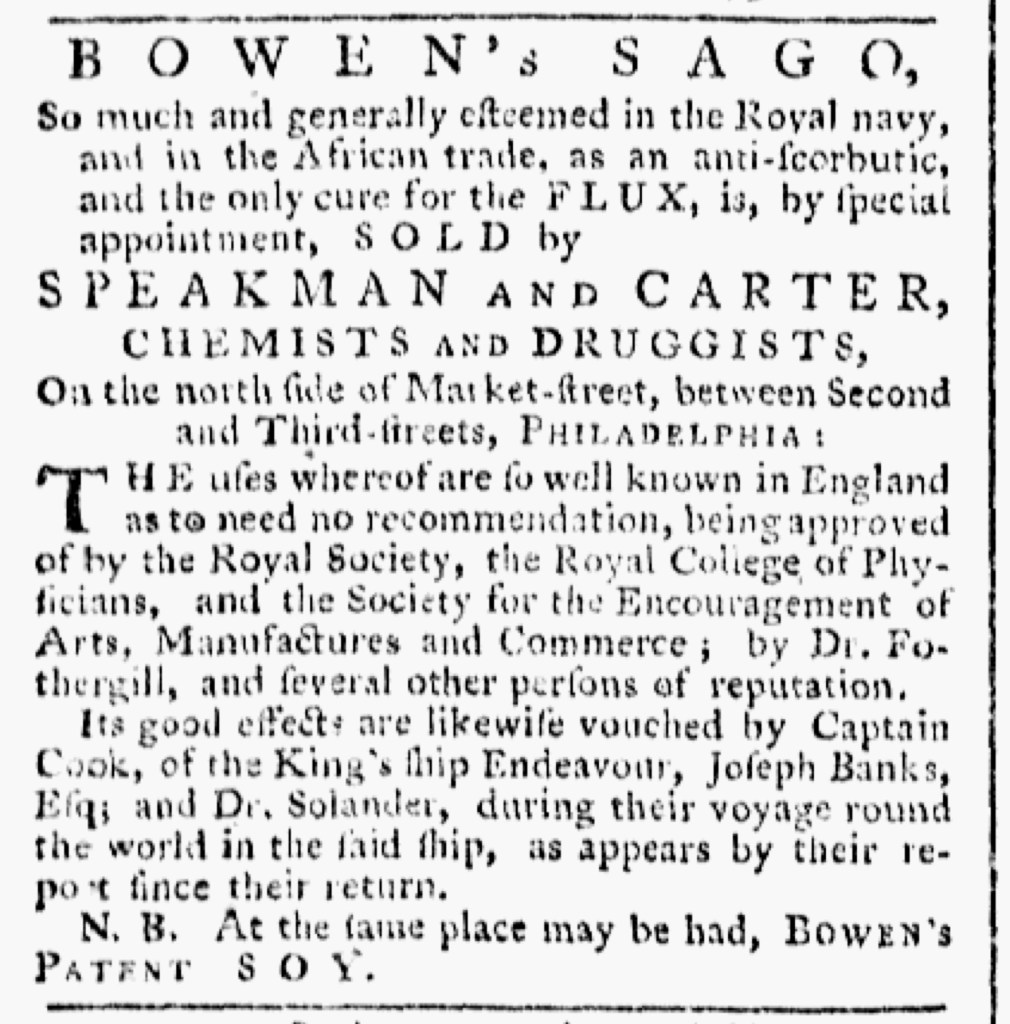
Dunlap’s Pennsylvania Packet (January 10, 1774).

“BOWEN’s SAGO … the only cure for the FLUX.”

Townsend Speakman and Christopher Carter, “CHEMISTS AND DRUGGISTS” in Philadelphia, took to the pages of Dunlap’s Pennsylvania Packet to advertise “BOWEN’s SAGO,” a medicine for preventing and curing scurvy.  The apothecaries did not, however, appear to generate their own copy.  Instead, they seemed to borrow heavily from advertisements that Zepheniah Kingsley placed in the South-Carolina Gazette and Country Journal and other newspapers published in Charleston several months earlier.

The headline differed only slightly, “BOWEN’s patent SAGO” in the original shortened to “BOWEN’s SAGO” in Speakman and Carter’s advertisement.  The introductory remarks remained the same, describing the product as “So much and generally esteemed in the Royal navy, and in the African trade, as an anti-scorbutic, and the only cure for the FLUX.”  In the original, the retailer then announced, “SOLD By Z. KINGSLEY,” and directed customers to his store in Beadon’s Alley.  The apothecaries in Philadelphia altered that portion slightly, declaring that the medicine “is, by special appointment, SOLD by SPEAKMAN AND CARTER, CHEMISTS AND DRUGGISTS,” and then gave directions to their shop.  The main body of both advertisements included an overview of endorsements by “the Royal Society, the Royal College of Physicians, and the Society for the Encouragement of Arts, Manufactures and Commerce.”  Speakman and Carter added additional endorsements: “by Dr. Fothergill, and several other persons of reputation.”  Another paragraph described how Captain James Cook and botanists who sailed with him during the Endeavour’s “voyage round the world” also “vouched” for the “good effects” of Bowen’s Sago in the report they published upon their return.  It appeared almost word-for-word, substituting “Joseph Banks, Esq” for “Mr. BANKES.”  A brief note appeared at the end, “SOLD at same Place, BOWEN’s patent SOY” in the original and “At the same place may be had, BOWEN’S PATENT SOY.”

Speakman and Carter created their advertisement at a time that most people thought little of reprinting what others had written or published, at least in certain contexts.  Colonial printers liberally reprinted content from one newspaper to another, often attributing their sources but sometimes not doing so.  Printers and booksellers who advertised books frequently copied the extensive subtitles or contents that appeared on the title page, treating those as advertising copy. Apothecaries, shopkeepers, and others who sold patent medicines sometimes published newspaper advertisements that drew heavily from the directions or promotional materials provided by the producers.  In this instance, Speakman and Carter may have used Kingsley’s advertisement as a model, revising it slightly for their purposes, or both the apothecaries in Philadelphia and the merchant in Charleston may have adapted handbills, newspaper advertisements, or other marketing materials sent to them by their suppliers.  Whatever the explanation, consumers in two major ports encountered nearly identical marketing for a product sold by local vendors.

July 27

What was advertised in a colonial American newspaper 250 years ago today?

South-Carolina Gazette and Country Journal (July 27, 1773).

“ITS USES are so well known as to need no Recommendation.”

Zepheniah Kingsley marketed “BOWEN’s patent SAGO” and “BOWEN’s patent SOY” in advertisements in the South-Carolina Gazette and the South-Carolina Gazette and Country Journal in July 1773.  In an advertisement placed in the Georgia Gazette five years earlier, Samuel Bowen explained that just one pound of his sago powder “will make a mess of wholesome nourishing food for 20 men.  It is of a light and nourishing substance, proper for fluxes and other disorders in the bowels, also in consumptive and ma[n]y other cases.”  At the time Kingsley placed his advertisement, he declared that the uses of sago powder “are so well known as to need no Recommendation.”  All the same, he trumpeted that the product was “So much esteemed in the ROYAL NAVY, and in the AFRICAN TRADE, as an ANTISCORBUTIC and the only CURE for the FLUX.”  In other words, captains fed it to sailors and captive Africans to prevent scurvy and treat dysentery.

Kingsley also noted that “the ROYAL SOCIETY, the ROYAL COLLEGE of PHYSICIANS, and the SOCIETY for the Encouragement of ARTS, MAUFACTURES and COMMERCE” all “approved” of sago powder, echoing endorsements that Bowen previously listed in his advertisement.  Furthermore, Kingsley made reference to testimonials from the captain and scientists aboard the Endeavour following that vessel’s famous “Voyage round the World” from 1768 to 1771, stating that sago powder’s “good Effects are likewise vouched by Captain COOKE, … Mr. BANKES and Dr. SOLANDER, … as appears by their Report since their Return.”  English botanist Joseph Banks and Swedish naturalist Daniel Solander were among the representatives of the Royal Society on that voyage.  To underscore the acclaim earned by “BOWEN’s patent SAGO,” the royal coat of arms of the United Kingdom adorned Kingsley’s advertisement in the South-Carolina Gazette and Country Journal.  Kingsley apparently did not consider it necessary to provide more details about the uses and effectiveness of Bowen’s sago powder.  The various endorsements of the product spoke for themselves.

November 30

What was advertised in a colonial American newspaper 250 years ago today?

Nov 30 - 11:30:1768 Georgia Gazette
Georgia Gazette (November 30, 1768).

“The Sago Powder will be of great utility at seas as well as on shore.”

At the end of November 1768, Samuel Bowen placed an advertisement promoting the “SAGO POWDER, SOY, and VERMICELLI” he cultivated and produced on several tracts of land near Savannah. He divided his advertisement into several parts, each with its own purpose. First, the prominent entrepreneur touted the accolades his products had earned. Next he described the use of sago powder. Then he offered a recipe for preparing “Sago Jelly.” Finally, after enticing prospective customers to purchase his products, he informed them of the prices and where to buy them.

By the time he placed this advertisement Bowen was a noted entrepreneur. In 1758, he traveled to India and China aboard vessels belonging to the East India Company. Little is known of the four years he spent in China beyond vague comments made by Bowen himself. He claimed to have been imprisoned for nearly four years, during which time he was moved from place to place in the interior of the country. He reappeared in London in late 1763, before heading to Georgia in 1764. Upon arriving in the colony he purchased tracts of land and commenced farming. Running short of land of his own to cultivate, he convinced Henry Yonge, the colony’s Surveyor General, to plant seeds Bowen had brought from China. That was the introduction of soybean cultivation in America.

Bowen traveled to London in the spring of 1766 and returned in the fall. His prominence as an entrepreneur increased, having received a gold medal from the Society of Arts, Manufacturers, and Commerce in London as well as present of two hundred guineas from George III. Bowen referenced these honors in his advertisement, perhaps considering them particularly important in promoting crops and products not native to Georgia and perhaps unfamiliar to many colonial consumers. He also noted these laurels as evidence that his sago powder, soy, and vermicelli were indeed “equal in goodness to those articles usually imported into Great-Britain by the East-India Company.”

In this advertisement, Bowen focused primarily on marketing sago powder. He did not, however, cultivate sago palms but instead substituted sweet potatoes. Despite his best efforts to promote his sago powder as a “wholesome nourishing food,” T. Hymowitz and J.R. Harlan report that it was more likely used “as packing material for the export of Wedgwood china from London to India.” Bowen’s product found a place in the consumer economy, but not the one he intended.

Still, some readers of the Georgia Gazette may have acquired Bowen’s sago powder with the intention of making the “Sago Jelly” from the recipe in the advertisement or otherwise using it for the purposes Bowen prescribed. He noted that the “light and nourishing substance” was “proper for fluxes and other disorders in the bowels, also in consumptive and ma[n]y other cases.” Bowen’s sago powder, soy, and vermicelli were “Sold at the Collector’s.” Eighteenth-century readers knew this referred to William Spencer, the Collector of Customs in Savannah. Spencer also happened to be Bowen’s father-in-law.

This overview of Bowen’s entrepreneurial activities draws from an article by Hymowitz and Harlan. For more on Bowen, see T. Hymowitz and J.R. Harlan, “Introduction of Soybean to North America by Samuel Bown in 1765,” Economic Botany 37, no. 4 (October-December 1983): 371-379.