
Who was the subject of an advertisement in a revolutionary American newspaper 250 years ago today?
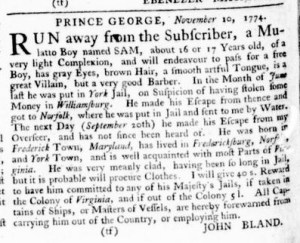
“RUN away … a Mulatto Boy named SAM … will endeavour to pass for a free Boy.”
As the imperial crisis intensified in 1774 and erupted into a war in 1775, Sam, an enslaved youth, had his own concerns and fought his own battle for independence. Like so many other enslaved people, Sam did not author his own story; instead, it was recorded by an enslaver in a newspaper advertisement that offered a reward for the capture and return of the young man after he had liberated himself by running away.
John Bland’s efforts to recover Sam and return him to bondage stretched over many months. His advertisement indicated that he composed it on November 10, 1774, three weeks before the Continental Association, a nonimportation agreement enacted in response to the Coercive Acts, went into effect. It ran regularly, including in the supplement that accompanied the April 29, 1775, edition of John Dixon and William Hunter’s Virginia Gazette. That supplement included the first reports of the battles at Lexington and Concord that appeared in newspapers published in Virginia. What did Sam think of those events? Perhaps he welcomed the distraction they provided, shifting attention away from efforts to discover his whereabouts as he “endeavour[ed] to pass for a free Boy.”
Bland offered a brief biography of Sam, likely not emphasizing the details that the youth would have chosen had he written his own narrative. The enslaver stated that Sam was a mulatto “born in Frederick Town, Maryland,” but did not say anything about his parents or other relations. Bland considered Sam a “great Villain” with a “smooth artful Tongue,” but acknowledged that he was “a very good Barber,” a rare note of praise in an advertisement of that type. Bland reported that in June 1774 Sam had been imprisoned in Yorktown “on Suspicion of having stolen some Money in Williamsburg,” but escaped and made his way to Norfolk. He had been captured and jailed there before being sent back to Bland. On September 20, Sam once again made a bid for freedom, escaping from Bland’s overseer and “has not since been heard of.” Having lived in Fredericksburg, Norfolk, and Yorktown, Sam was “well acquainted with most Parts of Virginia,” a factor that likely aided in eluding Bland. In addition, the enslaver considered it “probable” that Sam “will procure Clothes” to disguise himself. Bland warned “Captains of Ships” and “Masters of Vessel” against employing Sam or transporting him out of the colony.
Where was Sam? Did he manage to get aboard a ship? What other strategies did he deploy to make good on his escape? Did he have assistance from other enslaved people, free Black men and women, or even sympathetic white colonizers? What kind of freedom had he experienced in the months since he fled from Bland? Was he aware that Bland published an advertisement and offered a reward for him? What was Sam thinking and feeling over those many months? Bland’s advertisement does not answer those questions, but it does chronicle Sam’s courage and resilience as well as his commitment to seizing his own liberty during an era when colonizers claimed that Parliament and the king perpetrated acts of tyranny against them. Like so many other fugitives seeking freedom advertised in newspapers from New England to Georgia, Sam made a declaration of independence.