
What was advertised in a colonial American newspaper 250 years ago today?
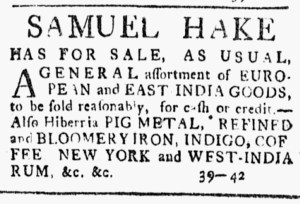
“AS USUAL, A GENERAL assortment of EUROPEAN and EAST INDIA GOODS.”
As readers perused the June 23, 1774, edition of the New-York Journal, they once again encountered Samuel Hake’s advertisements for a “GENERAL assortment of EUROPEAN and EAST INDIA GOODS, to be sold reasonably, for cash or credit.” It was the fourth consecutive week that it appeared in that newspaper, having originated in the June 2 edition. It was the first time, however, that the advertisement ran under a new image in the masthead. The New-York Journal previously included the coat of arms of the United Kingdom, a lion and a unicorn flanking a shield with the words “DIEU ET MON DROIT” (“God and My Right”) on a banner beneath it. After receiving word of the Boston Port Act that closed and blockaded the harbor until residents of that city paid for the tea destroyed during the Boston Tea Party, John Holt, the printer of the New-York Journal, selected a new image for the masthead, a snake severed into pieces with the words “UNITE OR DIE” beneath it. Short abbreviations indicated each part of the snake represented New England or one of the other colonies.

Holt drew inspiration from the “JOIN, or DIE” woodcut that appeared in Benjamin Franklin’s Pennsylvania Gazette twenty years earlier on May 9, 1754. At that time, the American colonies faced a threat from the French and their Indigenous allies on the eve of the Seven Years War. In an editorial, Franklin encouraged colonizers to support the Albany Plan of Union and recognize their shared identity as Americans. The “JOIN, or DIE” political cartoon that accompanied that call to a common cause is the earliest known visual representation of such unity, a symbol repurposed during the imperial crisis. According to public historians at the National Constitution Center, the “emblem appeared in colonial newspapers during the Stamp Act crisis” and again “during the American Revolutionary War, sometimes as part of a masthead.” Holt was the first printer to deploy it in 1774, though in the coming months variations appeared in the mastheads of other newspapers. Those newspapers carried editorials and coverage of the Boston Port Act and the rest of the Coercive Acts and the colonial response, including proposals to cease trade with Britain and stop purchasing imported goods. Over the next several months, the “GENERAL assortment of EUROPEAN and EAST INDIA GOODS” advertised by Hake would take on new political meanings for colonial consumers.
