July 27

What was advertised in a colonial American newspaper 250 years ago today?
Pennsylvania Journal (July 27, 1774).

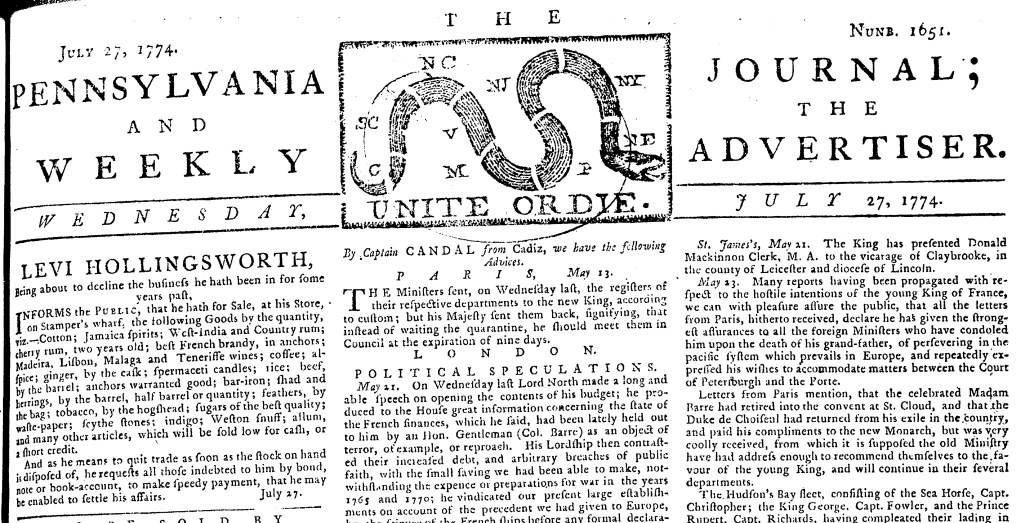
“Many other articles, which will be sold low for cash, or a short credit.”

Levi Hollingsworth’s advertisement for a variety of goods available “at his Store, on Stamper’s wharf,” in Philadelphia in the July 27, 1774, edition of the Pennsylvania Journal appeared immediately below a masthead that featured a new image.  Previously, the device had four components.  In the center, a newspaper bearing the title “JOURNAL” sat on a pedestal above a cartouche that showed a ship at sea, those items testifying to information that the newspaper disseminated and the commerce that it facilitated.  An indigenous American on the left and an angel representing Fame on the right flanked the newspaper and ship.  The new device depicted a divided snake, each segment assigned to a colony, with the motto, “UNITE OR DIE.”

In recent weeks, at least two other American newspapers incorporated similar images into their mastheads.  The New-York Journal, printed by John Holt, had done so on June 23.  The images were so similar that William Bradford and Thomas Bradford, printers of the Pennsylvania Journal, likely copied directly from Holt’s newspaper after they received it via exchange networks that linked printers throughout the colonies.  On July 7, Isaiah Thomas adopted an even more elaborate image in the masthead of the Massachusetts Spy, one that showed a divided snake with a pointed tongue and a pointed tail facing off against a dragon that represented Great Britain.  Its admonition demanded that readers “JOIN OR DIE.”  Once the Bradfords updated their masthead, a newspaper published in three of the four largest American port cities circulated the divided snake political cartoon to subscribers and other readers every week.  The Pennsylvania Journalcontinued doing so for fifteen months, returning to its previous device at the end of October 1775.  By that time, the Revolutionary War had started.

In his History of Printing in America (1810), Isaiah Thomas stated that the Pennsylvania Journal “was devoted to the cause of the country.”[1]  Each time that Hollingsworth or other advertisers placed notices in that newspaper they aided in underwriting a partisan press that advocated for the rights of colonizers as British subjects and, eventually, independence from Great Britain.  Each time a reader perused those advertisements, they likely saw the political cartoon in the masthead, forced to engage with its message even if they did not read the news and editorials closely.

**********

[1] Isaiah Thomas, The History of Printing in America: With a Biography of Printers and an Account of Newspapers (1810; New York: Weathervane Books, 1970), 437.
July 7

What was advertised in a colonial American newspaper 250 years ago today?

Massachusetts Spy (July 7, 1774).

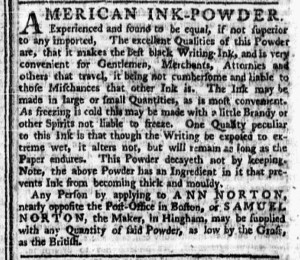
“AMERICAN INK-POWDER.”

In an advertisement in the July 7, 1774, edition of the Massachusetts Gazette, Ann Norton of Boston and Samuel Norton of Hingham heralded “AMERICAN INK-POWDER” made by Samuel.  They encouraged “Gentlemen, Merchants, Attornies and others that travel” to purchase this product “found to be equal, if not superior to any imported.”  Most of the advertisement described the various qualities of the ink powder that made it better than imported alternatives.  As colonizers in Boston and other towns considered enacting nonimportation agreements to protest the Boston Port Act, entrepreneurs like the Nortons seized the opportunity to present “domestic manufactures” or goods produced in the colonies as patriotic choices for consumers.  On the same page as the Nortons’ advertisement for “AMERICAN INK-POWDER,” Philip Freeman once again ran his notice asserting that “we can manufacture enough [gloves] here, to supply the whole Continent” and recommending that “the importation of this article at least will be totally stopped” during such “threatning” times.

Both advertisements ran in a newspaper that featured a new addition to its masthead: a snake in several segments facing a dragon.  The words “JOIN OR DIE” appeared above the snake and abbreviations for New England and other colonies accompanied each segment.  Readers understood that the snake represented the colonies and the dragon represented Great Britain.  As Isiah Thomas, the printer of the Massachusetts Spy, explained in his History of Printing in America(1810), “The head and tail of the snake were supplied with stings, for defence against the dragon, which appeared furious, and as bent on attacking the snake.”[1]  It was a more elaborate version of the “JOIN, OR DIE” emblem that ran in Benjamin Franklin’s Pennsylvania Gazette twenty years earlier and the “UNITE OR DIE” emblem added to the masthead of the New-York Journal just two weeks earlier.  With this image, Thomas made the threat to American liberty explicit with the addition of the dragon.  That “political device,” as Thomas called it, joined a quotation from Joseph Addison’s Cato that had been part of the masthead for many months: “DO THOU Great LIBERTY inspire our Souls – And make our Lives in THY Possession happy – Or, our Deaths glorious in THY just Defence.”  An assertion that the Massachusetts Spy was “Open to ALL Parties, but Influenced by None” disappeared from the masthead.  The combination of the quotation from Cato and the “political device” made the editorial perspective of the newspaper clear.  Thomas ceased publishing the Massachusetts Spy in Boston and left the city in April 1775 and soon after established the Massachusetts Spy; or, American Oracle of Liberty in Worcester.  Throughout the remainder of the newspaper’s publication in Boston, the snake defending itself against the dragon was part of the masthead, setting the tone for all the news, editorials, and advertisements that appeared below.

Massachusetts Spy (July 7, 1774).

**********

[1] Isaiah Thomas, The History of Printing in America: With a Biography of Printers and an Account of Newspapers (1810; New York: Weathervane Books, 1970), 273.

June 23

What was advertised in a colonial American newspaper 250 years ago today?

New-York Journal (June 23, 1774).

“AS USUAL, A GENERAL assortment of EUROPEAN and EAST INDIA GOODS.”

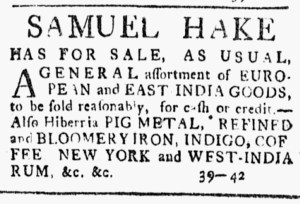
As readers perused the June 23, 1774, edition of the New-York Journal, they once again encountered Samuel Hake’s advertisements for a “GENERAL assortment of EUROPEAN and EAST INDIA GOODS, to be sold reasonably, for cash or credit.”  It was the fourth consecutive week that it appeared in that newspaper, having originated in the June 2 edition.  It was the first time, however, that the advertisement ran under a new image in the masthead.  The New-York Journal previously included the coat of arms of the United Kingdom, a lion and a unicorn flanking a shield with the words “DIEU ET MON DROIT” (“God and My Right”) on a banner beneath it.  After receiving word of the Boston Port Act that closed and blockaded the harbor until residents of that city paid for the tea destroyed during the Boston Tea Party, John Holt, the printer of the New-York Journal, selected a new image for the masthead, a snake severed into pieces with the words “UNITE OR DIE” beneath it.  Short abbreviations indicated each part of the snake represented New England or one of the other colonies.

Pennsylvania Gazette (May 9, 1754). Courtesy Library of Congress.

Holt drew inspiration from the “JOIN, or DIE” woodcut that appeared in Benjamin Franklin’s Pennsylvania Gazette twenty years earlier on May 9, 1754.  At that time, the American colonies faced a threat from the French and their Indigenous allies on the eve of the Seven Years War.  In an editorial, Franklin encouraged colonizers to support the Albany Plan of Union and recognize their shared identity as Americans.  The “JOIN, or DIE” political cartoon that accompanied that call to a common cause is the earliest known visual representation of such unity, a symbol repurposed during the imperial crisis.  According to public historians at the National Constitution Center, the “emblem appeared in colonial newspapers during the Stamp Act crisis” and again “during the American Revolutionary War, sometimes as part of a masthead.”  Holt was the first printer to deploy it in 1774, though in the coming months variations appeared in the mastheads of other newspapers.  Those newspapers carried editorials and coverage of the Boston Port Act and the rest of the Coercive Acts and the colonial response, including proposals to cease trade with Britain and stop purchasing imported goods.  Over the next several months, the “GENERAL assortment of EUROPEAN and EAST INDIA GOODS” advertised by Hake would take on new political meanings for colonial consumers.

New-York Journal (June 23, 1774).

May 24

Who was the subject of an advertisement in a colonial American newspaper 250 years ago today?

Connecticut Courant (May 24, 1774).

“RUN away … a negro man about 27 years of age.”

An advertisement in the May 24, 1774, edition of the Connecticut Courant offered a reward for the capture and return of an unnamed “negro man about 27 years of age” who liberated himself by running away from Thomas Moses, his enslaver.  Moses provided a description, declaring that the “negro man … lisps in his speech” and wore “a brown coat and red waistcoat, a white holland shirt, a new castor hat, a new pair of leather breeches, [and] a pair of blue stockings.”  He also took other clothing with him, items that he could use to vary his appearance or sell in his efforts to make good on his escape.  Moses stated that he would present ten dollars to “Whoever shall take up said negro and return him to me” or five dollars to whoever would “secure him in any of his majesty’s goals [jails] and send me word so that I may have him again.”  In a nota bene, he warned, “All persons are hereby forbid to harbour said negro on penalty of law.”

The first half of that advertisement appeared at the bottom of a column that featured an editorial with a headline that proclaimed, “JOIN OR DIE!!!”  A more extensive version first ran in the May 16 edition of the Newport Mercury as a combination of news and opinion.  An abbreviated version, the first paragraph, then circulated in other newspapers as printers followed the common practice of reprinting items from one publication to another.  The shorter version featured an additional exclamation mark for emphasis.  The editorial commented on the Boston Port Act and Parliament’s intention “to reduce its spirited inhabitants to the most servile and mean compliance ever attempted to be imposed on a free people.”  This new legislation was “infinitely more alarming and dangerous to our common liberties, than even that hydra the Stamp Act.”  While directed at Boston in retaliation for the destruction of tea the previous December, the Boston Port Act, according to the anonymous author, was also “a direct hostile invasion of every province on the continent.”  The people of Boston “nobly stood as a barrier against slavery.”  Now residents of other towns needed to do the same “to stand … for the relief, support, and animation of our brethren in the insulted, besieged capital of Massachusetts-Bay” because “nothing but unity, resolution, and perseverance, can save ourselves and posterity from what is worse than death — SLAVERY.”

Connecticut Courant (May 24, 1774).

Twice in a single paragraph, the author of the editorial invoked slavery as the consequence of Parliament’s treatment of the colonies.  Ebenezer Watson, the printer of the Connecticut Courant, selected that piece to feature in his newspaper and placed it in proximity to an advertisement that offered a reward for capturing an enslaved man who liberated himself.  A single advertisement, a probate notice, separated the editorial from the “RUN away” advertisement.  Perhaps even as he generated revenue from publishing the latter, Watson recognized the juxtaposition of very different concepts of slavery and could not position one item right after the other.  Just as likely, however, that juxtaposition did not register.  After all, Moses’s advertisement was one of at least eighty-five advertisements about enslaved people that ran in nineteen newspapers, including nine published in New England, that week.  Even as many printers advocated for liberty for colonizers who faced the prospect of figurative enslavement by Parliament, the early American press participated in perpetuating the literal enslavement of Africans, African Americans, and Indigenous Americans with advertisements for buying and selling enslaved people and notices calling on colonizers to capture enslaved people who liberated themselves by running away from their enslavers.  The proximity of such advertisements to content similar to the “JOIN OR DIE!!!” editorial was a common feature of newspapers published during the era of the American Revolution.

May 16

What was advertised in a colonial American newspaper 250 years ago today?

Newport Mercury (May 16, 1774).

“Fresh Imported … direct from LONDON … English & India GOODS.”

The crisis over tea hit the boiling point as Christopher Champlin inserted a new advertisement in the May 16, 1774, edition of the Newport Mercury.  Relying on standard language that appeared in notices placed by merchants and shopkeepers, he informed readers in Rhode Island that he stocked a “general assortment of English & India GOODS, Suitable for the Season, Which he continues to sell, by WHOLESALE and RETAIL.”  His merchandise was “Fresh Imported” on two ships “direct from LONDON.”  In a final appeal, Champlin asserted that he sold his wares “As low, for cash, as at any store or shop in the colony.”  Considering the news that ran immediately to the left of his advertisement, Champlin’s marketing strategy may not have been resonated differently than he originally intended.

Word of the Boston Port Act had arrived in Newport.  A news update with a headline that proclaimed, “JOIN or DIE!!” described the “act of parliament for blockading the harbour of Boston, in order to reduce its spirited inhabitants to the most servile and mean compliance ever attempted to be imposed on a free people” as leading to a fate “worse than death—SLAVERY.”  The editor had the news from “a gentleman” who recently arrived in Newport from Boston.”  That source stated that “a number of the first merchants in London had wrote the manufacturers in inland towns of England, not to send them any more goods, and had wrote to the merchants in Boston, that the surest way to settle the present difference, between the two countries, is to stop all trade immediately, and advised a strict union between all the colonies in this measure.”  Whether merchants in London had actually done any of that or it was wishful thinking on the part of patriots who sought allies on the other side of the Atlantic, colonizers had experience with nonimportant agreements (or boycotts) as political leverage in response to the Stamp Act and the Townshend Acts.  The update reminded readers “that hydra the Stamp Act … was destroyed by our firmness and union.”

By the end of October, the First Continental Congress adopted the Continental Association, a trade boycott intended to pressure Parliament into repealing the Boston Port Act and the rest of the Coercive Acts passed in retaliation for the Boston Tea Party as well as address other grievances.  For the moment, however, no boycott was in place when Champlin published his advertisement promoting his “Fresh Imported” goods.  The news that accompanied that notice perhaps caused some consumers to reconsider what they might purchase, but it might also have served to encourage sales among colonizers who suspected that it was only a matter of time before another boycott went into effect.  They could buy what they wished with a clear conscience and without others censuring them for doing so.  Whatever they chose to do in May 1774, consumers in Rhode Island made decisions in the context of news arriving from Boston, London, and other places.