March 21

What was advertised in a revolutionary American newspaper 250 years ago today?
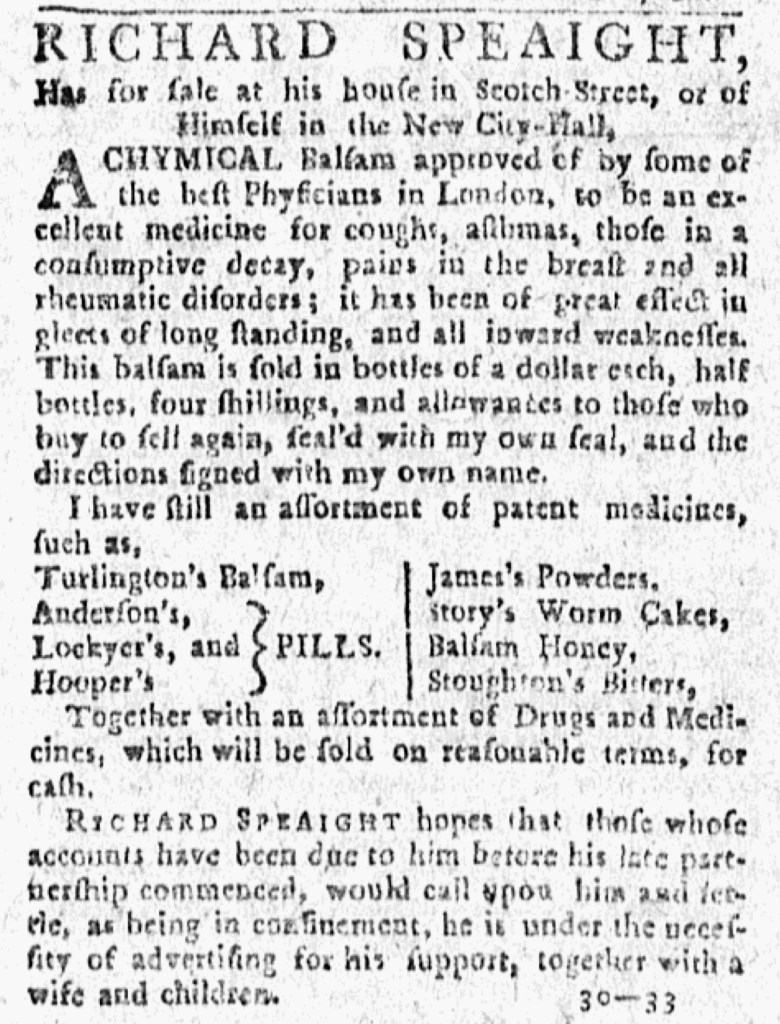
New-York Journal (March 21, 1776).

“This balsam is sold in bottles … seal’d with my own seal.”

Richard Speaight hawked a variety of patent medicines in an advertisement in the March 21, 1776, edition of the New-York Journal.  He listed Turlington’s Balsam, Anderson’s Pills, Lockyer’s Pills, Hooper’s Pills, James’s Powders, Story’s Worm Cakes, and Stoughton’s Bitters.  All these remedies were so familiar to consumers that Speaight did not consider it necessary to indicate which of them relieved which maladies.  Prospective customers knew them as well as modern consumers know the over-the-counter medications available at local pharmacies.  He sold all of them, along with “an assortment of [other] Drugs and Medicines,” for reasonable prices.

On the other hand, Speaight did devote a significant portion of his advertisement to describing a “CHYMICAL Balsam approved of by some of the best Physicians in London.”  Those practitioners, he reported, considered the balsam “an excellent medicine for coughs, asthmas, those in a consumptive decay, pains in the breast and all rheumatic disorders.”  It supposedly worked to “great effect,” a welcome promise to readers who had tried other treatments without success.

In addition to customers who purchased the balsam for their own use, Speaight also hoped to attract the attention of retails who would stock it in their own shops.  He set the price at one dollar per bottle and four shillings for a half bottle while also making “allowances to those who buy to sell again.”  In other words, he offered discounts for buying in volume.  To avoid counterfeits, he informed the public that bottles of the balsam were “seal’d with my own seal.”  Furthermore, he provided “directions signed with my own name.”  Retailers and consumers alike could refer to those instructions when selling or using the balsam.  For a medicine not nearly as familiar as Anderson’s Pills and Stoughton’s Bitters, a seal and printed directions likely enhanced confidence in the efficacy of the product.
July 27

What was advertised in a colonial American newspaper 250 years ago today?

Jul 27 - 7:27:1769 New-York Journal
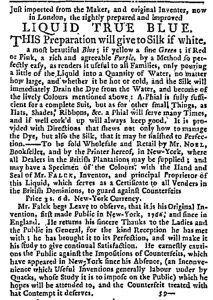
New-York Journal (July 27, 1769).

“Seal of Mr. FALCK, Inventor … to guard against Counterfeits.”

In an advertisement for the “LIQUID TRUE BLUE” that ran in the New-York Journal for months in 1769, Mr. Falck, “Inventor, and principal Proprietor of this Liquid,” cautioned readers against counterfeits. First, however, he described the dye to prospective customers, stating that it white silk became “a most beautiful Blue,” yellow “a fine Green,” and red or pink “a rich and agreeable Purple.” Users could dye an entire suit with a single vial or use it in smaller quantities for “other small Things” like hats and ribbons. The dye did not lose its potency as long as it remained “well cork’d up.”

Falck claimed the Liquid True Blue as his “original Invention,” first made available to consumers in New York in 1766, just a few years earlier. Since then, he had moved to England and expanded distribution there. Yet the product was still available in the colonies via Falck’s agents, John Holt, the printer of the New-York Journal, and Garrat Noel, a bookseller in New York. Holt and Noel sold the product “Wholesale and Retail,” both to local customers and “all Dealers in the British Plantations.” Falck realized that this left room for mischief on the part of unscrupulous purveyors of imitation products. The authentic Liquid True Blue came with the “Seal of Mr. FALCK … which serves as a Certificate to all Venders in the British Dominions, to guard against Counterfeits.”

Despite his frustration, Falck leveraged the appearance of counterfeits to sell the authentic Liquid True Blue. If he had not “brought it to its Perfection” then others would not have passed off their imitation products as the real thing. Though unfortunate, this was an expected consequence familiar to anyone who succeeded in business or, as Falck put it, “an Inconvenience which Useful Inventions generally labour under by Quacks, whose Study it is to impose on the Public.” The number of counterfeits had multiplied since he left the colony, making it all the more important that customers purchase only those vials of Liquid True Blue that bore his seal and otherwise treat imitations with the contempt they deserved.