September 29

What was advertised in a revolutionary American newspaper 250 years ago today?
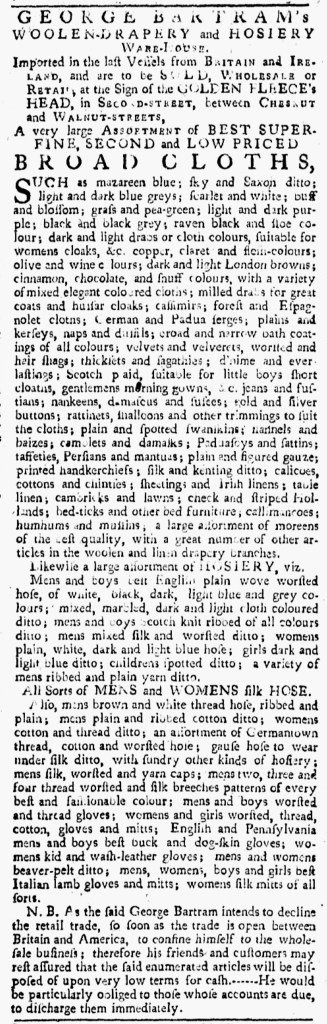
Story and Humphreys’s Pennsylvania Mercury (September 29, 1775).

“George Bartram intends to decline the retail trade, so soon as the trade is open between Britain and America.”

As September 1775 came to a close, George Bartram advertised a “very large ASSORTMENT of BEST SUPERFINE, SECOND and LOW PRICED BROADCLOTHS” and “a large assort of HOSIERY” available at his “WOOLEN-DRAPERY and HOSIERY WARE-HOUSE … at the Sign of the GOLDEN FLEECE’s HEAD” in Philadelphia.  He listed dozens of different kinds of textiles and hose for men, women, and children as well as an array of gloves and mittens.  Bartram stated that he imported that merchandise “in the last Vessels from BRITAIN and IRELAND,” but he may have meant the last ships to arrive before the Continental Association went into effect nearly ten months earlier.  After all, he acknowledged in a nota bene that the colonies were not trading with Britain at the time he placed his advertisement.

That nota bene also included a clarification about Bartram’s plans for his business.  In March, he had advertised that he was “resolved to decline his Retail Trade” and would “sell his Stock of Goods on Hand at the very lowest Rates.”  A headline proclaimed, “Now SELLING OFF.”  That gave the impression that Bartram was holding a going out of business, yet his subsequent advertisement suggests that was not his intention at all.  Instead, he planned to shift his emphasis.  “[S]o soon as the trade is open between Britain and America,” he would “decline the retail trade … to confine himself to the wholesale business.”  His “WOOLEN-DRAPERY and HOSIERY WARE-HOUSE” would not close after all, but that did not mean that customers could not find bargains when they visited the familiar Sign of the Golden Fleece’s Head.  For the moment, Bartram continued to serve retail customers, assuring them that “the said enumerated articles will be disposed of upon very low terms.”

Bartram did not know when trade with Britain would resume.  He placed his previous advertisement before hostilities broke out at Lexington and Concord.  He attempted to earn his livelihood as he navigated current events, not knowing when the conflict would end, hoping that good deals would convince customers to continue shopping at his “WOOLEN-DRAPERY and HOSIERY WARE-HOUSE” even as they kept their eyes on news arriving from Boston.

March 21

What was advertised in a colonial American newspaper 250 years ago today?

Pennsylvania Evening Post (March 21, 1775).

“Being resolved to decline his Retail Trade … he will sell his Stock of Goods on Hand at the very lowest Rates.”

George Bartram had been in business “At the Sign of the GOLDEN FLEECE’s HEAD” in Philadelphia for several years by the time he placed an advertisement in the March 21, 1775, edition of the Pennsylvania Evening Post.  He sometimes called his establishment the Woollen-Drapery and Hosiery WAREHOUSE and used visual elements to enhance his advertisements.  For instance, a decorative border enclosed the name of his business in some advertisements while others featured a woodcut that depicted that golden fleece’s head.  Earlier in his career, he kept shop “at the Sign of the Naked Boy.”  An even more elaborate woodcut replicated that sign with a naked boy holding a yard of cloth in a cartouche in the center, flanked by rolls of fabric on either side and the proprietor’s name below them.  Bartram was still using the golden fleece’s head woodcut to adorn his advertisements in Dunlap’s Pennsylvania Packet in March 1775, but he did not have a second one to use in the Pennsylvania Evening Post.

Instead, he relied on advertising copy in making his pitch to prospective customers.  As he had often done in previous newspaper notices, Bartram emphasized the array of choices he made available to consumers, promoting a “large and fresh Assortment of MERCHANDIZE.”  To demonstrate that was the case, he inserted a lengthy list of goods, such as “Broadcloaths, of the neatest and most fashionable Colours, with suitable Trimmings,” “beautiful buff and white Hair Shags,” “rich black Paduasoys and Satins,” and “handsome Silk and Worsted Stuff for Womens Gowns.”  His intended for those evocative descriptions to entice readers.  He played to both taste and imagination by making choice a theme throughout his catalog of merchandise: “Handkerchiefs of all Sorts,” “a Variety of Cambricks suitable for Gentlemen’s Ruffles and Stocks,” “a large Assortment of brown and white Russia Sheetings and Hessians,” “an elegant Assortment of the best Moreens,” “a Quantity of the best Rugs,” and “a large Assortment of Hosiery.”

In a final nota bene, Bartram announced that customers could acquire his wares at bargain prices because he was going out of business.  He “resolved to decline his Retail trade” and “assures his Friends and the Public that he will sell his Stock of Goods on Hand at the very lowest Rates.”  He also offered a discount “to those who purchase a Quantity,” hoping that would offer additional encouragement for prospective customers.  Bartram did not indicate why he was closing his business, though the Continental Association, a nonimportation agreement adopted throughout the colonies, may have presented an opportunity to liquidate his merchandise and get rid of items that had lingered on the shelves in his Woollen Drapery and Hosiery Warehouse.  Bartram was “SELLING OFF” his inventory, offering good deals on absolutely everything.

January 27

What was advertised in a colonial American newspaper 250 years ago today?

Pennsylvania Packet (January 27, 1772).

“GEORGE BARTRAM’s WOOLLEN DRAPERY AND HOSIERY WAREHOUSE, At the Sign of the GOLDEN FLEECE’s HEAD.”

Much of the content of George Bartram’s advertisement in the January 27, 1772, edition of the Pennsylvania Packetresembled what appeared in notices placed by other merchants and shopkeepers.  Bartram informed prospective customers that he “Just imported … A very large Assortment” of textiles “from BRITAIN and IRELAND.”  He then listed a variety of fabrics to demonstrate the choices available to consumers.

In addition to providing an overview of his merchandise, Bartram deployed other means of making his business memorable.  For instance, he marked it with a sign that featured a distinctive device, advising prospective customers to visit “the Sign of the GOLDEN FLEECE’S HEAD” on Second Street.  Some colonial entrepreneurs used similar signs, but many did not.  Among the other advertisers in the January 27 edition of the Pennsylvania Packet, John Carnan, a jeweler, ran a shop “AT THE GOLDEN LION,” but Joseph Carson, Francis Hopkinson, William Miller, Alexander Power, John Sparhawk, Mary Symonds, and James Wallace did not mention signs that marked their locations.  Bartram further enhanced his advertisement with an image of a golden fleece’s head that may have replicated his shop sign.  Most advertisers who called attention to their signs did not make the additional investment in woodcuts.  Bartram apparently made the investment only once.  He ran an advertisement with the same copy, but no image, in the Pennsylvania Chronicle on the same day.

Bartram also gave his business a name, another marketing strategy adopted by relatively few advertisers in the eighteenth century.  Some merchants, shopkeepers, and artisans used their shop signs as the names for their businesses, but most advertisers did not give their businesses any sort of name.  Printers and booksellers were the most likely to name their businesses.  Although he did not have a sign with a distinctive device, Sparhawk called his shop the “LONDON BOOK-STORE” in his advertisement.  John Dunlap, printer of the Pennsylvania Packet, advertised books available at the “NEWEST PRINTING-OFFICE.”  Among advertisers from other occupations, Bartram distinguished his shop from others by calling it “GEORGE BARTRAM’s WOOLLEN DRAPERY AND HOSIERY WAREHOUSE, At the Sign of the GOLDEN FLEECE’s HEAD.”  He incorporated his own name, a sign, an image depicting that sign, and a name for his business into his advertisement, distinguishing it from others and making his endeavor more memorable.