April 22

What was advertised in a revolutionary American newspaper 250 years ago today?
Dunlap’s Pennsylvania Packet (April 22, 1776).

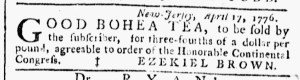
“GOOD BOHEA TEA, to be sold … agreeable to order of the Honorable Continental Congress.”

Advertisements for tea returned to Dunlap’s Pennsylvania Packet on April 22, 1776, after having disappeared for a while due to the prohibition on selling and consuming tea.  In a brief advertisement, Ezekiel Brown announced, “GOOD BOHEA TEA, to be sold by the subscriber, for three-fourths of a dollar per pound, agreeable to order of the Honorable Continental Congress.”  He did not elaborate on the details; instead, he expected readers knew the history of tea during the political crisis and how it became the most politicized commodity in the colonies.
Dunlap’s Pennsylvania Packet (April 15, 1776).

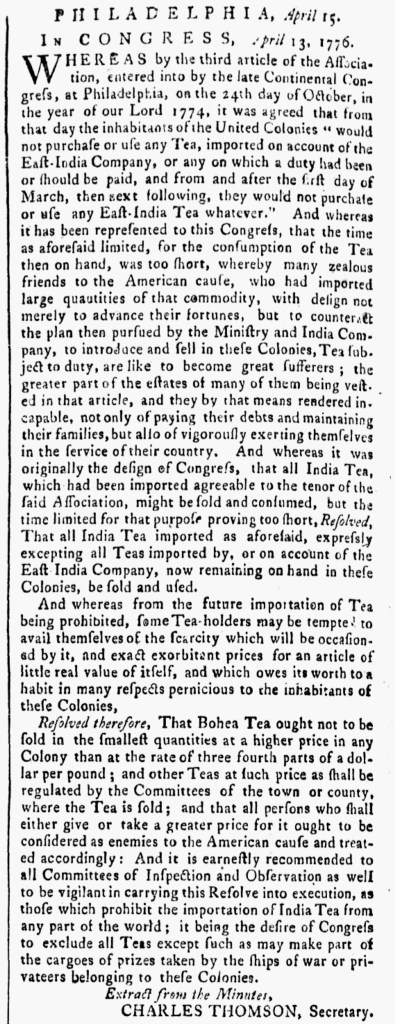
In response to the Intolerable Acts and other abuses perpetrated by Parliament, the First Continental Congress devised the Continental Association, a nonimportation, nonconsumption, and nonexportation agreement, in the fall of 1774.  The first article concerned a general boycott of imported goods, while the third article addressed consuming tea: “we will not purchase or use any Tea imported on Account of the East India Company, or any on which a Duty hath been or shall be paid; and, from and after the first day of March [1775], we will not purchase or use any East India Tea whatever.”  The Second Continental Congress reconsidered some aspects of that third article and passed a new resolution on April 13, 1776.  Two days later, Dunlap’s Pennsylvania Packet carried the resolution along with other news.  It came to the attention of the Second Continental Congress that some “zealous friends to the American cause” had imported “large quantities” of tea in an effort “to counteract the plan then pursued by the Ministry and India Company, to introduce and sell in these Colonies, Tea subject to duty.”  In other words, they stocked up on tea before Parliament and the East India Company could put their plan into effect, doing so as acts of resistance rather than merely “to advance their fortunes.”  Now, however, they stood to become “great suffers” because of their investment in tea, “incapable, not only of paying their debts and maintaining their families, but also of vigorously exerting themselves in the service of their Country.”  According to the new resolution, the First Continental Congress intended that “all India Tea, which had been imported agreeable to the tenor of said Association, might be sold and consumed,” but the March 1, 1775, deadline did not allow enough time for that to happen.  Accordingly, the Second Continental Congress passed a new resolution that “all India Tea imported as aforesaid, expressly excepting all Teas imported by, or on account of the East India Company, now remaining on hand in these Colonies, be sold and used.”  Even though advertisements for tea ceased for a while, colonizers never stopped consuming it in secret.  The new resolution allowed them to drink tea without subterfuge.

It also allowed for the selling of tea, yet it introduced some restrictions since “some Tea-holders may be tempted to avail themselves of the scarcity … and exact exorbitant prices.”  In another resolution, the Second Continental Congress set price controls: “Bohea Tea ought not to be sold … at a higher price in any Colony than at the rate of three fourths of a dollar per pound; and other Teas at such price as shall be regulated by the Committees of the town or county, where the tea is sold.”  That resolution also instructed “all Committees of Inspection and Observation … to be vigilant” in overseeing the sale of tea now that it was allowed once again and to discipline “enemies to the American cause” who engaged in price gouging.

For his part, Brown set the price for his “GOOD BOHEA TEA” at “three-fourths of a dollar per pound, agreeable to the order of the Honorable Continental Congress.”  He placed his advertisement as quickly as possible.  The Second Continental Congress passed the resolution on April 13.  It appeared in Dunlap’s Pennsylvania Packet on April 15.  Brown, who gave his location only as “New-Jersey,” likely saw it in that issue and immediately composed his advertisement, dated April 17.  It ran in the next issue of Dunlap’s Pennsylvania Packet, published once a week, on April 22.  Brown was ready to sell tea in the open (but according to the rules) and he believed that consumers would purchase it once they knew he made it available to them.
September 29

What was advertised in a revolutionary American newspaper 250 years ago today?

Story and Humphreys’s Pennsylvania Mercury (September 29, 1775).

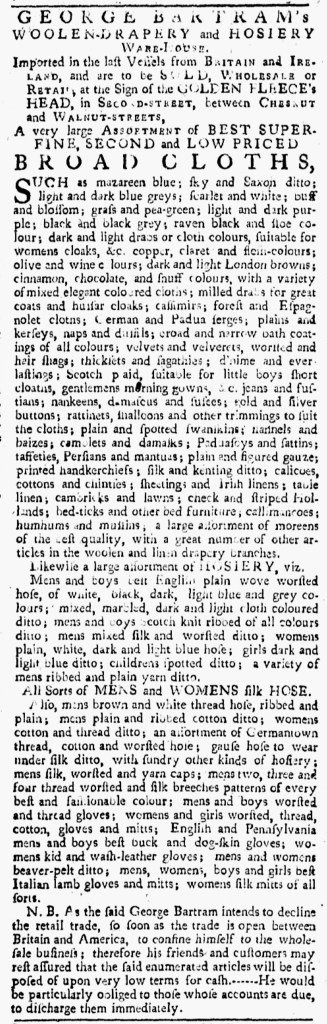
“George Bartram intends to decline the retail trade, so soon as the trade is open between Britain and America.”

As September 1775 came to a close, George Bartram advertised a “very large ASSORTMENT of BEST SUPERFINE, SECOND and LOW PRICED BROADCLOTHS” and “a large assort of HOSIERY” available at his “WOOLEN-DRAPERY and HOSIERY WARE-HOUSE … at the Sign of the GOLDEN FLEECE’s HEAD” in Philadelphia.  He listed dozens of different kinds of textiles and hose for men, women, and children as well as an array of gloves and mittens.  Bartram stated that he imported that merchandise “in the last Vessels from BRITAIN and IRELAND,” but he may have meant the last ships to arrive before the Continental Association went into effect nearly ten months earlier.  After all, he acknowledged in a nota bene that the colonies were not trading with Britain at the time he placed his advertisement.

That nota bene also included a clarification about Bartram’s plans for his business.  In March, he had advertised that he was “resolved to decline his Retail Trade” and would “sell his Stock of Goods on Hand at the very lowest Rates.”  A headline proclaimed, “Now SELLING OFF.”  That gave the impression that Bartram was holding a going out of business, yet his subsequent advertisement suggests that was not his intention at all.  Instead, he planned to shift his emphasis.  “[S]o soon as the trade is open between Britain and America,” he would “decline the retail trade … to confine himself to the wholesale business.”  His “WOOLEN-DRAPERY and HOSIERY WARE-HOUSE” would not close after all, but that did not mean that customers could not find bargains when they visited the familiar Sign of the Golden Fleece’s Head.  For the moment, Bartram continued to serve retail customers, assuring them that “the said enumerated articles will be disposed of upon very low terms.”

Bartram did not know when trade with Britain would resume.  He placed his previous advertisement before hostilities broke out at Lexington and Concord.  He attempted to earn his livelihood as he navigated current events, not knowing when the conflict would end, hoping that good deals would convince customers to continue shopping at his “WOOLEN-DRAPERY and HOSIERY WARE-HOUSE” even as they kept their eyes on news arriving from Boston.

October 17

What was advertised in a colonial American newspaper 250 years ago today?

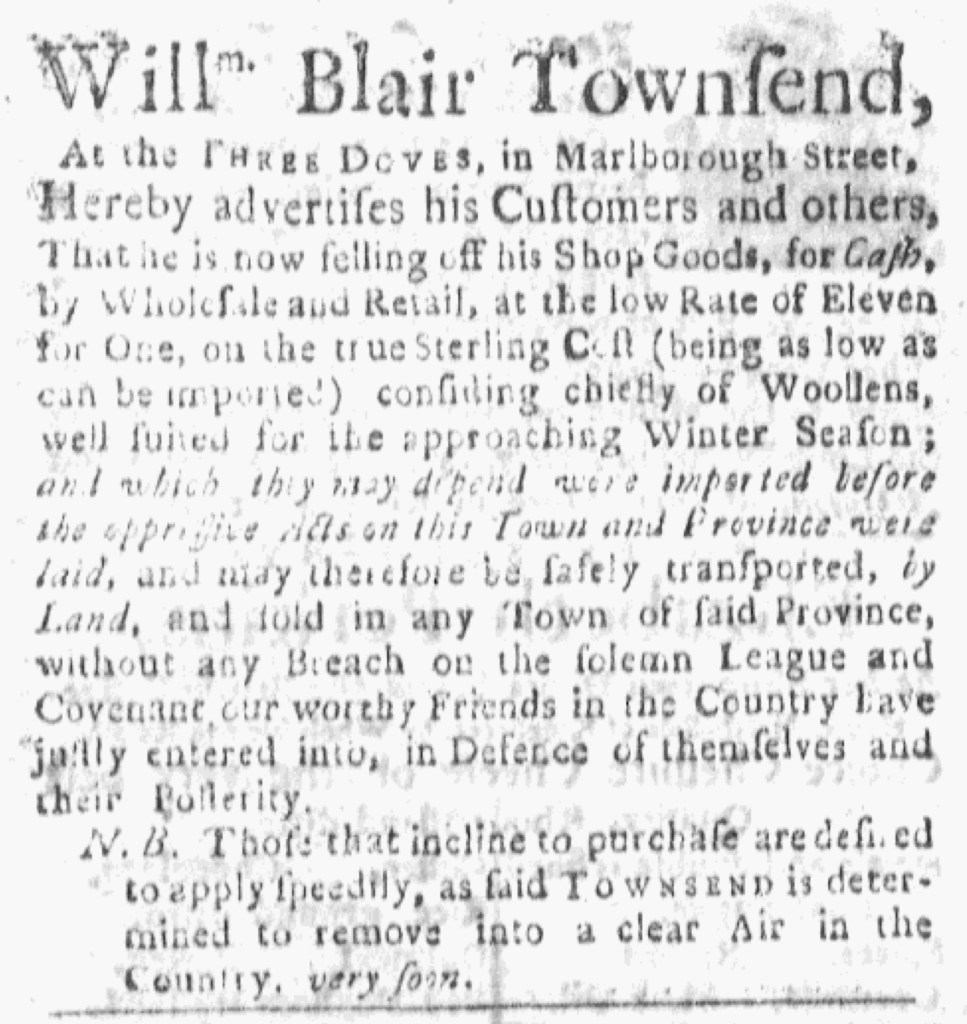
Boston Evening-Post (October 17, 1774).

“May therefore be … sold … without any Breach on the solemn League and Covenant.”

Politics took center stage in William Blair Townsend’s advertisements for “Shop Goods … consisting chiefly of Woollens, well suited for the approaching Season” in the October 17, 1774, edition of the Boston Evening-Post.  He looked to sell his entire inventory “by Wholesale and Retail” and close his shop, a casualty of the blockade of Boston that went into effect with the Boston Port Act that Parliament passed to punish the town for tossing tea into the harbor the previous December.  To that end, he assured prospective customers that “they may depend [the goods] were imported before the oppressive Acts on this Town and Province were laid.”  In addition to the Boston Port Act, Townsend invoked the Massachusetts Government Act and the other Coercive Acts.

Furthermore, he asserted that his wares “may therefore be safely transported, by Land, and sold in any Town of said Province, without any Breach on the solemn League and Covenant our worthy Friends in the Country have justly entered into, in Defence of themselves and their Posterity.”  Townsend referred to a plan outlined in a letter that the Boston Committee of Correspondence circulated on June 8.  After outlining the abuses perpetrated by Parliament, the letter encouraged resistance in the form of “affecting the trade and interest of Great Britain, so deeply as shall induce her to withdraw her oppressive hand.”  The Committee of Correspondence sought to revive nonimportation agreements enacted twice in the past decade, first in response to the Stamp Act and, later, the Townshend duties.  The letter proposed that colonizers “come into a solemn league, not to import goods from Great Britain, and not to buy any goods that shall hereafter be imported from thence, until our grievances shall be redressed.”  Some merchants advocated waiting for more comprehensive measures that enlisted cooperation of other colonies, like the Continental Association that the First Continental Congress was in the process of drawing up in Philadelphia at the time Townsend published his advertisement, yet colonizers in towns throughout Massachusetts supported the Solemn League and Covenant.

Knowing that was the case, Townsend acknowledged the politics of the moment in his advertisement.  He endorsed the pact while also making clear that neither he nor his prospective customers violated it.  They could buy and sell with clear consciences … and without attracting the ire of the public.  Beyond that, Townsend wished to clear out of Boston.  In a nota bene, he encouraged “Those that incline to purchase … to apply speedily” since he “is determined to remove into a clear Air in the Country, very soon.”  The situation had grown so bleak that that he did not intend to remain in Boston much longer.

June 16

What was advertised in a colonial American newspaper 250 years ago today?

Massachusetts Spy (June 16, 1774).

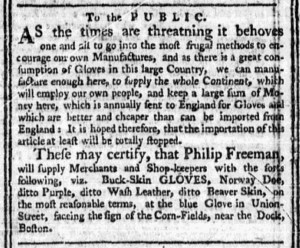
“It is hoped therefore, that the importation of this article at least will be totally stopped.”

Current events informed Philip Freeman’s marketing strategy as he attempted to sell gloves in the summer of 1774.  As colonizers from New England to Georgia discussed how to respond to Parliament closing Boston Harbor and other legislation passed following the Boston Tea Party, many proposed a new round of nonimportation agreements.  American merchants previously participated in boycotts to protest the Stamp Act and duties on several commodities imposed in the Townshend Acts, believing that disruptions to commerce served as an effective political tool.  Parliament relented, repealing the Stamp Act and duties on glass, lead, paint, and paper (but doubled down on tea with a new Tea Act in 1773).  A variety of other factors, including petitions and popular protests, played a role, so nonimportation agreements may not have had as much of an influence as intended.  Still, colonizers believed that boycotting goods imported from Britain effectively achieved their political goals.

Freeman believed that was the case and encouraged prospective customers of its veracity.  “As times are threatning,” he declared, “it behoves one and all to go into the most frugal methods to encourage our own Manufactures.”  He recognized “a great consumption of Gloves in this large Country,” yet proposed that “we can manufacture enough here, to supply the whole Continent.”  Such industry would have multiple benefits: it “will employ our own people, and keep a large sum of Money here, which is annually sent to England for Gloves.”  Furthermore, Freeman asserted that the gloves he made “are better and cheaper than can be imported from England.”  Not willing to wait for any sort of official nonimportation agreement enacted in Boston or throughout the colony or in cooperation with other colonies, Freeman implored that “the importation of this article at least will be totally stopped.”  In common cause, Freeman and his competitors in the colonies could meet demand without having to resort to imported gloves.  He did not direct his advertisement to consumers but rather the “Merchants and Shop-keepers” that he could supply with several different kinds of gloves “on the most reasonable terms.”  Working in concert, Freeman envisioned that glovemakers, retailers, and consumers could participate in politics via the decisions they made about production, consumption, and importing goods, starting immediately and informally with gloves and perhaps extending to other items through formal agreements as colonizers continued to organize in opposition to the Boston Port Act.